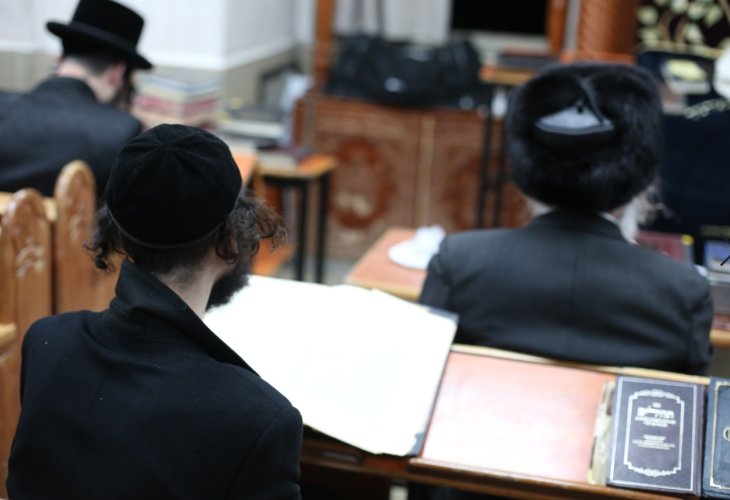
The Importance of Torah Study: A Journey into Spiritual Enlightenment
The commandment of Torah study is equivalent to all the commandments, as it's said, "The study of Torah is equal to them all." When a Jew engages in Torah study, they acquire eternal treasures that benefit them in this world and the world to come. Additionally, this study draws spiritual light into their soul, leading to personal elevation.
(Photo: shutterstock)The commandment of Torah study is a positive commandment from the Torah to learn the wisdom of the Torah and teach it to others.
It is stated in the Gemara: "These are the things a person does and enjoys their fruits in this world, while the principal remains for him in the world to come: honoring father and mother, performing acts of kindness, bringing peace between man and his friend, and the study of Torah is against them all" (Shabbat 127a).
The genius of Vilna writes in his book "Shanot Eliyahu" on the Mishnah "The study of Torah is against them all": "Every word a person learns in the Torah is equal to all the commandments" (of course, every Jew is required to fulfill all other commandments and obligations of the Torah).
The "Chafetz Chaim" explains in his book "Torat Habayit" that with every single word a Jew studies from the Torah, they fulfill the commandment of Torah study. Therefore, according to the simple calculation of the "Chafetz Chaim," a Jew who studies Torah for one hour earns 12,000 commandments in that hour!
A person who sets a fixed time each day for studying Torah and makes use of spare moments for study merits endless reward.
From this fact, we can appreciate and value every minute of Torah study that grants eternal spiritual treasures.
Regarding the importance of Torah study for every Jew, Rabbi Ovadia Yosef, may his memory be a blessing, taught: "The study of Torah is not only for those in yeshivas whose Torah is their profession, but everyone in Israel is obligated to learn. A Jew without Torah is like a body without a soul. The Torah is our soul! Without it, we have no life.
"For it is your life and the length of your days" (Deuteronomy 30:20) - thus said Hashem. Just as a person without life is worthless, so it is impossible for a Jew to exist without Torah! Even a person who observes commandments, does acts of kindness, and helps others, without Torah is a body without life" (from "Ma'adanei HaMelech").
The Gemara teaches that on a person's day of judgment, when their soul stands before the Heavenly Court, they are asked if they established fixed times for Torah study, and the Gemara states: "Rabbi Abba said, when a person is brought for judgment, they are asked: Did you conduct business honestly? Did you set times for Torah study? Did you engage in procreation? Did you await salvation? Did you delve into wisdom? Did you understand something from something else??" (Shabbat 31a), and our sages explain that the beginning of a person's judgment and punishment will be if they did not establish times for Torah study - "A person's judgment does not begin except with matters of Torah" (Rabbi Menuna (there).
The "Mishnah Berurah" writes: "And the man who does not urge himself to set times for Torah daily will certainly remain empty-handed, heaven forbid! What will he answer on the day of judgment - the wise man has his eyes on his head" (Biur Halacha, Siman 135, does learn).
(Photo: shutterstock)Source of the Commandment
The commandment of Torah study is mentioned in many places in the Torah, as it is stated: "Only take heed and guard your soul diligently, lest you forget the things your eyes have seen and lest they depart from your heart all the days of your life; and make them known to your children and your children's children" (Deuteronomy 4:9);
"Gather the people, the men and the women and the children and your stranger who is within your gates, that they may hear and that they may learn and fear Hashem your God and observe to do all the words of this Torah" (Deuteronomy 31:12);
"And Moses called all Israel and said to them: Hear, Israel, the statutes and the judgments which I speak in your ears today; and learn them, and keep and do them" (Deuteronomy 5:1);
"And you shall teach them diligently to your children, and you shall talk of them when you sit in your house and when you walk by the way and when you lie down and when you rise up" (Deuteronomy 6:7);
"And you shall teach them to your children, to speak of them when you sit in your house and when you walk by the way and when you lie down and when you rise up" (Deuteronomy 11:19).
Rabbi Maimonides writes that "this commandment has been repeated many times, 'and you shall teach', 'and you shall do', 'so they shall learn'. And this commandment has been greatly emphasized and urged in many places in the Talmud" (Sefer Hamitzvos, Positive Commandment 11).
This commandment encompasses the study of and labor in Torah and the knowledge of the Torah.
The obligation of knowing the Torah is learned from the verse: "And you shall teach them diligently to your children, and you shall talk of them when you sit in your house and when you walk by the way and when you lie down and when you rise up" (Deuteronomy 6:7). The Sifri explains: "And you shall teach them - that they be sharp in your mouth: when a person asks you about something, you should not stutter, but you should answer him immediately".
This means that our sages learned from the wording "And you shall teach them" the obligation to learn comprehensively, to review and repeat the study until if they are asked about something they learned, they can answer correctly.
Our sages learned from the verse: "and you shall meditate on it day and night" (Joshua 1:8) the source for the obligation of Torah study at every free moment of the day and night (Tosafot in Berakhot, 11b).
A Jew's time is extremely precious, and it should not be wasted. Therefore, during times that are not dedicated to the needs of the body, such as earning a living, eating, sleeping, etc., or to genuine needs of the soul, such as conversation, walking, etc. – they should engage in Torah study. (Shulchan Aruch, Laws of Torah Study 3:6; Mishnah Berurah, Siman 135, S.K. 4).
Watch Rabbi Zamir Cohen explain in a short clip about the immense power of Torah study:
The Reasons for the Commandment
There are three reasons for the existence of the commandment of Torah study: knowing how to perform the commandments and knowing what is prohibited, studying for the sake of learning, and studying for the sake of devotion and connection to Hashem.
One of the reasons for the commandment of Torah study is to know the laws and judgments of the Torah in order to understand how to fulfill the commandments of the Torah and to be aware of the prohibitions, as Rabbi Yisrael Salanter, may his memory be a blessing, explains: "The purpose of the commandment of knowing the Torah is to inform the laws of the Torah and its judgments in their entirety, so that he will have a clear halacha in every place, how to guard and fulfill all of the Torah and the commandments" (Ohr Yisrael, Letter 27).
Likewise, the "Meir La'olam" wrote: "The main reason that the Torah commanded us to learn is solely so that we can fulfill the commandments, for without learning, one would not know how to observe; it is also written: 'And you shall teach them and guard them to do them' – it is clear that this is the main reason for the commandment of Torah study. And it is explicitly written: 'This book of the Torah shall not depart from your mouth... so that you may guard to do according to all that is written in it' (Joshua 1)" (Part 2, Siman 12).
To fulfill the commandments properly and conduct oneself in accordance with the ways of the Torah, one requires halachic and Torah knowledge. Additionally, one needs to know the moral and faith-based principles of the Torah to act according to its values, perceive life's events correctly, and adopt behaviors aligned with Hashem's will.
(Photo: shutterstock)Besides knowing how a Jew should conduct their life, the very act of engaging and studying Torah for its own sake is also a purpose of the commandment of Torah study.
It is Hashem's desire for a Jew to learn and know the Torah, and study performed for the purpose of carrying out Hashem's will is study for its own sake.
The wording of the Rambam states: "One who serves out of love, engages in Torah and commandments and walks in the paths of wisdom - not for any reason in the world, not for fear of punishment, nor to inherit good, but does the truth because it is true" (Laws of Repentance, Chapter 10),
and likewise, the "Chatam Sofer" writes regarding this matter that the very act of study is a commandment by itself: "But the essence of the commandment of Torah engagement is a commandment in itself to engage in it day and night, to delve and ponder all its outcomes and interpretations... 'And if you walk in my statutes' which means that you will toil in the Torah... the study itself is the reward and brings satisfaction before the Holy One, blessed be He, and this is engaging in Torah for its own sake, not for another intention" (Chatam Sofer on Nedarim, 81a).
Furthermore, the actual act of studying Torah leads to a connection and bond with Hashem in a way that is superior to the other commandments of the Torah.
The Maharal of Prague explains in his book "Tiferet Yisrael" the reason for exile, "that they do not bless the Torah first" as the lack of devotion of the people of Israel to Hashem was the cause behind the giving of the Torah to Israel.
The absence of devotion to Hashem, as expressed by the fact that the people of Israel did not bless the Torah first, was what led to great sins, after which the children of Israel were exiled from their land.
The Maharal states: "If they had blessed the Torah first... and were devoted to Him, blessed be He, in love for what He gave to Israel, by this devotion, Hashem would have also prevented the Torah from being nullified. But because they did not bless the Torah first, that they were not devoted to Him, blessed be He, in love for what He gave to Israel, there was no reason to maintain the Torah in Israel, and they came to the point that they transgressed the Torah, and this caused the land to be lost."
Studying Torah for its own sake brings about a connection between the studying Jew and Hashem – thereby infusing the Divine presence into the world, and when the study is done for ulterior motives, it resembles a tree without roots and leads to destruction.
Rabbi Yoel Sirkis, known as "the Bach," brings out the sanctity and spirituality created in a Jew's soul through Torah study done for its own sake: "The intentions of the Holy One, blessed be He, have always been that we should be engaged in Torah so that our souls can become strengthened in the essence, spirituality, and sanctity of the source of Torah. Therefore, Hashem gave us the Torah of truth as a gift that it should not be forgotten from us - so that our soul and body may bond at the 248 organs and 365 tendons with 248 positive commandments and 365 prohibitions in the Torah.
If Israel would engage in Torah with this intention, they would be a chariot and sanctuary for His Divine Presence, that the Divine presence would truly reside among them... for they are the sanctuary of Hashem, and within them, the Shechinah would establish its dwelling, and the entire land would shine with His glory. And this would create a connection between the heavenly and earthly realms, and the Mishkan would be one... But now, since they have transgressed this rule, that they have engaged in Torah only for physical benefits, to know the laws for business purposes, even to boast to display their wisdom, and not intended to be strengthened and connect with the sanctity and spirituality of the Torah, thus causing the Divine presence to depart from the earth and ascend above, the earth has remained in its physicality without sanctity, making it the cause of its destruction and loss.
Before us was Mount Sinai, and He gave us His sacred Torah, the cherished vessel with which He enjoyed daily, so that our souls would bond with the essence of the sanctity and spirituality of the Torah, and to bring the Divine presence among us" (the Bach, in his commentary to the Tur, Shulchan Aruch, Orach Chaim, Siman 47).
The Impact of Torah Study on Individuals, the Jewish People, and the World
Torah study purifies a person's soul and character traits.
The Torah exists at the highest spiritual level in the very creation, and a person learning it is impacted by its great light, which is drawn into their soul, thus cleansing them of negative traits, making them pure and elevating them spiritually.
The wording of the Ramchal in his book "Derech Hashem": "Among the influences that are emitted from Him, blessed be He, for the need of His creations, there is one supreme influence above all others, which is the most precious and excellent of anything that exists. This is the ultimate purpose of what can be found among creations... Indeed, the Creator, blessed be He, tied this influence to a creation derived from Him, for this purpose, and that is the Torah… that through speaking it and understanding [and intellectual comprehension], this great influence is drawn down".
Likewise, the Ramchal writes in his book "Derech Eitz Chaim": "The Torah is the holiness of Hashem, which has a high existence in the heights of the heavens. And when a person engages with it below - it is a light that will illuminate their soul to bring it to the heavenly treasures, the treasures of the Creator's Name, through a powerful illumination and action that it performs".
Additionally, the Torah protects and saves a person from sin.
Our sages say: "I created the evil inclination, I created for it the Torah as a spice" (Kiddushin 30b). This means that the purpose of the evil inclination is to lead a person to sin and transgressions, and the way to overcome the tests it presents before a person is through the Torah, with its power to enable one to prevail against it and summon strength against it.
It is also said that one who learns Torah for its own sake merits longevity, wealth, honor, blessing, and success. Furthermore, they will earn a place in this world and the next. They will also merit healing during times of illness, as the Torah provides a remedy (Avot 6:1, Mishnah 1 and 7).
Moreover, the Shechinah rests upon a person during study (Berakhot 6a). Additionally, a Jew who studies at night has a thread of kindness drawn upon them (Chagigah 12b). It is also said that a house where the words of Torah are heard at night will not be destroyed (Eruvin 18b).
Furthermore, the Torah creates protection and defense for a person and for the Jewish people as a whole.
Our sages say: "The Torah protects and saves" (Sotah 21a), and the wording of the Midrash explains: "When they engage in the Torah, no nation rules over them" "(Midrash "Between Waters" - houses of study, part 2).
The "Amek Davar" writes: "Engagement in Torah is called a sword, as explained by the verse 'Gird your sword upon your thigh' (Shabbat 60b)... And just as a sword is meant to protect from harmful individuals, so does the power of the Torah protect from all evil" (Amek Davar, Bereshit 26:5).
Additionally, King David says: "Our feet stood in your gates, Jerusalem" (Psalms 122:2), stating that it was by virtue of their study and engagement in the Torah, of which Jerusalem was full – that they were victorious in battle.
The power of Torah study also creates protection for the entire world and sustains it.
Torah study is in fact the purpose of creation, as our sages state: "The Holy One, blessed be He, conditioned the work of creation: if Israel receives the Torah – you will endure, if not, I will return you to chaos and void" (Shabbat 88a). This means that the study of Torah at all times sustains creation itself, and without it – there would be no existence to creation.
Rabbi Chaim of Volozhin, in his book "Nefesh HaChaim" (page 227), states: "And the truth, without any doubt, is that if the entire world were even for one moment to be devoid of our engagement and contemplation in the Torah, in that moment all worlds, upper and lower, would be destroyed, and they would revert to nothingness and void, heaven forbid."
What is the immense reward a Jew receives for studying Torah? Rabbi Zamir Cohen explains:
Summary of the Laws of Torah Study from "Yalkut Yosef"
1. It is a positive commandment for every man in Israel to study Torah, practically according to his ability, and through this, he can also fulfill the commandments properly and guard himself against all prohibitions of the Torah. Therefore, every man in Israel is obligated in Torah study, whether poor or rich, whether whole in body or afflicted, whether a young man or an old man whose strength has weakened. Even if he is a poor man who relies on charity and knocks on doors, even if he has a wife and children that he is obliged to support, he is required to set aside time to learn Torah day and night (Rambam, Chapter 1 of Laws of Torah Study 8, and Tur and Shulchan Aruch, Yoreh De'ah, Siman 256, S.K. 1).
2. The essence of the commandment of Torah study is not merely to read without understanding at all, but rather the commandment of Torah study is engaging with understanding the material. This answers those who have a "merit" to finish the entire Talmud within a short period, without deep understanding of the matters; it is clear that this is a waste of time and a nullification of Torah (Responsa Yabia Omer 8:11, Siman 26, note 9).
3. Even one who cannot study due to being burdened by work should strive to find free time to engage in the laws and statutes of the Torah, especially on Shabbat and holidays, to fulfill "And you shall teach them to your children." Likewise, he should strive to learn at least two laws each day so that he will include what they said: "Whoever studies laws every day is assured he is a child of the world to come."
4. Anyone who teaches Torah in this world merits to teach it in the world to come, and anyone who studies Torah and teaches it will have it said about him "And the Torah of kindness is on her tongue." And a person who studies Torah and teaches it to others, his reward is very great, as the merit of the many depends upon him; he eats from their fruits in this world, and the principal remains for him in the world to come.
5. Even though certainly one should not study Torah uncovered, nonetheless, it is not a fundamental prohibition, but it is to be warned against very much, even when studying alone in his room (Responsa Yabia Omer 8:6, Siman 15, S.K. 7).
6. No sleeping is allowed in the house of study, neither a deep sleep nor a short nap, and anyone who dozes off in the house of study, his Torah becomes torn into pieces, as it is said, "And you will be clothed with rags" (Sanhedrin 71).
7. Talking in the house of study is only with words of Torah; the holiness of the house of study is stricter than that of the house of prayer. And even one who sneezes is not told to say "refuah" (health) in the house of study. Some say that today, when they are not so careful about conversing in the house of study, they do say it. It is advisable to be stringent. One should be careful not to speak idle things, especially during study, for one who interrupts while studying to speak idly is fed with hot coals, as is said (Job 30) "they gather brambles upon the herb and roots for warmth."
8. Women are exempt from the commandment of Torah study, as it is said to "teach them to your children," and not to your daughters (Kiddushin 29), and yet they are obliged to learn the laws relevant to them, because if they do not know the laws of *niddah* and *tevilah*, the laws of Shabbat, the laws of blessings, the laws of prohibitions and permissions, salting, and meat and milk, etc., how can they fulfill them? For this reason, women bless the Torah daily, saying "Who has sanctified us with His commandments and commanded us concerning the words of Torah."
And one should know that a woman who studies Torah, even regarding other commandments that are not applicable to her - she has a reward, though her reward is not as great as that of a man who studies, for "One who is commanded and does is greater than one who is not commanded and does" (Kiddushin 31).
9. A woman who raises her children to Torah and teaches them to learn Torah, encouraging her husband to study Torah, has a great reward, and she shares in that reward with them.
(Photo: shutterstock)10. It is a positive commandment to teach one's son Torah, as it is said: "And you shall teach them to your children, to speak of them." He is also obligated to teach his grandson, as it is said, "And you shall inform your children and your children’s children." Anyone who teaches the son of a *hamaretz* Torah, even if the Holy One, blessed be He, decrees a decree, he annuls it for him.
11. A man is obligated to educate his children in Torah from their youth, and therefore, once the child begins to speak, the father should teach him the verse: "The Torah was commanded to us by Moses, an inheritance for the congregation of Jacob," and "Hear, O Israel: Hashem is our God, Hashem is One." Afterwards, he teaches them verses from the entire Tanakh. And he should accustom them from their youth to bless the blessings of enjoyment, the blessing of "Asher Yatzar," and to respond "Amen" to every blessing he hears. He should not let them sleep until they recite the *Shema* before sleeping.
12. Fortunate is the man who educates his children in Torah and the fear of Hashem in purity, and does his utmost to educate them in yeshivas. And all the merits his son acquires during his lifetime, he and his offspring and descendants - all are credited to this father.
And of him it is said: "Israel, in you will I be glorified".
Click here for the full reading of the laws of Torah study from "Yalkut Yosef".
Watch Rabbi Eliyahu Amar explain the importance of establishing fixed times for Torah study:
Don't miss: Read here the 3-minute address by the "Chafetz Chaim" that touched hearts.
עברית