

Wonders of Creation
The Invisible Pump That Waters the World: Nature's Perfect Water System
No machine on earth can match the system that moves water across the planet. The journey of rain reveals how this natural wonder delivers water wherever life needs it.
- Yosef Yabece
- | Updated
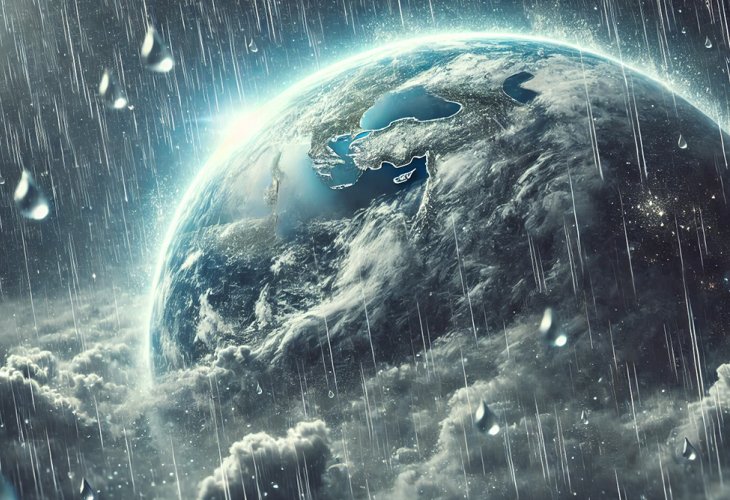
Water is indispensable for life. Every living being on Earth, from humans to animals and plants, depends on it for survival. Yet simply having water on this planet is not enough. For life to thrive, water must reach every organism in a form suited to its needs.
Water’s Challenge
Water naturally flows downward, gathering in the oceans. For it to benefit life on land, several conditions must be met:
Water must somehow move against gravity, rising from the low-lying ocean to higher land areas.
It must remain on land long enough to support living systems.
It should absorb essential minerals needed by plants, animals, and humans.
All of this must happen automatically, without external technology.
Remarkably, these complex abilities are built into water itself.
The Limits of Human Technology
The most powerful man made pump in the world, the Pentair Fairbanks Nijhuis HP1-4000.340, has two units installed at a pumping station in IJmuiden near the North Sea Canal in the Netherlands. These pumps help prevent flooding in western Netherlands, a country located below sea level.
With a power of 5,634 horsepower, one pump can draw 60,000 liters of water per second. To understand this scale, imagine turning the Empire State Building into a deep swimming pool. This pump could fill it in just under five hours. It can fill an Olympic sized pool in 41.6 seconds, and it would take two years to fill the Sea of Galilee.
Even this impressive technology is tiny compared to what happens in nature.
Nature’s Global Pump
Nature operates on a far greater scale. Using only the energy of the sun, water is transformed into vapor that rises into the atmosphere. The vapor condenses into tiny droplets that form clouds. Winds carry these clouds over land, and as the air cools the droplets fall as rain.
In colder regions they fall as snow, which melts slowly and provides a steady water supply throughout the year rather than only during rainy seasons. This entire system runs on solar energy alone, without the need for millions of giant pumps.
It is an extraordinarily efficient natural process.
Why Water Makes It Possible
This system depends on water’s ability to exist in three states within Earth’s narrow temperature range: gas, liquid, and solid. This characteristic is neither obvious nor common.
Consider molecular weight, a typical property of substances. It can be compared to the weight of a suitcase: the heavier it is, the harder it is to lift or move. A lighter suitcase is easier to lift and more likely to drift away, like a helium balloon.
If a substance such as ammonia, with a molecular weight of 17, were to dominate Earth, ocean temperatures would have to be minus 33 degrees Celsius for it to remain liquid and minus 78 degrees for it to freeze.
Water, with a molecular weight of 18, is ideally suited to Earth's conditions. It exists naturally as a liquid. It freezes at 0 degrees Celsius, where ice can remain for long periods and act as a natural temperature regulator. To evaporate and rise into the sky, it requires only ordinary summer temperatures.
An Astonishing Scale
The efficiency of this natural system is extraordinary. Every day about 875 cubic kilometers of water are lifted into the atmosphere.
With an upward flow rate of roughly 100 million liters per second, this solar powered system could fill the Empire State Building in about 10 seconds and the Sea of Galilee in less than 11 hours.
The journey of rain reveals a system that works continuously and automatically, delivering water from the oceans to the land in precisely the form life requires.

