

Magazine
Smoke and Mirrors: Houdini’s War Against Fake Magic
Harry Houdini insisted his escapes were pure skill and worked to expose fake magic, even when one of the world’s greatest writers refused to believe him.
- Yosef Yabeitz
- | Updated
Sir Arthur Conan Doyle was considered one of the greatest writers of the British Empire during Queen Victoria’s golden age. He was best known as the creator of Sherlock Holmes, the brilliant detective who calmly and rationally analyzed every detail and uncovered decisive proof to expose criminals.
Conan Doyle wrote sixty stories about Sherlock Holmes, and with each one his fame grew. He became a celebrated author whose opinions were sought not only in literature but also on political and legal matters.
Yet real life proved stronger than fiction.
A Personal Tragedy
At the height of his success, when he was fifty one years old, Conan Doyle’s wife passed away. A few years later World War I broke out, and the losses struck him again: two of his brothers in law and two nephews were killed.
These tragedies left him deeply shaken. In his grief and longing he turned to mediums and séances, hoping to communicate with his late wife. Paradoxically, the creator of the most rational detective in literature began to believe in the supernatural.
Conan Doyle became convinced that he had indeed spoken with his wife through a medium. He formed close connections with such figures, who in our eyes appear as swindlers and charlatans. According to the Torah, consulting mediums is forbidden even if it appears to have substance, since one must not inquire of the dead. Nevertheless, Conan Doyle became an enthusiastic supporter of spiritualism, as the movement was called.
The Rise of Harry Houdini
At that time, a dazzling figure crossed the skies of Europe and America like a meteor: the famous magician Harry Houdini. Many people today know his name but are unsure whether he was a fictional character or a real person. In fact, he was a real man, born in Hungary as Ari Weiss.
His father served as a rabbi in a progressive synagogue. After the family immigrated to the United States, Ari changed his name to Harry. He adopted the stage name Houdini after the famous French magician Jean Eugène Robert Houdin and went on to astonish audiences around the world.
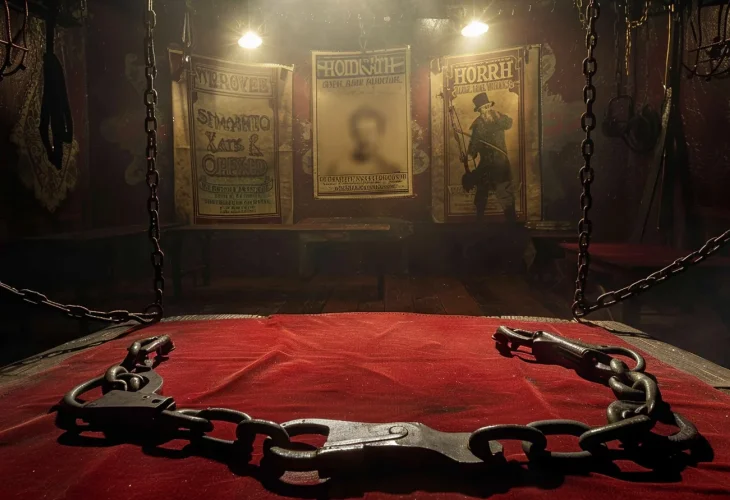
Houdini became famous for freeing himself from extraordinary restraints. These were not staged situations that he controlled himself, but complex bindings designed by expert locksmiths. He was shackled in chains and locks, suspended upside down, sealed inside boxes, and submerged in water tanks. Again and again he escaped.
In 1902 Houdini was secured with a sealed bolt positioned beyond the reach of his hands, a situation considered technically impossible. After two hours of effort he nevertheless managed to free himself.
In 1904 the renowned locksmith Nathaniel Hart challenged him by designing special handcuffs that he claimed no one could escape. He boasted that even an elephant or a wild bull could not break them.
"You will never succeed," Hart declared.
Betting booths sprang up, and experts predicted Houdini’s failure. Yet Houdini escaped from those cuffs as well, by means no one could explain.
A Clash of Beliefs
Conan Doyle believed he had found support for his ideas in the Jewish magician. Surely Houdini must possess supernatural powers. To Conan Doyle, Houdini seemed to prove that nature’s limits could be overcome by hidden forces and mystical knowledge.
Houdini strongly rejected this idea. There was no magic, he insisted. Everything he did depended on skill, practice, and careful technique. The same was true, he maintained, of mediums and spiritualists. They were all deceivers.
Conan Doyle refused to accept this. He remained convinced that supernatural forces were at work and tried repeatedly to prove his position, while Houdini continued to insist that all such claims were fraudulent.
An Ironic Reversal
In the end the roles were strangely reversed. The man who created the world’s most rational detective spent his final years pursuing mediums and spiritualists, convinced that they possessed genuine supernatural powers. Even when the magician himself insisted that it was all illusion, Conan Doyle would not believe him.
Meanwhile the great master of illusion openly declared that there was no sorcery, only skill and misdirection. People could enjoy the performance, he said, but should not attribute supernatural powers where none existed.
It seems likely that this message came from Ari Weiss’s Jewish upbringing. However far he may have been from traditional Judaism, Harry Houdini still carried with him a firm opposition to charlatanry, sorcery, and false mysticism, a message he shared with the world.

