

Passover
The Language of Redemption: Torah, Israel and the Hidden Connection
A deep spiritual reflection on Exodus, the hidden language of creation, and how the bond between Torah, Israel, and the Divine Presence shapes the meaning of the Seder night
- Yosef Yaavetz
- | Updated
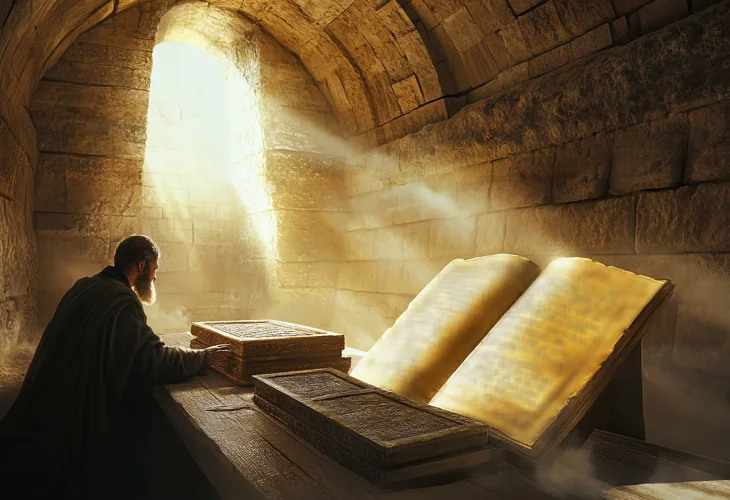
He stood before hundreds of tablets filled with dense letters. He stared at them again and again, as he did every day, for hours at a time, facing a language he did not understand. He wanted to understand it. He wanted to decipher the language.
All he needed was a connection, the understanding of one combination of two letters. But this language was built from hundreds of different shapes and symbols, unlike Hebrew and its related languages. Guessing was impossible. He needed to find even one place where the meaning of a pair of letters could be proven. Once he had one connection, then everywhere those two letters appeared on the tablets he could begin to understand something, and at one of those points he might discover another connection, a third letter joining the pair.
For years he searched and tested until he reached the first clue. The illustration beside the writing, the context of the document, the background all helped him. He found an explanation for two letters. He broke through the barrier of the hidden language and created a connection. With that connection he continued working until he found another place where a third letter joined them. Now he had a word. With that word he plowed through the texts again and again, until at last he deciphered the ancient language. He could read all the hundreds of tablets and understand their meaning.
This is how Linear script, the ancient writing system of the Greeks before they adopted the Semitic alphabet, was deciphered.
Reading the Language of the World
A person wants to read the language in which the world is written. The world speaks to us through hundreds and thousands of “letters” that we long to read, to connect one to another until they form words, the utterances through which the world was created.
The creation of the world was a tremendous explosion of separation. Reality split into countless tiny particles. This breaking was a breaking of the vessels, the material that receives the light from the Creator. The light itself did not break, but it cannot be seen without vessels, and the vessels were scattered and fragmented.
Humanity and the Broken Vessel
Humanity was created with the power of connection. The first human could see from one end of the world to the other. He understood the language the world spoke, but in order to remain at that level he needed to obey. In doing so he would have become a vessel able to continue receiving the light. Instead, he broke his own vessel through disobedience, and the light could no longer be contained within him.
He was expelled from Eden into a fragmented world, where his descendants did not understand it. They did not know how to draw food from it without endless toil, nor did they grasp the word of the Creator. They descended into idolatry. The vessels of the world were scattered into infinite fragments. A broken and dispersed world.
The Hidden Light Within a Fragmented Reality
And yet, the light and goodness were always there. This world is good, and the works of the Creator are good, but humanity cannot see or connect the pieces. It is like a magnificent puzzle divided into countless fragments. Only one who assembles the puzzle will see the image and be filled with joy. It is like shattered tablets covered with writing that no one can read until someone gathers the pieces together and suddenly the words become clear and wisdom flows.
The Exodus as the First Connection
The Exodus from Egypt was the joining of two letters. The people of Israel were a great vessel but could not see the light. They were in the darkness of Egypt, and the departure from there connected them with the light of the Torah.
The bond and covenant emerged from within reality itself. Israel reached a state of empty vessels in Egypt, and what drew them out was the commandment, obedience. They listened to the voice of God and trusted Him, and those among them who were worthy vessels were redeemed and filled with Torah. The two letters were joined. Their meaning exists only together. From that point onward the Torah has meaning only through the vessel that is Israel, and Israel has meaning only through the light that is the Torah.
The Third Letter: The Divine Presence
To these two letters, Torah and Israel, we strive to attach the third letter, the Divine Presence. The Shechinah is the dwelling of God among us. When Israel and the Torah cling to one another properly, the Divine Presence rests among us. But when cracks appear, when the vessel no longer holds the light properly, the Presence withdraws and hides.
The Holy One, the Torah, and Israel form the language through which the world speaks to us, the language in which it is written, for through it the world was created according to the blueprint of the Torah that flows from Divine wisdom. We are the vessel through which the language of reality and nature is read. Our purpose is that nature and existence reveal not only the reality of the Creator but also His will, until all will know and the earth will be filled with knowledge.
The first stage of the Exodus is therefore so central in Torah and mitzvot. It is an inseparable union. This pair has existed together from that moment until now, Torah and Israel. The night of the Seder is the night when this connection continues, sustaining the world.

