

Magazine
An Email from Afghanistan: Saving a Forgotten Jewish Heritage
A surprising email from Afghanistan led to an extraordinary effort to restore synagogues and a cemetery left behind by a vanished Jewish community.
- Yosef Yabeitz
- | Updated
"Hello, my dear, did you get my email?" That is how a classic phishing message usually begins. If you reply, "I didn’t. What’s this about?" you might receive a follow-up such as: "I live in Nigeria or Cambodia. A relative of mine shares your last name. I want to give you a million dollars. Please send your details."
Hard to believe people still try such tricks. Most of us ignore the minor annoyance and move on.
That is exactly what Osnat Gad thought when, twelve years ago, she received an email that read: "I am Hamaduli from Afghanistan. I want to donate money to renovate holy places. Please respond."
At first it sounded like a joke. But then Osnat paused and wondered: This man is writing in Afghan. How would he know that I can read it? I am American.
Could there be something real behind this message?
Memories of Herat
In 1959, Osnat left the city of Herat in Afghanistan together with most of the country’s Jews. Some immigrated to Israel and others to the United States. Osnat settled in America.
Her partner, Shlomo Yakutiel, was also of Afghan origin. Through him she deepened her connection to her heritage. Over the years she often heard painful reports about the deterioration of the Jewish holy places in Herat.
When the Jews of Herat left the city, they sadly left behind four large and beautiful synagogues. Two were converted into mosques by the authorities, a third became a school, and the fourth, the Mulla Yoav synagogue, became an Islamic cultural center. Hebrew verses are still engraved on its walls, a painful sight in photographs showing Muslim visitors and an Afghan flag flying at the entrance.
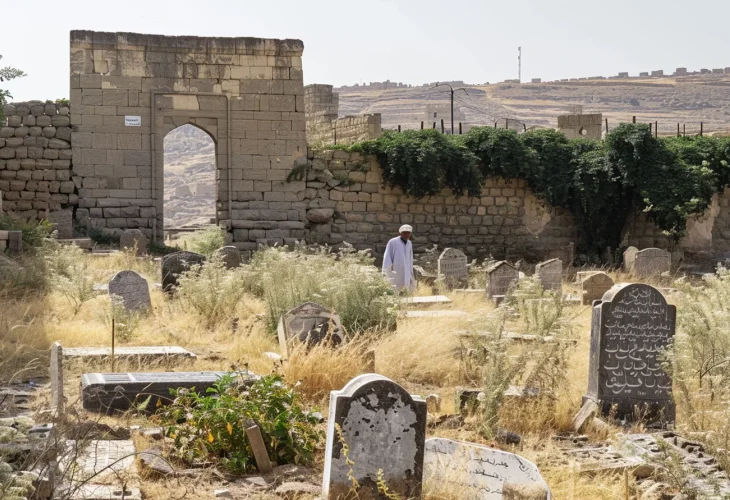
While the synagogues are still in use, the centuries old Jewish cemetery has steadily deteriorated. Nearly two thousand headstones remain there, along with many unknown graves. Vegetation splits the stones, the fence disappeared long ago, and herders stable animals on former burial plots. Animals overturn stones and dig in the soil. The neglect is heartbreaking.
A Risky Possibility
For years Afghanistan has been ruled by the Taliban, a zealous regime that allows no activity that is not Islamic, certainly nothing Jewish or Zionist.
Even if Hamaduli was a real person and not a scammer, what could he possibly accomplish? If he were wealthy, he would not be sending emails like this.
Still, Osnat felt that the message had not reached her by accident. In the Afghan community in New York it was well known that she cared deeply about preserving Jewish heritage in Afghanistan.
Osnat Gad is a respected jewelry designer in the New York community, and her name may have traveled far.
After some thought, Osnat sent a short reply saying she would be willing to cooperate.
To her surprise, she soon discovered that there were indeed Muslim residents of Afghanistan who respected Jewish heritage and wanted to help preserve it. Not only Hamaduli, but others as well.
Guardians of the Cemetery
One of the key partners was the Abdalaz family, who served as guardians of the Jewish cemetery. Nearly two hundred years earlier, the Jewish community had paid a salary to the family’s grandfather for maintaining the site.
Now the great grandson, Jalilhamd Abd al Aziz, wished to continue that role. He still remembered Jews caring for the cemetery and conducting the last funerals there. He wanted to help restore and preserve the graves.
As Osnat soon realized, Hamaduli’s promised "big money" would not even cover a small part of the project. But his goodwill proved far more valuable.
A Global Effort
Osnat launched a crowdfunding campaign among Jews of Afghan origin. At the time such campaigns were still new, and she was unsure whether they would succeed.
The results exceeded all expectations. Afghan Jews across the world contributed generously. A group of Afghan expatriates in London joined the effort as well.
But raising money was only part of the challenge. Official approvals were required from the Taliban authorities, and Jews themselves were forbidden from entering Afghanistan. The entire project had to be managed remotely. Approval was also needed from the United States State Department in order to operate in an enemy country.
A sea of bureaucracy became an ocean.
Building from Afar
At the same time Osnat was rebuilding her home in the United States after it had been destroyed by Hurricane Sandy. She found herself working on construction plans for two homes at once: the house she was rebuilding in America and the heritage she had left behind in Afghanistan.
Hamaduli served as her representative on the ground and worked tirelessly to advance the project.
Over five years the work progressed. A fence was built around the cemetery, forty headstones were restored, and the grounds were cleared and organized.
Restoring the Synagogue
As the work continued, it became clear that the synagogue that had been turned into a school was in danger of collapse and had already been abandoned. Its walls now lean dangerously.
Members of the Afghan Jewish diaspora secured funding from a Swiss foundation that undertook the restoration of the synagogue.
It turned out that part of the structural problem came from the ancient mikveh known as Hammam e Mousavi. When it was connected to its original water source it caused no damage, but over time the source dried up or was diverted, leaving sinkholes that weakened the structure.
The Swiss foundation is now restoring both the synagogue and the mikveh.
With Hashem’s help, when the Taliban regime eventually disappears and Jews can once again visit Afghanistan, they will find a restored synagogue and an ancient mikveh standing beside it, preserved for future generations.

