

Wonders of Creation
Nature's Sculptor: The Extraordinary Power of Water
A single drop of water can break stone, carve valleys, and move mountains. Discover how nature turned ordinary water into one of Earth’s most powerful sculptors.
- Yosef Yabece
- | Updated
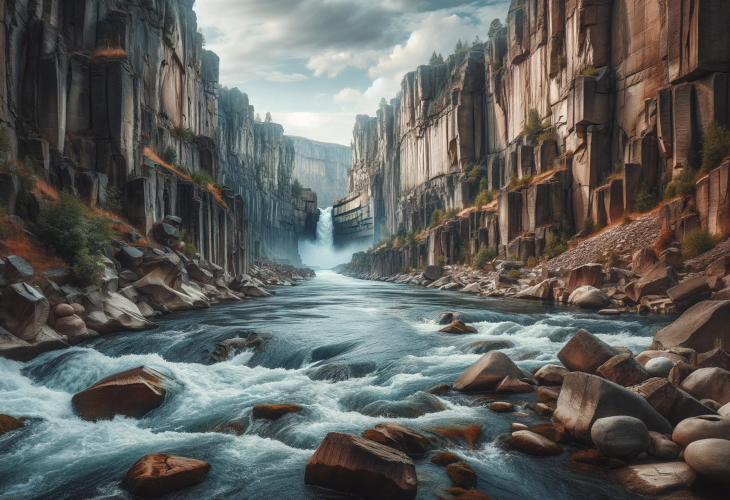 Witness the unexpected artistry of water in motion.
Water rises into the skies and returns as rain to replenish the earth and its inhabitants across the globe. Winds carry the clouds and rain falls where it is needed, but another question arises: how is water stored wherever life depends on it?
If we tried to create such storage mechanically, the task would be enormous. Consider the world’s largest mining machine, the Bagger 293. This colossal machine stands 96 meters tall, about the height of a 35 story building, and stretches 225 meters in length. It weighs 14,000 tons and requires a crew of five operators. Powered by an external supply of 16.5 megawatts of electricity, it uses a cutting wheel 21.3 meters in diameter and can move 218,880 tons of earth in a single day.
Even such massive output would be insignificant compared to the need for continuous excavation to store rainfall for humans, animals, and plants. Even hundreds of machines like the Bagger 293 would require thousands of years to create the necessary reservoirs.
Nature’s solution is far more elegant. Each drop of water acts like a miniature solar powered excavation machine.
Water as a Natural Excavator
Water has a remarkable ability to break down rock. Its molecules are polar, meaning they behave like tiny magnets. When a drop of water encounters minerals, it attracts their atoms and gradually pulls them apart. This is why water is such an effective solvent, allowing many substances to dissolve easily within it.
Water also absorbs carbon dioxide from the air, forming carbonic acid. This mild acid accelerates the breakdown of minerals, especially limestone, helping transform solid rock into soil and sand.
Water’s viscosity allows it to flow at an ideal speed. It moves slowly enough to maximize its chemical effect on rocks, yet quickly enough to carry tiny particles of stone. These particles increase the abrasive effect, turning flowing water into a kind of liquid sandpaper that steadily wears away even the hardest surfaces.
Because of their magnetic properties, tiny droplets are drawn into microscopic cracks within rocks, pulling more droplets along with them and deepening the fractures over time.
The Power of Freezing Water
Water has another unusual property. When it freezes, it expands by about ten percent instead of contracting.
When water seeps into cracks in rock and then freezes, it expands and exerts pressure from within. Over time, this pressure widens the cracks and eventually breaks the rock apart. What begins as a tiny fracture can become a major break through repeated cycles of freezing and thawing.
This process plays a major role in turning solid rock into loose material that can later be carried away by rivers and streams.
Glaciers as Moving Bulldozers
Another powerful tool of nature is glacier erosion. Glaciers form when layers of ice accumulate into enormous masses hundreds of meters thick and weighing billions of tons.
Ice has a much lower viscosity than most crystalline solids. The viscosity of rocks in the earth’s crust is estimated at around 10²¹ to 10²⁴, while glacier ice is closer to 10¹¹, roughly ten orders of magnitude lower.
If ice behaved like rock, most of Earth’s water would remain trapped in massive ice caps at the poles and on mountain peaks. Liquid water would be scarce, and glaciers would be unable to shape the land.
To erode rock effectively, glaciers must be able to move. Under the immense pressure of their own weight, ice more than 50 meters thick behaves less like a rigid solid and more like a viscous fluid, allowing it to flow slowly across the landscape.
At the base of the glacier, a thin layer of liquid water forms between the ice and the ground. This layer acts as a lubricant, allowing the glacier to slide forward. A similar process allows ice skaters to glide smoothly across a frozen rink.
This combination of factors transforms a glacier from a passive mass into an active excavation system. As it moves, the glacier acts like a gigantic bulldozer, crushing mountains, cliffs, and hills in its path. Rocks and debris trapped within the ice increase its grinding power, intensifying the erosion.
Once glaciers complete their work, they disappear. The ice melts and the water flows away, leaving behind the vast channels and valleys that later become riverbeds.
A Global Excavation System
Water reshapes the earth through three processes at once. Glaciers crush mountains, mechanical abrasion grinds rocks into smaller fragments, and chemical erosion dissolves minerals into fine particles.
The scale of this system is enormous. Over the past 12,000 years, Niagara Falls has retreated about 10 kilometers due to continuous erosion.
The scientist Lawrence Joseph Henderson estimated that rivers carry about five billion tons of mineral material into the oceans each year, roughly 14 million tons every day. This is an extraordinary achievement for a digging system that operates without engines and can fit on the tip of a finger.
The Unique Properties of Water
Water’s extraordinary effectiveness comes from a unique combination of properties:
It is the only substance that exists on Earth within normal temperature ranges as a solid, liquid, and gas
Its molecules are highly polar
It absorbs carbon dioxide and forms carbonic acid
It has an optimal level of viscosity
Its surface tension allows it to penetrate tiny cracks in rock
It expands when it freezes
Ice becomes more mobile under pressure
A thin layer of water beneath glaciers allows them to slide
Together, these properties make water one of the most powerful natural forces on Earth, quietly shaping mountains, valleys, and riverbeds drop by drop.

