

Shabbat
What Would You Do? A Moral Dilemma for the Shabbat Table
When staying true to your values might hurt someone else, what is the right thing to do? A thoughtful dilemma for meaningful family discussion.
- Hidabroot
- | Updated
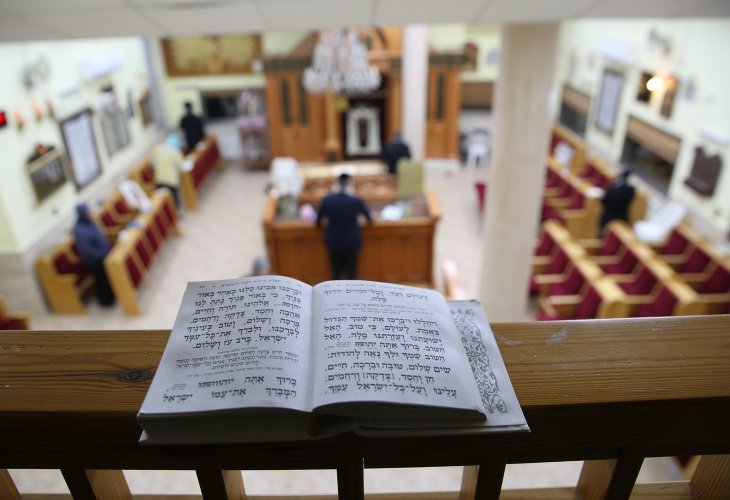 (Photo: David Cohen / Flash 90)
Yossi closed the door behind him and slowly walked down the stairs. He knew he could not avoid the situation. Once again he would pass the neighbors gathered for the minyan they held every Saturday night at the entrance to the building. He expected their disapproving looks and felt certain they were upset with him for not joining.
Yossi preferred to pray at the synagogue, where the prayers felt deeper and more meaningful to him. But he wondered whether he should give that up in order to please his neighbors. At the same time, he worried that his absence from the building minyan might appear arrogant, as if he were saying, "This is not good enough for me."
Yossi shared his dilemma with his friend Avi, who listened sympathetically.
"I understand your struggle," Avi said. "I've also found myself in situations where I had to choose between doing what felt right and avoiding hurt feelings. I have an elderly aunt who insists on shaking my hand every time we meet. Once I tried to explain that halacha does not allow it. I thought she would understand that it was not personal, but she was deeply hurt."
Yossi nodded. "It really is complicated," he said. "I have a friend who asks me to come over whenever he is sick so I can help him catch up on what he missed in class. I hesitate because I'm afraid of getting sick myself. But I cannot say that directly because he is sensitive and it would hurt him. What do you do in situations like that? On one hand, I do not want to hurt anyone. On the other hand, I do not want to harm myself just to satisfy someone else."
What do you think? What is the right thing to do?
A Guiding Principle
The Talmud in Taanit teaches in the name of Rabbi Elazar ben Rabbi Shimon: "A person should always be flexible like a reed and not rigid like a cedar."
Although the reed appears weaker than the cedar, it bends with the wind. It represents flexibility and sensitivity. Rabbi Elazar teaches that the ideal approach is to remain faithful to one's principles while at the same time avoiding unnecessary harm to others.
Learning from the Sages
A well known story is told about the rabbi of Ponevezh, who during one of his travels abroad was approached by elderly women who wished to greet him by shaking his hand. He could have insisted firmly on the prohibition and explained the halachic restriction to each of them, even if it meant causing embarrassment or hurt feelings.
Instead, he chose to be flexible like a reed. Each time a woman approached him, he removed his hat, held it respectfully in both hands, and bowed in greeting. In this way he maintained the requirements of halacha while still showing respect and sensitivity.
A similar story is told about Rabbi Shlomo Zalman Auerbach. Once, while traveling on a bus, he found himself seated next to a woman. Rather than risk hurting her feelings by openly changing seats, he quietly got off at the next stop and walked a considerable distance to reach his destination.
Applying the Principle
Situations like these arise often in everyday life. The challenge is to remain faithful to the spirit of halacha while also striving to avoid hurting others.
In many cases, the best approach is to look for a respectful and creative solution that preserves both values.
For example, in the case of Yossi's sick friend, he might try to find a considerate explanation that allows him to avoid visiting while still protecting his friend's feelings.
Being flexible like a reed does not mean giving up one's principles. It means expressing those principles with sensitivity and wisdom.
Weekly Family Exercise
Take a few moments to think about whether there are mitzvot you observe that might sometimes affect others in uncomfortable ways.
Discuss together how these mitzvot can be fulfilled in a manner that is both faithful to halacha and sensitive to other people, striving to be flexible like a reed.
Based on the book The Obligation of Man in His World: Issues in Morality and Character for the Whole Family.

