

Magazine
The Unexpected Call: Why a Rabbi Led a Far-Left Activist’s Funeral
When a rabbi was asked to officiate at the funeral of a far-left activist, he never imagined what he would discover along the way.
- Naama Green
- | Updated
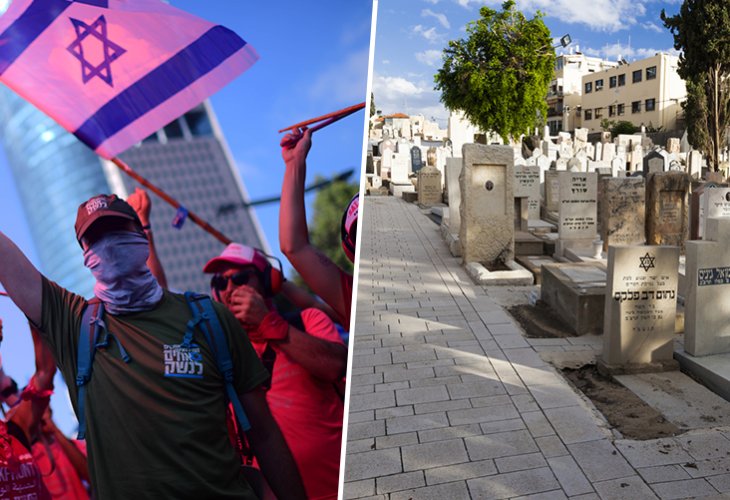 (Photos: shutterstock, Tomer Neuberg / Flash 90)
Rabbi Yoni Lavie, a lecturer for teens, parents, and educators on Torah and educational topics, once shared the story of an unusual funeral he was invited to lead. What began as a routine request turned into a powerful lesson about Jewish identity, unity, and the meaning of life and death.
An Urgent Request
“My mother passed away this morning,” an unfamiliar man wrote to Rabbi Lavie on WhatsApp. “The funeral is in four hours, and it is very important to us that you lead the ceremony. Can you? We will pay whatever it takes.”
Rabbi Lavie checked his calendar and saw that with some effort he could fit the funeral in between a lecture and a meeting.
“I do not take money for this,” he replied, “but if it matters to you, I will come. I would be glad if you could tell me a bit about your mother.”
The man thanked him warmly. Instead of calling, he sent a link to the deceased woman’s Wikipedia page.
A Surprising Discovery
When Rabbi Lavie opened the link, he was shocked.
“I almost fell off my chair,” he later recalled. “She was a far left activist who dedicated her life to fighting what she called the occupation. She supported dismantling the settlements and establishing a Palestinian state, and organized joint events with families of terrorists. She was among the founders of a far left party and a fierce opponent of religion in public life.”
Rabbi Lavie could not understand why the family had turned to a rabbi to conduct a Jewish funeral ceremony. But after speaking with the son, the answer became clear. The woman had come from a traditional family, and although she raised her sons as secular Jews, she had requested a Jewish burial.
A Challenging Atmosphere
At three in the afternoon Rabbi Lavie arrived at the alternative cemetery in Tel Aviv and was struck by the size of the crowd.
He looked around for familiar faces but recognized almost no one, aside from a few Knesset members from the far left. After opening the ceremony, he invited the speakers to begin the eulogies.
“The next few minutes were difficult and jarring for me,” he recalled. “One after another came passionate speeches about the injustices of the occupation and harsh criticism of the current government.”
He began to wonder whether it had been a mistake to accept the invitation and what he could say without being accused of pushing religion.
Then he reconsidered.
“The family invited you,” he told himself. “The deceased came from a traditional background and asked for a Jewish ceremony. There is something beautiful in the fact that even people whose lives are so different still hold on to a Jewish burial according to the tradition of Moses and Israel.”
A Jewish Message About Life and Death
Rabbi Lavie stepped up to the microphone and spoke as he does at every funeral.
He explained the Jewish perspective on life and death, saying that the value of life is not measured by the number of years a person lives but by the meaning and purpose they bring into those years.
He spoke about the Jewish belief that a human being is not only a body but also a soul. Even after the body is laid to rest, the soul continues on.
He invited the two sons to perform keriah, the traditional tearing of a garment, and to recite Baruch Dayan HaEmet. The crowd stood respectfully as he handed the sons a page with the Kaddish prayer, and everyone answered Amen together.
From there, the mourners accompanied the coffin while reciting passages from Tehillim. At the graveside, Rabbi Lavie recited the memorial prayer El Malei Rachamim.
“The deceased remained silent the whole way,” Rabbi Lavie reflected. “But I have a feeling that from the place where her soul is now, she was glad that after all the years she fought religion, at least at her funeral there was a fully traditional Jewish ceremony.”
A Meaningful Goodbye
After the funeral, the two sons approached Rabbi Lavie.
“Rabbi, we are deeply grateful,” they said. “We could not imagine a more dignified and beautiful way to say goodbye to Mom. Maybe you could still accept payment?”
He declined, explained the basic customs of shivah, and parted from them with a warm handshake.
As he left the cemetery and washed his hands, Rabbi Lavie reflected on what he had experienced.
“It is amazing how far apart Jews can be and yet how close they remain,” he said. “The gap between people can be enormous during a lifetime, yet at the decisive moment a point of connection appears that unites us.”
The Jewish Soul Never Disappears
Rabbi Lavie reflected that even during her lifetime, the woman may have been motivated by values she believed were moral and meaningful. She believed strongly in peace and fought against what she saw as injustice.
Even if there was a gap between her worldview and Torah truth, from her perspective she was trying to make the world better.
In the end, although she lived as a secular Jew and raised her children that way, she chose to leave this world as Jews have done for generations, according to Jewish tradition, with her sons reciting Kaddish and proclaiming:
“Yitgadal v’yitkadash shmei rabba.”
Why Life Matters Even Though We Die
The question often arises: What is the point of living if life eventually ends?
In a powerful conversation, journalist Zvi Yehezkeli spoke with Rabbi Daniel Cohen about the meaning of life and death, exploring the deeper purpose behind our existence and what continues after we leave this world.
This story reminds us that no matter how far a person may seem from tradition, the Jewish soul remains connected. At the most meaningful moments of life, that connection often reappears in powerful and unexpected ways.

