

Magazine
He Kissed the Land and Never Rose Again: The Immigrant Who Came Home
After a long journey on foot from Iraq in 1947, a Jewish man reached the Land of Israel, kissed its soil in tears, and died moments later. Years later, his identity was revealed.
- Yosef Yabeitz
- | Updated
In the small cemetery of Kibbutz Beit HaArava once stood a simple headstone with a short inscription:
“Here lies Avraham ben Avraham. May his soul be bound in the bond of life.”
For many years, no one knew who this man was. His identity remained a mystery, and the story behind his final moments seemed almost unbelievable.
A Forgotten Cemetery in the Desert
Kibbutz Beit HaArava was founded in early 1940 by members of the Kibbutz HaMeuhad movement. They settled on the sandy and salty soil north of the Dead Sea and worked tirelessly to make the land productive, growing bananas, tomatoes, and other crops.
Before the kibbutz could even celebrate its first anniversary, tragedy struck. Two residents were murdered by an Arab gang, and they became the first to be buried in the small desert cemetery.
The kibbutz existed until 1948. During the War of Independence, it was decided that the isolated area could not be defended, and the Jewish residents were evacuated. The northern Dead Sea region fell under Jordanian control.
Over the years the desert reclaimed the land. When the area returned to Israeli control during the Six Day War, almost nothing remained of the settlement. The buildings had disappeared and the land had become barren once again.
Only five graves remained to testify that a Jewish community had once lived there: the two murdered residents, a child who drowned in a pit, a Palmach fighter who fell in the area, and one anonymous immigrant.
The Desecrated Graves
Even the graves did not remain intact.
During the years of Jordanian rule, the cemetery was desecrated. The headstones were destroyed and the bones of the deceased were removed from their resting places.
After 1967, a large communal grave was prepared at the site. The remains that were recovered were buried together, and a new headstone restored the original inscriptions, including the name given to the unknown immigrant: Avraham ben Avraham.
The Anonymous Immigrant
The story of the unknown immigrant later became known through a radio interview with Knesset Member David Koren, whose two year old son was among those buried there.
The events took place in 1947. Several kibbutz members were working in the fields when they noticed a lone Jew approaching from the eastern bank of the Jordan River. He had crossed the river on foot and walked toward them, exhausted from the journey.
With deep longing, the stranger asked if he had truly reached the Land of Israel.
They answered that he had indeed arrived and that he was standing on the soil of the Land of Israel.
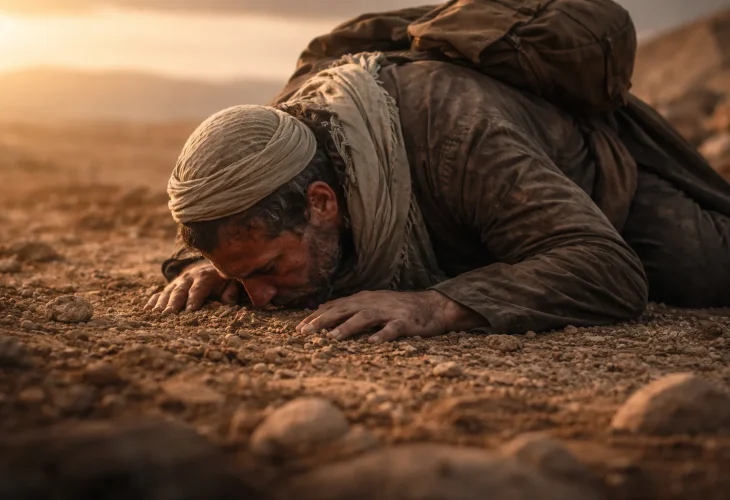
The man immediately bent down, stretched himself on the ground, and kissed the soil with emotion and devotion.
When several moments passed and he did not rise, the workers approached him.
To their astonishment, they discovered that he had died while kissing the soil of the land he had dreamed of reaching.
Since nothing was known about him, they engraved on his headstone the words:
“Here lies Avraham ben Avraham. May his soul be bound in the bond of life”
The Daughter Who Recognized the Story
Years later, a radio listener heard the story and felt that it sounded familiar. Something in the details stirred her memory.
After checking further, she made a stunning discovery. The anonymous immigrant was her own father, who had disappeared during that period.
Her father, Eliyahu Abd al Nabi, had set out from Iraq on September 11, 1947, at the age of forty eight. Determined to reach the Land of Israel, he traveled on foot across several borders until he finally reached the Jordan River, exhausted and worn from the journey.
Only then did the family learn how his life had ended.
A Privilege Even Moshe Did Not Receive
His daughter reflected that her father merited something even Moshe Rabbeinu was not granted.
Moshe Rabbeinu prayed 515 prayers asking to enter the Land of Israel and be buried there, but his request was denied. He saw the land only from a distance and was buried on the far side of the Jordan River.
Her father, Eliyahu Abd al Nabi, was privileged to step onto the soil of the Land of Israel and to be buried in its holy ground.
May his soul be bound in the bond of life.

