

Passover
Fire and Water in the Exodus: The Hidden Meaning of the Plagues
Why Egypt was struck through water and not fire. A deep look at Pharaoh’s worldview, the symbolism of the plagues, and the spiritual meaning of Passover renewal
- Yosef Yaavetz
- | Updated
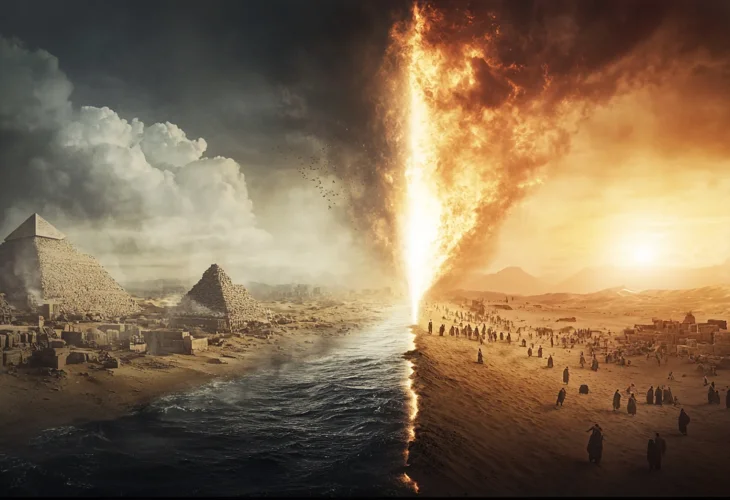
During the Exodus from Egypt, Egypt was struck with every illness and every plague, yet not with fire.
Indeed, the pillar of fire constantly testified to God’s presence, but none of the plagues themselves were plagues of fire, and none of the miracles came through fire. There was fire flashing within the hail, but it is not described as burning or causing destruction. Rather, it served only as a sign of the Creator’s existence and as proof that the hail was supernatural.
Egypt’s greatest blow, as is well known, came at the sea, and therefore even years later, in the time of Titus, idol worshippers could still imagine that the God of Israel was a god of water.
Fire as a Sign for Israel
Fire distinguishes between Egypt and Israel. Just as the pillar of fire stood at the head of Israel’s camp and cast arrows toward the Egyptian camp, God revealed Himself through fire. “For the Lord your God is a consuming fire.” At Mount Sinai He descended in fire, and in many places He revealed Himself through fire. Yet Egypt was struck only through water.
Why?
The Egyptian Worldview: Sun and Water
The Egyptians worshipped the sun. The name “Ra,” which appears in many of their names, was the name of the sun-god in their culture. When Pharaoh said, “See that evil is before you,” he was referring to that deity. Egypt was a kingdom of water, a civilization of the Nile and the sea. Their worldview was shaped by water. Pharaoh was even buried with ships so that he could supposedly sail into the afterlife.
Their perception however was idolatrous. They did not seek the single cause behind all reality; instead, they searched for multiplicity behind unity. Pharaoh was the local god who ruled the waters, while the distant sun-god ruled another opposing force.
Why Egypt Was Struck Through Water
The Nile was a powerful, eternal river whose waters did not cease. Because of this, Pharaoh could imagine that he controlled it, attributing the river’s strength to himself. The sun, however, was beyond his control. Sometimes it burned too fiercely, sometimes too weakly, bringing famine. They attributed this to the distant sun-god.
Therefore, had Egypt been struck by fire or by the sun, it would have only reinforced Pharaoh’s claim: my sun-god is angry with me because I considered releasing the Jews. I must become stronger and keep them enslaved.
The purpose of the plagues was to show Pharaoh that he did not control the waters. “The Nile is mine, and I made it myself,” he had claimed. Thus the river was struck repeatedly, and in the end even the great sea was struck. The sun-god too was humbled through the plague of darkness.
The plagues were plagues of cold and moisture. Sun-drenched Egypt became dark, damp, wet, and afflicted. The sun-god could not warm it. Instead, the children of Israel gathered around fire, which warmed the world for them. The waters of Egypt rose higher and higher until they closed above the Egyptians’ heads; the waters reached their very souls.
Passover, Fire, and Renewal
For this reason, the month of spring is the beginning of months. It marks the rising “sun” of Israel and the departure from the land of winter and rain. It is a time to gather around the pillar of fire. All the leaven from the previous year is burned in fire, and we begin counting toward the new grain.
The renewal of Passover is also a beginning of a new year: let the old year and its curses end. We do not preserve food from one year to the next. Even the Passover sacrifice carries a warning: “Do not eat it raw.” It must be governed by fire, removing all moisture and any trace of the former life.
Water and Fire: Two Opposite Forces
Water, when it comes as punishment, represents burial and destruction. It covers, seals, and suffocates. Fire, however, burns, cooks, and refines. God brought Israel into Egypt because it was an iron furnace. For the Egyptians it became a watery grave, but for Israel it became a crucible that purified.
From Israel, God sometimes exacted judgment through fire, such as with Nadav and Avihu, Korach and his followers, and the complainers. Water is the most common state of matter; much of the world is composed of it, and therefore water represents life. Yet when balance is disrupted, water can suffocate life, just as when fluid enters a vital organ.
Fire, by contrast, is the rarest state. It requires constant energy, and it represents a process of refinement and correction.

