

Passover
The Plague of Locusts: Pharaoh’s Refusal and Egypt’s Destruction
A powerful retelling of the warning before the locust plague, the debate in Pharaoh’s palace, and the devastating swarm that consumed Egypt’s food, land, and hope
- Behalacha Ube'agadah
- | Updated
 (Photo: Shutterstock)
The day after the plague of hail, while chunks of ice still covered the land and smoke rose from the trees and barns, Moshe and Aaron once again entered Pharaoh’s palace and warned him that if he did not send the Children of Israel away, he would be struck by a plague of locusts. For three weeks the warning was repeated, and on the final day Moshe said to Pharaoh:
“Thus says the Lord, God of the Hebrews: How long will you refuse to humble yourself before Me? Send out My people so they may serve Me. For if you refuse to send My people, tomorrow I will bring locusts into your borders, and they will cover the face of the land.”
This time Pharaoh’s servants feared Moshe’s warnings and began to discuss the matter among themselves. Seeing that they were debating, Moshe stepped aside for a while to give them an opportunity to repent. As soon as he left, Pharaoh’s servants turned to their king and said: “How long will this man be a snare to us? Send the men so they may serve the Lord their God. Do you not yet realize that Egypt is ruined?”
Pharaoh listened to them and called Moshe and Aaron back. He said: “You may go and serve your God. But who exactly will be going?”
Moshe answered: “All of us. Young and old, sons and daughters, with our flocks and our cattle, for it is a festival of the Lord for us.”
Pharaoh’s heart hardened once more. “It is fitting for the young men and the elders to sacrifice,” he replied, “but not the children. From your words I understand that you intend to escape! Now leave at once. I do not want to hear you or your requests again.” Pharaoh failed to understand that among the people of Israel, the service of God includes the entire family, unlike other religions in which only priests serve on behalf of the nation.
An Army of Locusts
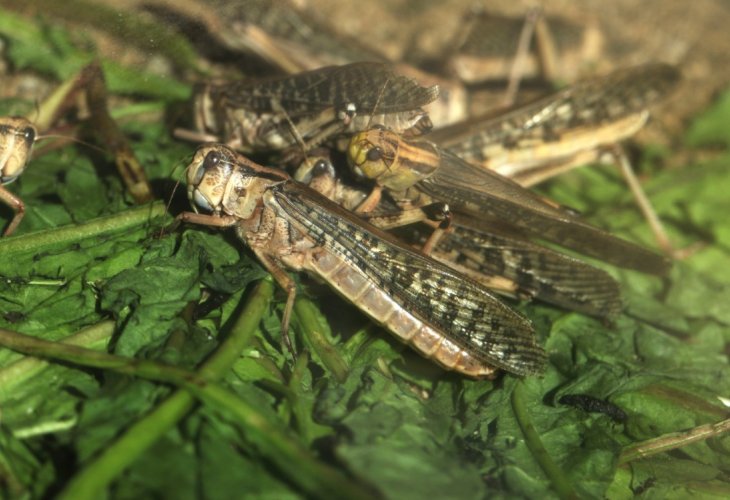
After leaving Pharaoh, Moshe stretched out his staff toward the heavens, and God brought an east wind that blew throughout the day and night. By morning the locusts arrived. Such vast swarms had never been seen before. The air of Egypt filled with locusts stacked one upon another to heights of several meters. There were no gaps between them, and the sunlight was blocked so that the land grew dark. Seven different species of locusts came upon Egypt.
Imagine an Egyptian walking calmly along the street at that moment. He notices a strong east wind blowing but does not understand its meaning. Suddenly he sees a massive dark cloud rising from the east. Perhaps the wind carried it here, he thinks. No rain falls from it, no hail, yet strangely the day grows dark. Has the sun set in the middle of the day? Soon he realizes his mistake: the cloud is made of locusts, billions of crawling creatures hiding the sunlight. The unfortunate Egyptian runs toward his home seeking shelter, but before he reaches it the swarm lands on a tree and begins devouring it relentlessly. As he struggles through the swarm, he discovers that these are no ordinary locusts. They begin chewing his clothes and even biting at him. Every step becomes difficult as he pushes his way through the living army, pecked and bitten as he goes.
The Destruction of All Supplies
Those inside their homes look through the windows and see a cloud of locusts descending from the sky, covering the land. Without hesitation the swarm begins devouring whatever remained after the hailstorm. Disaster! The wheat and the spelt are consumed. What will they eat now?
The Egyptians grieve over the destruction of their fields but take comfort in the food stored safely inside their homes. However, their relief does not last long. The tiny devourers do not settle for what remains in the fields. Once everything edible outdoors is gone, including branches and tree trunks, they invade the storehouses and consume the food stored there. From there they even enter the houses themselves, unlike ordinary locusts that eat only what is outside. They reach every room and every corner, gnawing at clothes, jewelry, and precious belongings. They even dare to peck at the Egyptians’ faces and eyes. What audacious locusts!
A difficult week passed over Egypt. The remaining food was destroyed, and even drinking water became scarce because the massive swarms clogged the springs. The air filled with a foul stench, and the relentless buzzing and chewing deafened the ears. The noise frayed the nerves, and the last scraps of food vanished. Yet the Egyptians found some comfort: locusts themselves are edible. Let us gather them, they thought, fill every container we have, salt them, and use them as a substitute for the food that was lost. And so they did. All week long families gathered barrel after barrel, preparing provisions for the coming months.
But God had other plans. “Wicked ones,” He declared, “were you happy even in the plague I brought upon you?” When the plague ended, even the stored locusts flew away with the wind.
Not One Locust Remained
Pharaoh, who had driven Moshe and Aaron away from his palace only days earlier, now called them back in desperation. He confessed his wrongdoing and begged them to pray to God to “remove this death from me.” He did not ask on behalf of his people, only for himself.
Moshe left Pharaoh’s presence and prayed to God. Then God brought a powerful west wind, and in a single moment it carried away all the locusts, “and not a single locust remained in all the land of Egypt.” Even those preserved in pots and barrels flew away. What bitter disappointment! A whole week of labor by every family was lost. Just as the Egyptians had caused Israel deep frustration by forcing them to build on unstable ground, watching all their work collapse, so too their own efforts now came to nothing.
