

Magazine
The Surprising Reason Rabbi Ben Tzion Pelman Danced With His Kids Every Day
A moving collection of true stories about how Rabbi Ben Tzion Pelman zt"l raised his children with joy and love, and why learning with them mattered more than anything.
- Naama Green
- | Updated
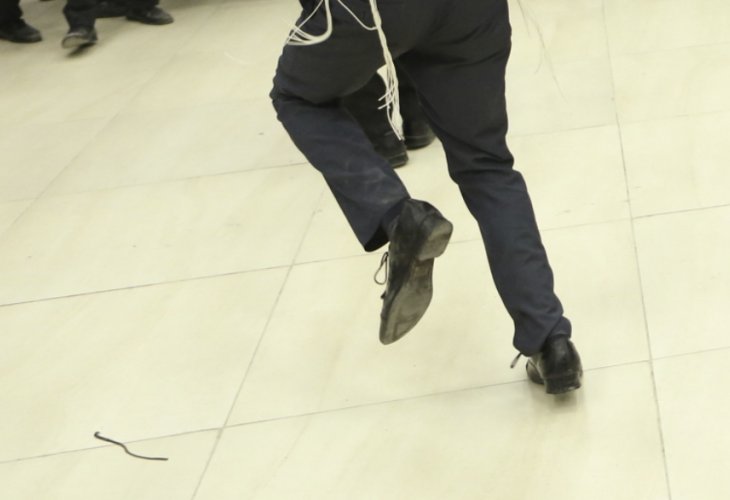 (Illustrative photo: Flash 90)
Rabbi Ben Tzion Pelman zt"l raised a flourishing family and devoted his life to Torah study. Those who knew him understood that alongside his greatness in Torah, he possessed a deep devotion to educating his children. For Rabbi Pelman, nothing was more important than learning Torah with them every single day.
A Class He Refused to Give
A prominent philanthropist who greatly respected Rabbi Pelman once visited his home and offered him a generous salary to give a daily halacha class from 6:30 to 7:30 in the evening.
Rabbi Pelman listened carefully, thought for a few moments, and then answered quietly, “I cannot teach at that time.”
The philanthropist was surprised. “Why not?”
Rabbi Pelman stood up and pointed toward the children sleeping in the living room.
“Do you see the child on the top bunk? I learn with him every day from 6:30 to 6:50. Do you see the second child on the middle bed? With him I learn from 6:50 to 7:10. And with the third child I learn from 7:10 to 7:30.”
He continued:
“I cannot cancel this fixed time with them. It is worth more to me than anything else. I am sorry, but I cannot give the class. If you would like, I will gladly teach at another time.”
The philanthropist later said that this encounter changed his life.
“Until that day I did not see the importance of learning with my children. I thought the Talmud Torah taught them everything they needed. But when I saw how important it was to Rabbi Pelman to learn with his children, I began learning with each of my children every Shabbat. During the week I was too busy with business, but on Shabbat I set aside several hours to learn with them patiently. That meeting taught me that learning Torah with one’s children is worth far more than money.”
His Children Came First
Rabbi Pelman received many offers throughout his life, including opportunities to head kollels with excellent salaries. Although he needed a livelihood, he turned down every position that required travel outside the city.
After declining one such offer, he explained to his study partner:
“Before anything else, I must learn with my children. If I accept a position outside the city, I will not be home when they return from Talmud Torah. They come before everything.”
The Daily Dance
Rabbi Pelman learned with each of his children every single day, from the oldest to the youngest. His measure of success was simple: if the child enjoyed the learning, then the learning had truly succeeded.
If a child did not enjoy Gemara, Rabbi Pelman felt that memorization alone had little value. But when a child fully understood the Gemara’s question and answer, along with Rashi and Tosafot, the enjoyment came naturally.
When he saw a spark of joy on the child’s face, he would say, “Now I see that you understand.”
Then came a special moment the children never forgot.
At the end of each learning session, Rabbi Pelman would stand up and dance with the child in a joyful circle. Sometimes he held the child’s shoulders from behind, like a small train, and sometimes they danced side by side.
Hundreds of times the walls of the house witnessed that daily dance.
Sometimes the children wanted to learn just for the joy of that dance. When the Gemara was clear and sweet, the dance that followed felt even sweeter. It was a dance of mitzvah and love.
One of his sons later recalled:
“Abba learned with everyone every day. From the son who was already learning in a large yeshiva to the youngest children in Talmud Torah. The older son would come to learn with Abba after Shacharit at Ponevezh Yeshiva. Another learned in the morning, others in the afternoon, and the younger ones learned after Maariv at home. The little ones especially loved the dance.”
Even decades later, the children still remembered those dances with longing and emotion.
Praying for His Children at the Western Wall
Late one night after midnight, Rabbi Ben Tzion called his brother Rabbi Yisrael and asked him for a favor.
“Please take me to the Western Wall now.”
His brother was surprised. “Now? In the middle of the night? What happened?”
“I need to go to the Kotel,” Rabbi Ben Tzion replied. “Please take me to the place from which the Divine Presence never departed.”
His brother agreed and drove him to Jerusalem.
During the drive Rabbi Ben Tzion remained quiet and absorbed in thought. Finally his brother asked if something had happened.
Rabbi Ben Tzion answered softly:
“About an hour ago I heard that one of the children is struggling in his learning. I felt that I must go to the Western Wall and pray for him.”
They arrived at about 2:15 in the morning. Rabbi Ben Tzion stood by the stones of the Western Wall and prayed with deep emotion.
Until five in the morning he remained there, pouring out his heart in prayer and weeping like a child.
When he finished, his brother suggested staying to pray the early Shacharit service, but Rabbi Ben Tzion preferred to return home to Bnei Brak.
The next day he continued his routine as usual, as if he had slept through the night.
This was not the only time he traveled suddenly to the Western Wall. Whenever an issue arose in the education of one of his children or descendants, he would go and pour out his heart in prayer.
His sister once said:
“The secret of Rabbi Ben Tzion’s success in raising his children was that he constantly prayed for them.”
A Father Who Stayed Involved
When Rabbi Pelman’s sons studied in yeshiva, he regularly visited to ask about their progress.
A senior teacher who taught his sons remembered:
“He would come with humility and gratitude. I knew he was a very busy man, so I was surprised that he did not settle for phone calls but traveled in person to ask about his son.”
Each time Rabbi Pelman visited, he brought an envelope with a donation for the yeshiva.
“This man from Bnei Brak, who could barely support himself, felt deep gratitude and expressed it with generous donations,” the teacher recalled. “Some wealthy parents did not give anything. It all depends on what a person feels. Only someone who truly appreciates gives.”
The teacher said that Rabbi Pelman’s sincerity inspired him to invest even more effort in helping his son succeed in Torah learning.
Rabbi Pelman also visited the Talmud Torah where his younger sons studied each week to ask how they were progressing. He donated funds so the teachers could fully support the boys’ Torah education.
When children feel that they are their father’s greatest treasure and see how much he invests in them, it inspires them to grow and gives strength to their teachers as well.
Rabbi Shalom Ben Tzion Pelman zt"l was a respected halachic authority, rabbi of the Nachalat Moshe community in Bnei Brak, and author of the halachic series Shelamei Todah. His life remains a powerful example of devotion to Torah and to the spiritual growth of one’s children.

