

World News
U.S., Iran Open Third Round of Indirect Nuclear Talks in Geneva
Fresh U.S. sanctions announced a day earlier as Oman mediates indirect talks focused primarily on Iran’s nuclear program
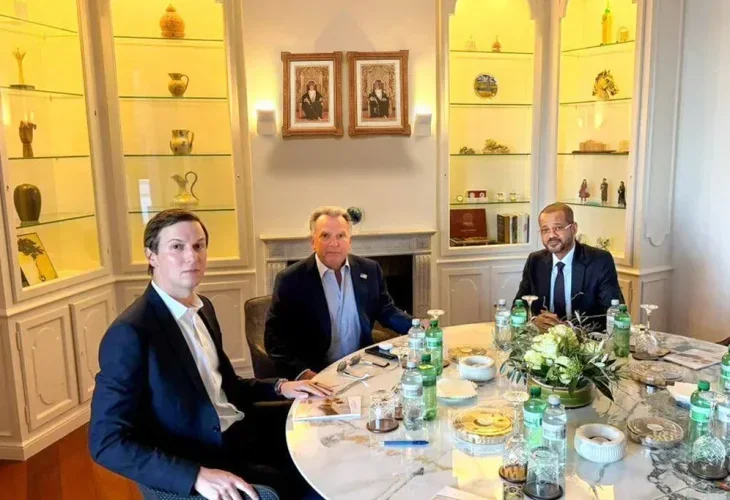 Witkoff, Kushner and the Omani Foreign Minister at the Third Round of Talks in Geneva (No Credit)
U.S. and Iranian delegations opened a third round of indirect negotiations Thursday in Geneva, continuing efforts to reach a new agreement over Tehran’s nuclear program. The talks are being mediated by Oman and are not taking place face-to-face.
The renewed diplomatic push comes one day after the United States imposed sanctions on more than 30 individuals, entities and vessels linked to Iranian oil sales and ballistic missile procurement networks.
The American delegation is headed by U.S. Middle East envoy Steve Witkoff and presidential adviser Jared Kushner. Iran is represented by Foreign Minister Abbas Araghchi, who arrived in Switzerland ahead of the talks. Omani Foreign Minister Badr al-Busaidi is facilitating the indirect exchanges between the sides.
Albusaidi said both parties are “demonstrating unprecedented openness to new ideas and solutions, and creating a supportive environment for progress and reaching a fair agreement.”
The scope of the negotiations remains a central point of contention. U.S. officials have said the discussions are focused primarily on Iran’s nuclear program, while also signaling concern over Tehran’s refusal to broaden talks to include its ballistic missile activities.
Secretary of State Marco Rubio said yesterday, “The talks will focus primarily on the nuclear issue. The fact that Iran is not prepared to discuss ballistic missiles is a very serious problem.”
Iranian officials have publicly framed the talks more narrowly. Ali Shamkhani, secretary of Iran’s Supreme Defense Council, said, “If its core is that Iran will not obtain nuclear weapons, then an agreement is immediately possible.”
He added, “This principle is consistent with the fatwa issued by Iran’s leadership and with our defense doctrine. Foreign Minister Abbas Araghchi has the support and authority for such an agreement, if the other side shows willingness.”
Araghchi himself said Iran will “under no circumstances” develop nuclear weapons, while maintaining that Tehran will not relinquish what it describes as its right to civilian nuclear technology.
President Donald Trump said earlier this week that Iran needs a deal more than the United States in order to avoid a potential strike, adding that Tehran has not explicitly ruled out building a nuclear weapon.
Reports on Thursday also indicated that International Atomic Energy Agency Director General Rafael Grossi is in Geneva in connection with the negotiations, highlighting the technical and verification dimension surrounding any potential agreement.
No breakthrough has been announced, and both sides appear to be testing the parameters of a possible framework while maintaining public pressure. The talks are ongoing.
Questions & Answers
+What are indirect U.S.–Iran nuclear talks?
+What is the role of the IAEA in Iran nuclear negotiations?
+What is Iran’s position on nuclear weapons?

