

Behind the News
India Elevates Israel to Top-Tier Strategic Partner
Upgrade strengthens trade and energy partnerships and supports a new regional model built on cooperation rather than ideology
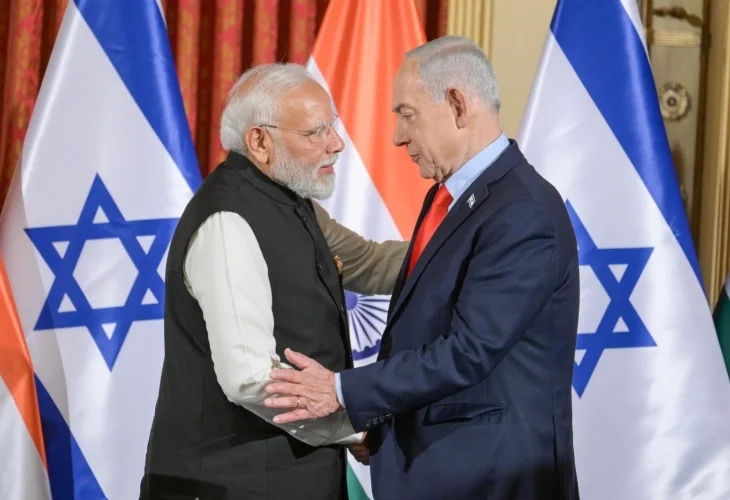 Prime Minister Benjamin Netanyahu and Narenda Modi
Prime Minister Benjamin Netanyahu and Indian Prime Minister Narendra Modi on Thursday oversaw the signing of 16 agreements in Jerusalem, formally upgrading ties between the two countries to what Modi called a “Special Strategic Partnership.” The visit marked a new phase in bilateral relations as Modi addressed the Knesset and met Israel’s top leadership.
“Today we are granting our partnership, which has proven itself over time, the status of a special strategic partnership,” Modi declared during the signing ceremony.
The upgrade expands cooperation between Israel and the world’s most populous democracy in defense, technology, and economic integration. The agreements span agriculture, geophysical exploration, heritage, science, education, cyber, artificial intelligence, and security coordination.
“We decided today to establish cooperation in the field of critical and emerging technologies, which will further boost our collaboration in areas such as artificial intelligence, quantum, and critical minerals,” Modi said.
The leaders also announced progress toward a mutually beneficial free trade agreement and confirmed that 50,000 Indian workers will be permitted to work in Israel over the next five years, according to India’s Foreign Ministry. Netanyahu said the government-to-government framework between the two countries would continue to deepen.
“We know that the meeting of minds and hearts that we've had here will also continue in this remarkable G2G that is long overdue and will create an even greater boost to the enormous benefits that we can bring to each other, and I think, to humanity at large,” Netanyahu said.
Both leaders emphasized shared opposition to terrorism. “Terror has no place in the world in any form or manifestation. Terror must not be accepted. We will continue to stand shoulder to shoulder against terror and its supporters,” Modi stated. He also referenced ongoing discussions regarding regional stability, including Gaza, and reiterated India’s longstanding condemnation of terrorism.
As part of his visit, Modi toured Yad Vashem, beginning in the Hall of Names, where he laid a wreath and placed a stone in memory of Holocaust victims. “The Holocaust stands as one of humanity’s darkest chapters. It is an eternal reminder of the need to uphold humanity, dignity, and peace,” he wrote following the ceremony.
Modi also addressed the Knesset last night, becoming the first Indian prime minister to speak before Israel’s parliament. Lawmakers greeted him with standing ovations. Reflecting on his return visit to Israel, Modi said, “The moment I stepped again into this historic and inspiring land of Israel is a proud and emotional moment for me.”
Netanyahu praised his counterpart during their joint appearance. “You have an incredibly efficient government,” he told Modi, announcing plans for a reciprocal intergovernmental meeting in India.
Beyond the agreements, the visit included renewed discussion of the India-Middle East-Europe Economic Corridor (IMEC), a multilateral initiative involving India, Israel, the United Arab Emirates, and the United States. Modi said the countries would work in “new momentum” to advance the corridor’s development.
Lt. Col. (res.) Amit Yagur, former deputy head of the Palestinian arena, told Channel 14 that the emerging framework represents a broader regional shift. “The IMEC corridor is an idea that replaces jihad. It replaces the most basic common denominator of the Middle East – religion and Arab nationalism. What they are trying to do here is turn the region into a transit corridor between East and West, where the central interest is economy, energy, and enormous profits,” Yagur said, noting reported concern in parts of the Arab media.
The visit concluded with both leaders describing the agreements as a milestone in relations that have steadily expanded in recent years. The elevation to a special strategic partnership formalizes that trajectory, with further coordination expected in defense, technology, and regional economic initiatives.
Questions & Answers
+Why is India’s relationship with Israel considered strategically important?
+What is the India-Middle East-Europe Economic Corridor (IMEC)?
+Has an Indian prime minister addressed the Israeli Knesset before?

