

World News
NYC Attempts to Establish Synagogue Protections as Free Speech Activists Push Back
Revised bill would require the NYPD to create protest buffer plans after Hamas-chant demonstrations outside synagogues
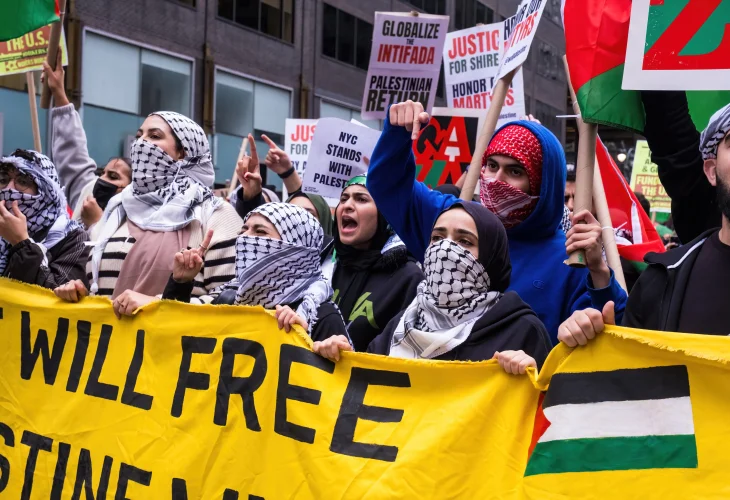 Pro-Palestine Protest New York (Shutterstock)
New York City lawmakers are moving forward with a bill that would require the NYPD to create security plans for synagogues and other houses of worship, following a surge in antisemitic hate crimes and protests outside synagogues. According to NYPD data, Jews were targeted in more than half of all reported hate crimes in January 2026.
City Council Speaker Julie Menin rallied alongside faith leaders and fellow lawmakers Wednesday ahead of a hearing by the council’s Committee to Combat Hate, framing the proposal as a response to mounting fear in the Jewish community. “These bills are grounded in a simple but urgent principle: every New Yorker should feel safe entering their house of worship or their school,” Menin said.
The legislation was escalated after two high-profile incidents: a November protest outside Manhattan’s Park East Synagogue and a January demonstration near a synagogue in Kew Gardens, Queens. In Queens, demonstrators were heard chanting “we support Hamas,” while residents reported hearing the chants from nearby homes.
“They were 300 feet away, and we were able to hear them and hear their calls of hate,” State Assemblyman Sam Berger testified via Zoom. He described a call from a local mother, the daughter of a Holocaust survivor, who was huddled inside with her children while the chants echoed outside.
Regarding the Park East protest, where demonstrators gathered near a synagogue entrance during an Israel-related event, police later acknowledged mistakes in their response. “We got that one wrong,” said Michael Gerber, the NYPD’s deputy commissioner for legal matters.
Menin said the Manhattan rally “was not a peaceful protest,” describing it as a catalyst for legislative action.
The bill originally proposed a mandatory 100-foot police-enforced buffer zone around religious buildings during protests. After discussions with NYPD Commissioner Jessica Tisch and concerns raised about constitutional free speech protections, the language was revised. The current version removes a fixed distance and instead directs the NYPD to craft location-specific plans.
“The NYPD needs to be able to make decisions based on the facts on the ground,” Gerber told council members. “Anytime you have a fixed rule across the board that’s going to raise constitutional questions.”
Under Menin’s revised city legislation, the NYPD would have 45 days to submit a detailed plan to the City Council speaker and the mayor explaining how it would manage protests outside houses of worship, followed by a final plan within 90 days outlining how and when buffer zones may be implemented. Supporters say the goal is to prevent obstruction and intimidation while preserving protesters’ right to be seen and heard.
Jewish organizations including the UJA-Federation of New York, the Jewish Community Relations Council of New York and the Anti-Defamation League testified in favor of the legislation. Mark Trager, CEO of the Jewish Community Relations Council, said codifying the policy into law would make a tangible difference. “There’s a significant difference between guidance and an actual law. Now it’s going to be a right rather than just a suggestion,” he said.
Interfaith leaders also expressed support. “Our masjids, like all places of worship, should be spaces of peace, prayer, safety,” said Imam Maaz Ali of Iqra Masjid. “Protecting one community ultimately protects us all.”
Outside City Hall, activists protested the proposal, holding signs reading “Protect our right to protest” and chanting “Free Palestine.” Opponents argued the measure shields pro-Israel events from criticism.
“These bills are not about protecting worshipers or students. They are about making sure the machinery of empire runs without interruption,” one speaker said.
Mayor Zohran Mamdani, who has faced criticism over his response to previous synagogue protests, said Wednesday that the revised proposal represents “a distinct shift from the original legislation,” noting earlier legal concerns about fixed perimeters. He has not yet committed to signing the bill if it passes the council.
The debate comes as Governor Kathy Hochul advances a separate statewide proposal establishing 25-foot buffer zones around houses of worship. An Anti-Defamation League poll released this week found broad support among New Yorkers for such protections.
If approved, the city legislation would require the NYPD to formalize its approach to managing protests near synagogues and other religious institutions, a move supporters say is necessary as antisemitic incidents continue to rise across the city.
Questions & Answers
+What are buffer zones around synagogues and how do they work?

