

Parashat Tetzaveh
Bells and Headscarves: When Clothes Remind Us of Our Responsibility
From the High Priest’s ringing hem to a scarf tied on a Roman street, a visible Jewish identity tells us who we are
A few years ago, back in my single days, I worked as a counselor in a traveling camp. It was an incredible experience for so many reasons, not the least of which is that we went to Alaska and Hawaii.
We spent the last Shabbat of camp in Honolulu, and that Shabbat morning, I found myself walking to shul with the program director. He was wearing his tallit (prayer shawl), and along the way, he told me that he enjoys the opportunity to walk through a very non-Jewish city in his very out-of-place Jewish garb, because people look at him and notice him, and it gives him the chance to be an ambassador of the Jewish people.
And I, an Orthodox Jewish girl, wearing my long skirt, long sleeves, and high-necked shirt in the middle of July in tropical Hawaii, looked at him and jokingly said, “Ah, I wonder what that’s like.”
Over the years, as I traveled around the USA and around the world, I would get many looks and comments about my outfits. Anyone familiar with Orthodox Judaism would instantly recognizeme. Other times, if my friends and I were out in the boondocks, we would be sized up by our similar black skirts and long-sleeved shirts, and told that we had a great uniform.
And I cannot tell you how many times we were asked if we were Mormon. The common theme, regardless of the comment, was that we stood out.
We are certainly not the first ones to experience this kind of standing out. In fact, there is Biblical precedent for it: In this week’s Torah portion, Tetzaveh, we are given the guidelines for making the garb of the priests and the High Priest.
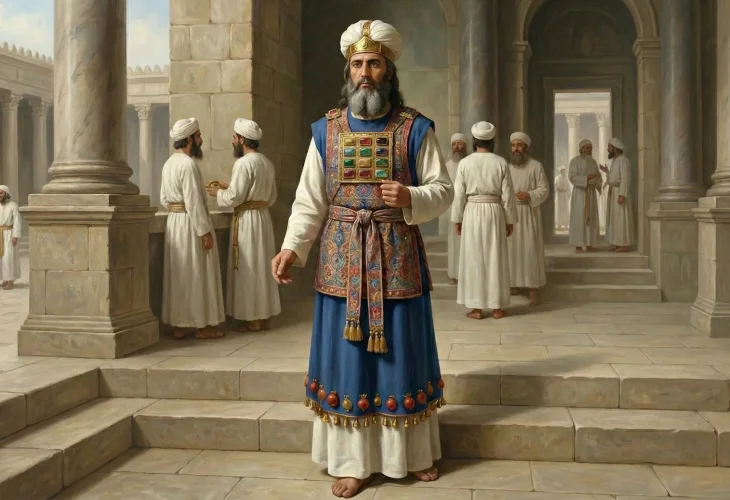
There were four garments that were specific to the High Priest, which he wore in addition to the regular priestly vestments. One of those articles of clothing was the me’il, a brilliant blue overcoat which, instead of fringes on the bottom, had alternating golden balls and bells.
The verses themselves make it clear that the purpose of these bells on the overcoat is to make noise: “[The overcoat] will be on Aharon when he serves, and its sound will be heard when he comes to the sanctuary before God and when he leaves, and he will not die” (Ex. 28:35). There are many ways of interpreting the last phrase of the verse.
Rashi says that we learn from here that the High Priest must wear all of his vestments when he is serving, and that if the High Priest is missing even one, it is an offense punishable by death from Heaven. Ramban explains that the phrase, “He will not die,” refers specifically to the ringing of the bells, as if the High Priest’s presence is announced as he walks into the sanctuary to stand in front of God.
Rabbi Adin Steinsaltz, a scholar of the last century, points out that gold is a soft metal, so in theory the golden bells would ring only very softly, but because of the amount of bells, there would be significant noise as the High Priest moved and thus he would not die as he entered and exited the sanctuary.
I’d like to politely suggest that there is another layer of meaning here. If the High Priest is walking along and making noise with every step, the one who is most conscious of that noise is the High Priest himself. Consider, on a very mundane level, if you have ever tried stepping quietly while someone is sleeping in the room.
I know that I always hear every squeak of my shoe in such a scenario, even though such soft noise rarely bothers the person who is sleeping. Similarly, the High Priest would be extremely aware of the noise of his garments with every step he took, and he would be reminded, as he entered the sanctuary to stand in front of God and serve on behalf of the people, that he was not here by chance.
He had a duty to fulfill, and it was of the utmost importance that he be mindful and present as he served. With that clarity of thought, the High Priest would successfully enter and exit the sanctuary, “and he will not die.”
When in Rome
Read through this frame, the verse is almost reflexive in nature. Certainly, everyone around the High Priest would hear him coming, and they, in turn, would afford him the respect that he deserved. But the most important person who had to hear the noise was the one who lived with it, moment after moment, day after day, reminding him of who he was and the responsibility that he carries as ambassador of the Jewish people.
My husband and I recently took a trip to Rome. Since getting married, I have been covering my hair, and now, in addition to the uniform I always wore, I walk around with a scarf wrapped over my hair. Specifically, the style in which I tie the scarves is distinctly Israeli, and anyone even remotely familiar with Israeli style can identify me as such in an instant. I’ll admit: While I am long-since used to wearing the Orthodox style of dress, I was nervous to travel abroad with such a head covering.
Yet, I learned to embrace it precisely because of how I can be identified. In one particularly funny moment, my husband and I were strolling down the main avenue of the Jewish ghetto, stopping to read the restaurant menus that are posted out front, and the waiter of one restaurant came over to us to give us a menu in Hebrew. (Ironically, the local Italians insisted that I looked Italian because of my complexion—they clearly didn’t recognize the headscarf as Israeli!)
Like the uniform of the High Priest, my clothes remind me of who I am. They remind me, at every given moment, that I stand as an ambassador for the Jewish people. And they remind me, most importantly, to carry that responsibility with dignity and pride, because someone, somewhere, at some point, will want to know about my beautiful uniform.
Questions & Answers
+Why did the Kohanim need such magnificent uniforms, doesn't God look at the heart?
+What is the significance of the bells on the hem of the robe?
+Does modest dress aim to "hide" the person or their beauty?
+Why is there such importance to the smallest details in clothing?

