

Behind the News
Trump Calls for Uprising Even as US Officials See Regime Likely to Hold
President urges Iranians to “take back your country” after Khamenei’s killing, while intelligence assessments and internal debate question prospects for near-term regime collapse
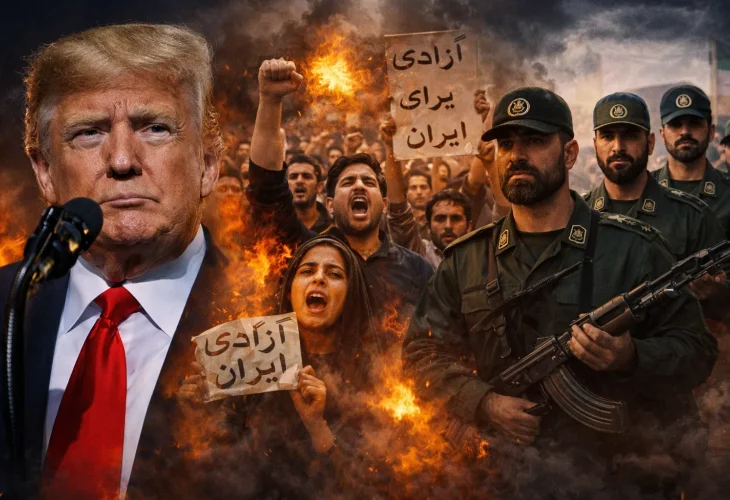
US President Donald Trump on Sunday called on the Iranian public to rise up against their government following the killing of Supreme Leader Ayatollah Ali Khamenei, even as US intelligence officials expressed skepticism that the Islamic Republic is likely to fall in the near term.
In a video posted to Truth Social, Trump declared, “I call upon all Iranian patriots who yearn for freedom… take back your country,” urging them to “be brave, be bold, be heroic.” He added that “combat operations continue at this time in full force, and they will continue until all of our objectives are achieved.”
Trump framed the joint US-Israeli campaign, known in Washington as Operation Epic Fury, as a sweeping strike against Iran’s top leadership. “The entire military command is gone,” he said, adding in other interviews that “most of those people are gone,” and placing the number of senior officials killed at 48. He said the operation could last “four weeks, or less,” noting that Iran is “a big country” that will take time to fully neutralize.
At the same time, Trump left the door open to diplomacy. “They want to talk, and I have agreed to talk,” he said of Iran’s leaders. A senior White House official later clarified that while talks with “new potential leadership” may happen “eventually,” the military campaign is continuing without pause.
Behind the scenes, US intelligence officials are far less confident that Khamenei’s death will lead to the regime’s collapse. According to Reuters, several officials said it is “far from likely or even probable in the near term” that Iran’s weakened opposition can bring down the Islamic Republic, which has ruled the country since 1979.
Central Intelligence Agency assessments presented to the White House before the strike reportedly concluded that if Khamenei were killed, he would likely be replaced by “hard-line figures” from the Islamic Revolutionary Guard Corps or similarly hard-line clerics. Officials also pointed out that during the January anti-government protests, no members of the Islamic Revolutionary Guard Corps were reported to have defected. Several sources said such defections would likely be necessary for any uprising to successfully bring down the regime.
US officials have additionally debated whether Khamenei’s death would significantly alter Tehran’s posture in nuclear negotiations or deter it from rebuilding missile and nuclear capabilities. According to Reuters, there has been significant debate across agencies but no consensus that the leadership decapitation would produce a fundamental shift in Iran’s strategic direction.
Inside Iran, the government moved quickly to signal continuity. President Masoud Pezeshkian announced that a temporary leadership council composed of himself, the head of the judiciary, and a member of the Guardian Council had assumed the Supreme Leader’s duties. Security chief Ali Larijani warned “secessionist groups” against taking action and accused the US and Israel of seeking to disintegrate the country.
Jonathan Panikoff, a former senior US intelligence official now with the Atlantic Council, said the regime’s survival will likely depend on whether rank-and-file security forces remain loyal. “Once US and Israeli strikes stop, if the Iranian people come out, their success in promoting the end of the regime will depend on the rank and file standing aside or aligning with them,” he said. “Otherwise, the remnants of the regime, those with the weapons, are likely to use them to keep power.”
For now, Trump’s public messaging continues to encourage uprising while military operations proceed and intelligence officials caution against assuming imminent collapse. Whether the Islamic Republic fractures from within or consolidates under new hard-line leadership remains uncertain as the campaign enters its second day.
Questions & Answers
+How powerful is the Islamic Revolutionary Guard Corps (IRGC)?
+If Iran’s regime collapses, who could take power?
+Why does Trump support regime change in Iran?

