

World News
Iran War Exposes Growing Fracture Inside America’s Political Right
As joint U.S.–Israel operations enter their third day, prominent MAGA figures break with Trump while lawmakers press for a war powers vote
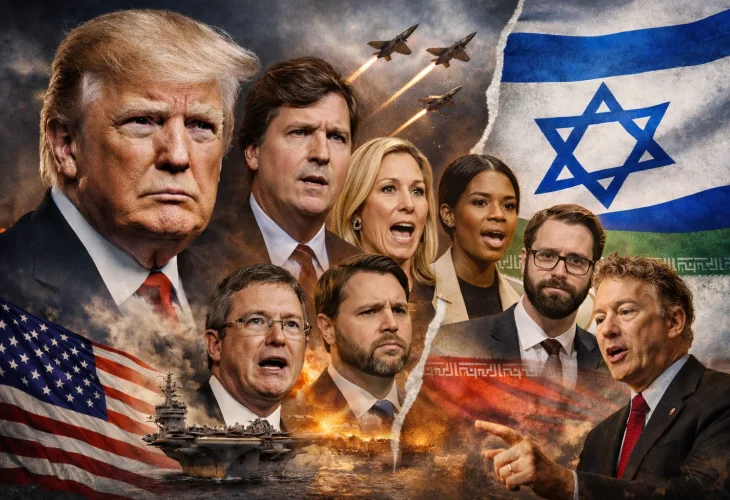
As the war between the United States and Israel and Iran moves into its third day, political tensions are rising in Washington, most visibly within the conservative movement that helped define President Donald Trump’s “America First” agenda.
While Democratic opposition was largely expected, the sharper surprise has come from influential voices on the right, where several prominent MAGA figures have openly criticized the operation. A Reuters/Ipsos poll conducted after the opening phase of the campaign found that 27% of Americans support the strikes, 43% oppose them, and 29% remain unsure, also reflecting uncertain public backing as the conflict continues.
Among the most prominent conservative critics is Tucker Carlson, a longtime Trump ally, who called the attack on Iran “absolutely disgusting and evil.” He warned that “This is going to shuffle the deck in a profound way,” suggesting the decision could reshape the Republican coalition.
Conservative commentator Candace Owens similarly framed the operation as a betrayal of “America First” principles, arguing that American voters did not support another foreign military entanglement. Matt Walsh of The Daily Wire wrote, “If a single American life is lost in the service of that goal, it will be a travesty,” questioning whether regime change abroad justifies the risk to U.S. troops.
The backlash has moved beyond media personalities. Rep. Thomas Massie of Kentucky declared, “This is not ‘America First,’” and insisted, “The Constitution requires a vote, and your Representative needs to be on record as opposing or supporting this war.” Sen. Rand Paul echoed that view, writing, “The Constitution conferred the power to declare or initiate war to Congress for a reason, to make war less likely…”
Rep. Marjorie Taylor Greene, a vocal Trump supporter, accused the administration of abandoning its anti-interventionist platform. “We said ‘No More Foreign Wars, No More Regime Change!’” she wrote, adding, “Thousands and thousands of Americans from my generation have been killed and injured in never ending pointless foreign wars and we said no more.”
Momentum is building in Congress for a War Powers Resolution that would require a formal vote on continued military action, expanding beyond the initial bipartisan effort led by Massie and Rep. Ro Khanna.
Democratic leaders quickly framed the strikes as unlawful and unnecessary. Rep. Alexandria Ocasio-Cortez said, “This war is unlawful. It is unnecessary. And it will be catastrophic.” Rep. Ilhan Omar accused Trump of “unilaterally dragging this nation into an illegal and unjustified war with Iran without congressional authorization, without a clear objective, and without any imminent threat to the United States.”
New York City Mayor Zohran Mamdani described the joint strikes as “a catastrophic escalation in an illegal war of aggression,” adding, “Bombing cities. Killing civilians. Opening a new theater of war. Americans do not want this.” He also sought to reassure Iranian New Yorkers, telling them, “You will be safe here.”
California Gov. Gavin Newsom struck a more nuanced tone, writing, “The corrupt and repressive Iranian regime must never have nuclear weapons. The leadership of Iran must go.” But he added that this “does not justify the President of the United States engaging in an illegal, dangerous war…”
The administration has rejected claims that the conflict will spiral. Vice President J.D. Vance stated, “There is no chance the United States will be dragged into a prolonged war,” signaling officials view the campaign as limited in scope. President Trump, in a video posted to Truth Social, said that “combat operations … will continue until all of our objectives are achieved. We have very strong objectives,” underscoring that the campaign is likely to persist until strategic goals are met.
Questions & Answers
+Does the U.S. Constitution require Congress to approve war with Iran?
+What is the War Powers Resolution and how does it apply to Iran?
+What does “America First” mean in U.S. foreign policy?

