

World News
Trump Leaves Door Open to U.S. Ground Troops as U.S. Declines Iran War Timeline
Pentagon refuses to set end date as Netanyahu says war aims to create conditions for regime change in Iran
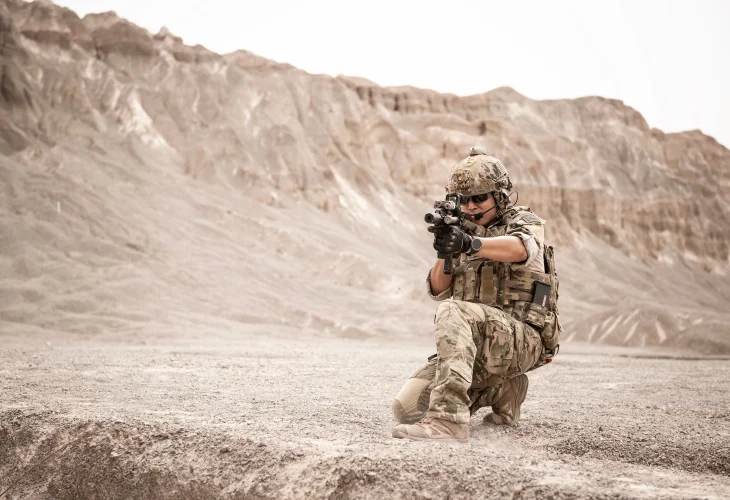 United States soldier (Shutterstock)
U.S. President Donald Trump on Monday refused to rule out sending American ground troops into Iran, as Washington and Jerusalem signaled that their joint military campaign is entering an expanded and potentially prolonged phase. The remarks came as U.S. officials confirmed the deaths of four American soldiers since the operation began.
Taken together with statements from U.S. Defense Secretary Pete Hegseth and Prime Minister Benjamin Netanyahu, the messaging pointed to a war effort without a defined ceiling, militarily or politically, even as leaders avoided committing to a specific end state.
In interviews with CNN, NY Post, and Daily Mail, Trump said he was “not ruling anything out” regarding boots on the ground, adding that the U.S. “probably don’t need them.” He declined to set a firm timeline for Operation Epic Fury, saying earlier he had projected four to five weeks but stressing, “Whatever it takes.”
Trump also signaled further escalation, telling CNN, “We haven’t even started hitting them hard. The big wave hasn’t even happened. The big one is coming soon.” At the White House, he offered condolences to the families of the four U.S. troops killed, saying the mission would continue with resolve.
At the Pentagon, Hegseth pushed back against claims that the United States was entering another protracted Middle East war, declaring, “This is not a so-called regime change war.” Still, he declined to provide a timetable for the operation’s conclusion and refused to rule out the possibility of ground forces, arguing that doing so would signal limits to the enemy.
“Our ambitions are not utopian. They are realistic,” Hegseth said, outlining objectives that include destroying Iranian offensive missiles, missile production capabilities, naval assets, and preventing Iran from obtaining nuclear weapons. “We didn’t start this war. But we will finish it,” he added, while acknowledging that more casualties could occur.
U.S. Central Command confirmed the use of B-2 stealth bombers and heavy munitions against reinforced Iranian ballistic missile facilities. Officials described the strikes as targeting hardened infrastructure linked to Tehran’s missile and nuclear programs.
Standing at the site of an Iranian missile strike in Beit Shemesh that killed nine people, Netanyahu framed the campaign in existential terms. “We embarked on this campaign to free ourselves from the attempt to renew existential threats against us, and we also embarked on it to create the conditions for the brave Iranian people to cast off the yoke of tyranny from upon themselves,” he said.
“The day when they will be able to do this is approaching,” Netanyahu added. He concluded by invoking a biblical commandment: “We remember, and we act.”
Trump also pointed to what he described as an unexpected regional shift, saying Iran’s attacks on neighboring Arab states had drawn them deeper into the conflict. “We told [the Arab states hit], ‘We’ve got this,’ and now they want to fight. And they’re aggressively fighting. They were going to be very little involved and now they insist on being involved,” Trump said, framing the widening fallout as one of the conflict’s biggest surprises.
While U.S. officials insist the campaign is focused on eliminating specific military threats, the refusal to define strict limits on duration, force posture, or political outcome. suggests a deliberate strategy of strategic ambiguity. With leadership decapitation claims, expanded strike packages, and continued casualties, the trajectory of the war remains open-ended.

