

Purim
Life Is A Game Of Hide And Seek
The Secret Of The Double Reading Of The Megillah
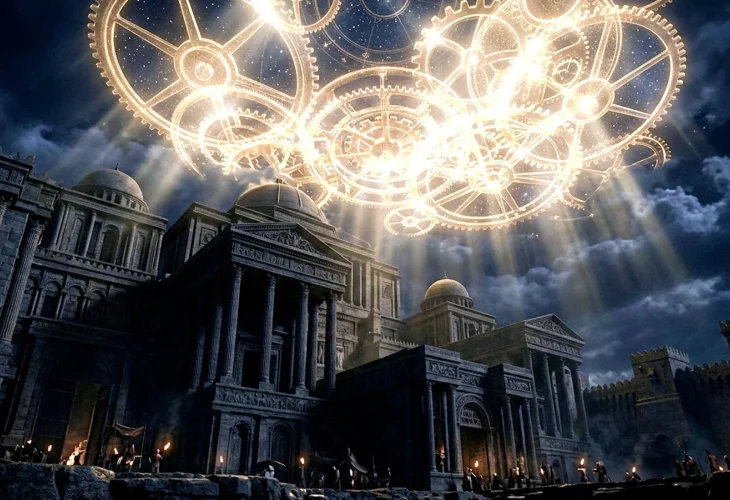
The Secret Miracle of Purim
The Divine Thriller
You ever watch a scary movie — or a mystery — for the first time? You're on the edge of your seat, eart racing. Is she going to make it? Is he going to survive? Now try watching that same movie a second time. It's not the same, is it?
I want to start with a simple question that has stayed with me for a long time: Why do we read the Megillah — the Scroll of Esther — twice in Purim? Ten chapters of seemingly endless details, read once, then read again the very same day. Imagine running into an old friend you haven't seen in years. Over coffee, he tells you everything that happened to him — in great detail. Then the next morning he calls and starts telling you the exact same story again. So why do we do it?
Same Story, Different Life
Think about why we watch movies more than once. We're not actually watching the same movie. The experience is completely different. The fear is gone — but something far more interesting takes its place. Suddenly you start noticing things. A glance exchanged in the background of an early scene.
A line of dialogue that seemed completely throwaway the first time. Hidden clues the director planted right from the very beginning. And you find yourself thinking: how did I miss that?
The answer is both simple and profound. The first time through, you were living the story. You were too close to it, too caught up in the suspense of not knowing, to see what was hiding in plain sight.
Think about it another way. Imagine you're driving to a place you've never been before. Your friend gave you directions, good ones — but it's still hard to really know if you're going the right way. You think you are, but you're not positive. Every few minutes you second-guess a turn. Why? You have the directions. You're following them. Why aren't you sure? Because it's all new. You can't slow down enough to take it all in while you're in the middle of navigating it.
That's life. The pace of life is perfectly designed — but for a perfect observer. In reality, we move through our days distracted, anxious, scattered; trying to handle too many things at once. We get stuck on the wrong details, and miss what matters most.
A Story That Begins Before It Begins
The rabbis teach something that should stop us in our tracks: before we even read the first word of Megillat Esther, God was already moving. Quietly. Invisibly. Setting events in motion in a world that hadn't even appeared on the surface of the story yet. The pieces of the miracle were already in place before anyone knew there was a puzzle.
This is the secret of Purim. It is the ultimate divine thriller — a story engineered from its very first page to be experienced twice, in two completely different ways, each one revealing something the other simply cannot.
The Illusion of Being Alone
On the surface, the story of Purim looks terrifyingly like our own world. A reality ruled by chance, raw power, and moral chaos. A world where the strong win and the weak perish. Where greedy, powerful people do whatever they want — using and abusing others to feed their endless addiction to power and pleasure. A world where darkness seems to be running the show.
We all dream of a beautiful life. Deep friendships. A home filled with warmth. Peaceful days. But for the Jewish people in ancient Shushan, life went from manageable, to difficult, to something close to unbearable — and fast. The darkness and despair were overwhelmingly real. Completely alone. Completely exposed. The silence from heaven felt total and absolute.
When you are living in that kind of darkness, it feels as though God is nowhere.
The Ultimate Test of Faith
And yet — that terrifying silence was the very moment the Jewish people faced their most defining test.
The temptation was right there, and it was completely rational. You can almost hear the whisper: "God doesn't love us anymore. He isn't splitting the sea for us this time. He has turned His back on us — so maybe we should do the same.
The decree of death is only on Jews — so we'll just stop being Jews. Assimilate. Blend in. Live like everyone else. It's better to live together with the nations than to die simply because of who we are." The logic of self-preservation whispered: walk away.
And then something happened that is, in itself, the very heart of the Purim miracle.
That betrayal never took root. Not for a single second. Not in one person, not in one corner of the community. Instead — collectively and individually — men, women, and children rose up. They stood tall in the darkness, with no guarantee, no sign, no sea splitting open before them, and declared:
"We are Jews. We belong to God. If we die, so be it —
but we will never let go of our hope, our faith, or our God."
That choice — made in complete darkness, with no visible reason for hope — is the true miracle of Purim.
The Humility of the Hidden King
We tend to think of miracles as loud. Dramatic. Impossible to miss. Seas splitting. Fire descending from heaven. Plagues moving through a nation like a force of nature. The supernatural announcing itself so powerfully that no one can deny it or look away.
But Purim asks us a deeper and more unsettling question: When is God actually showing greater greatness? When He shatters His own rules of nature to accomplish His goal? Or when, in His Divine humility, He chooses to step back — to work quietly within the limits of the natural world — accomplishing His purpose in a way that is less dramatic, but infinitely more profound?
Think about what it means. If God solved every problem with a lightning bolt, what would we be? Nothing more than actors following a fixed script. Robots executing Divine commands without any real choice of our own. By hiding — by stepping back from the visible stage — God created the conditions for something genuinely extraordinary:
real human greatness.
He gave Esther, Mordechai, and the entire Jewish people the space to become not just recipients of a miracle, but active partners and co-producers in the story of their own salvation. The darkness, the fear, the despair, the bone-deep feeling of being utterly alone — all of it was the catalyst. It was precisely what pushed them to dig deeper than they ever had before. To reach into the very essence of their souls.
To rise to the occasion and become, through their own free choice, partners in their own miraculous rescue — while at the same time, everything was watched over and guided by God.
And here is the deeper secret: when an ordinary person — created with limits — chooses to go beyond those limits, something reverberates above. That act of self-sacrifice, that leap of faith from below, draws down a response from above. When we go beyond our nature, God goes beyond His. And hidden miracles happen.
"We did it — and God did it."
That is a miracle of an entirely different and greater order.
The Shark and the Fisherman
But make no mistake — even when God cannot be seen, He is in absolute control.
Picture a great white shark chasing its prey through open water. It is certain it is the apex predator. Certain it is winning. Certain the meal is already as good as caught. What it cannot see — what it has no idea about — is that there is a line attached to the bait. And God is holding the rod.
God allowed the darkness and the greed of the wicked to run their course — just long enough, just far enough — to draw them all the way into His trap. Haman and Achashveirosh weren't just villains in a story. They fully embraced their evil potential and turned it into action; and by choosing evil, they locked in their own fateful end. Every step they took toward destruction became another thread woven into the fabric of their own undoing.
The Double Reading of Life
This is exactly why the rabbis established one of the most distinctive laws of Purim: we read the Megillah twice.
The first reading is the live experience. We enter the story exactly as its original characters lived it — in real time, with no map, no guarantee, and no visible God. In fact, God's name does not appear even once in the entire scroll. Not once. When we read the word "King," it sounds like it can only mean Achashveirosh — vain, self-serving, stumbling through history while believing he is the one pulling all the strings.
But then comes the second reading.
The second reading is retrospect. It is the moment the dots suddenly connect, the design reveals itself, and the entire story shifts beneath your feet. Now the word "King" carries an entirely different weight. Now we realize that at every single moment — in every room, every conversation, every seemingly random twist of fate — it was the King of Kings who was present. Directing. Protecting. Weaving every thread.
The details that seemed invisible the first time were never actually absent. They were hiding — concealed within the pace of the story, its complexity, its noise and distraction. Just like that movie you watch a second time: suddenly things pop out and you can't believe you missed them. The answer is they were hiding inside the concealment of life itself.
This is why we read the Megillah a second time — to slow down, to look again, to finally see what was always there.
In English, take the phrase "God is nowhere" — move just one letter — and suddenly it reads: "God is now here." And if He is here now... He was here then. He was always here. We just couldn't see Him.
The Tragedy of the Unread Megillah
Achashveirosh witnessed all of it. He sat at the very center of the greatest hidden miracle in history — the salvation of an entire people, accomplished without splitting a sea, without fire from heaven, without a single supernatural sign. It all unfolded quietly, between the thoughts and choices and passing whims of human beings. The perfect, seamless fusion of human free will and Divine Providence. And it happened right inside his own palace.
He should have been shaken to his core. He could have looked back, connected every dot, and emerged as a truly great and righteous king. The lesson of a lifetime — of many lifetimes — was sitting right in front of him.
But Achashveirosh never re-read his Megillah. He refused to slow down, look back, and see what had really happened. He refused to let the second reading change him. He chose to remain exactly who he had always been — selfish, hollow, blind from beginning to end. His end.
And so he and Haman vanished into the dust of history. As the wicked always do. As all those who turn away from the eternality of God and His true world always will.
Reading Your Own Megillah
This is the real invitation of Purim. Not only to celebrate a rescue that happened long ago in a distant kingdom — but to learn a way of seeing. And then to bring that way of seeing into the Megillah of your own life.
We must live our story. And then we must look back and re-live it — gathering up the dark moments, the fearful silences, the times when God seemed absent and the world seemed cold, random and cruel — and seeing them, finally, for what they actually were: the hidden architecture of a plan far greater than anything we could have grasped while we were in the middle of living through it.
That fusion — of the terrifying first reading with the illuminated second reading — is what transforms darkness into the greatest light. The very places where we felt most abandoned become the proof of how close God always was. The moments that seemed most random reveal themselves as the most carefully, lovingly arranged.
The wicked fade. They always fade. But those who hold onto truth, faith, and goodness — who are willing to stand in the dark and simply refuse to let go — they endure and make it to the ending.
This secret partnership between God and mankind is not just the story of Purim. It is the eternal story of creation itself. It is the long, unfolding march toward the Messianic era — toward the world described by the prophet Zephaniah, when all nations will be united in peace, serving God together as one, finally recognizing what was always true:
Not only Will God become King in the Messianic Era, He was King all along.
Chag Purim Sameach ?

