

Magazine
Bridging Divides: How Two Women Are Bringing Jewish Unity to the Stage
Blending creativity, Torah depth, and a passion for unity, two women from different Jewish paths are transforming the stage into a space of connection and understanding.
- Michal Arieli
- | Updated
 (Photo: Talia Engelman)
What happens when five very different women who have never met before find themselves stuck together in an apartment in Uman during Rosh Hashanah?
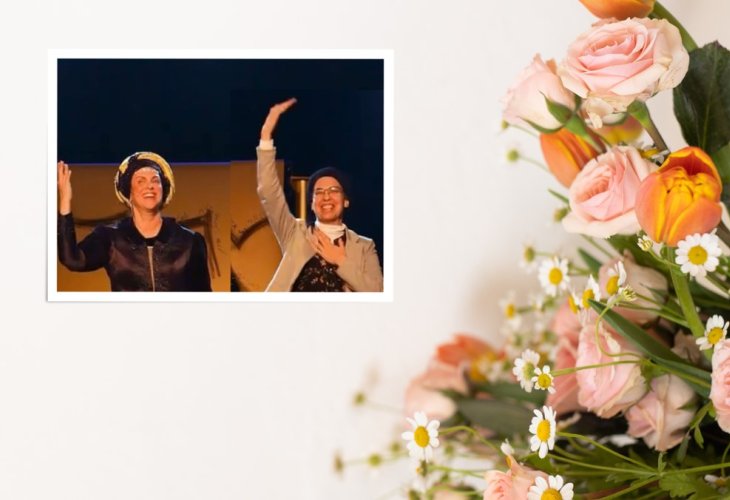
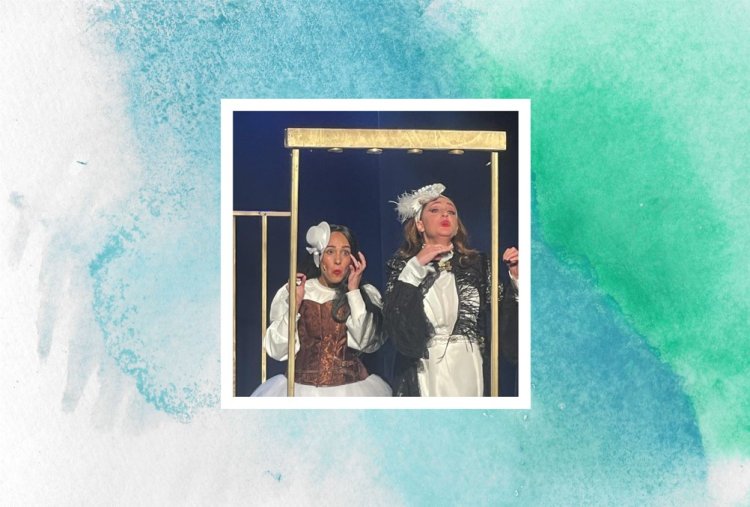
We will not reveal the entire plot of the play Floor 8 and Above, brought to life by theater producers Tamar Avonon and Sharon Aharoni. But behind the performance and the two women who created it lies a powerful and inspiring story about faith, creativity, and Jewish unity.
 (Photo: Talia Engelman)
From Film and Music to Women’s Torah Theater
Tamar Avonon comes from the film industry. She previously worked as an editor and directed commercials for the Israeli government advertising agency. At a certain point, she experienced what she describes as a return to her roots and became connected to the Breslov Hasidic movement. Since then, she has chosen to approach cinema and storytelling through a religious lens.
Sharon Aharoni was born and raised in Miami to Israeli parents. Alongside her career in music, she earned a degree in business management. When she entered the performing arts world, she brought with her not only artistic vision but also strong organizational and business skills.
Together, they founded Theater Eshta, a women’s theater company dedicated to producing high quality performances for female audiences.
“What is most interesting,” Tamar explains, “is that Sharon is Chabad and I am Breslov. Some might see that as contradictory. At times it can look that way, especially when we are shaping scripts or discussing messages and themes.”
“But only from a good place,” Sharon adds. “I do not remember real arguments or objections. Each of us brings her own perspective, and together it deepens and enriches the performance.”
The Goal: Creating Jewish Unity
Their partnership began in an unexpected way.
“A few years ago, I started working in the women’s theater department with Ofer Halevi,” Tamar shares. “That is where I met Sharon, who was in charge of production and essentially managed the department.”
“From the very first moment, we realized we had so much in common,” Sharon says. “What started as a professional connection quickly became a true friendship. Later, we both left that theater and founded Theater Eshta. For us, this is much more than entertainment. It is the fulfillment of a shared dream.”
From the outset, their mission was clear: to create connection between Jewish women from all backgrounds.
“Our theater was always meant to build connection through acting and storytelling,” Tamar explains. “The content itself focuses on unity. Our audience is incredibly diverse. Women from Haredi communities, including Mea Shearim, sit alongside women from secular neighborhoods in Tel Aviv. We also have many baalot teshuva who longed for high quality, well produced theater within a religious framework. And beyond all of that, there is also a woman’s connection to herself.”
Sharon smiles as she recalls some surprising audience moments. “Sometimes women experience culture shock. Some are amazed that professional level theater exists within the religious community. Others have never attended a theater performance in their lives. We once had a woman stand up during the show and ask to pause everything because her aunt was running late. Another time, someone came to the control area and asked if she could take my chair because she did not have one. It can be very funny and very touching at the same time.”
Reaching Every Woman: Layers of Meaning
How do you create a performance that speaks to such a wide range of women?
“When we write a play,” Tamar explains, “we build it with several layers, similar to pshat, remez, drash, and sod. Women who are well versed in Torah, halacha, and midrash will notice the depth. Those who are less familiar still enjoy the outer story, which carries an uplifting and meaningful message. That is how we connect to everyone.”
In Floor 8 and Above, the story centers on five women stuck in an apartment in Uman during Rosh Hashanah. Even audience members unfamiliar with Breslov or the concept of traveling to Uman can laugh and be moved by the storyline itself. But those who understand the deeper Hasidic background pick up on subtle details.
“There are hints woven into the set and the script,” Tamar says. “A bed, a table, a chair, a candle. These elements echo themes found in the stories of Rabbi Nachman of Breslov. Sometimes women only recognize these clues afterward, which makes them want to return and watch the play again.”
Perhaps this reflects the well known teaching that theaters are destined to become houses of study.
Stories of Connection in the Audience
The actresses themselves also reflect diversity.
“We have twelve actresses, each from a different background,” Sharon explains. “We do this intentionally. It is part of our message that we all come from different places, yet we can create something beautiful together.”
Tamar recalls a memorable experience. A group of secular cousins were persuaded by a relative to attend a performance, even though they were strongly opposed.
“When they arrived, they were upset,” Tamar says. “They joked that they had been dragged to some religious event. But their relative asked them to stay for just five minutes. After those five minutes, they put away their phones and did not move until the end. Later they told us, ‘You changed our minds. This is not what we expected.’”
Sharon shares another powerful story. A baalat teshuva mother attended a show with her two secular daughters, with whom she had been estranged for years due to cultural differences. The daughters did not realize what type of performance they were coming to until they arrived.
“In the end, they stayed,” Sharon says. “Afterward, the mother told us that their relationship had grown stronger. Through the play, they discovered shared ground and a new way to communicate. That is exactly our goal. To create unity in every possible sense.”
Choosing Unity in a Divided World
When asked about the painful divisions within the Jewish people today, both women pause.
“Through our connection to Hasidic teachings and stories, we understand what it means to swim against the current,” Tamar says. “Because we come from a world of creation, we also know how to separate media portrayals from reality. The division is real and painful. But that is precisely why we feel responsible to act. If each of us does not dream of unity and actively work toward it, it will not happen.”
Sharon adds, “We begin each day with shared Torah study. Most importantly, we truly love every woman in the Jewish nation. I believe that with love, goodwill, and less judgment, we can accomplish tremendous things.”
Looking Ahead
The future holds more creativity and connection.
“We are planning another meaningful play focused on unity and connection,” Tamar shares. “We also want to build a community around our performances so women can feel part of something ongoing and supportive.”
“We have chosen this path intentionally,” Sharon concludes. “Every day we see how powerful love of Israel can be. We understand the responsibility. Hundreds of women sit in our audience, and every word matters. We pray that we continue to connect hearts and bring only goodness through what we create.”
Through faith-based women’s theater, Hasidic inspiration, and a deep belief in Jewish unity, Tamar Avonon and Sharon Aharoni are proving that the stage can be more than entertainment. It can be a bridge between worlds.

