

World News
U.S. Senate Fails to Stop Trump’s War Against Iran
Lawmakers voted on whether to force Trump to seek congressional approval before continuing U.S.–Israel strikes on Iran
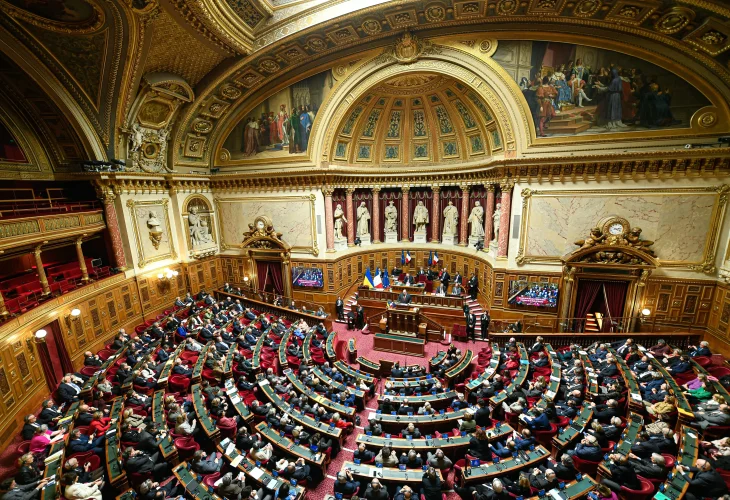 US Senate (Shutterstock)
The U.S. Senate voted Wednesday to block a Democratic-backed resolution that would have forced President Donald Trump to halt the war against Iran without congressional approval, preserving the administration’s authority to continue military operations alongside Israel.
The 47–53 vote marked Congress’s first formal attempt to limit the conflict following U.S.–Israeli strikes in Tehran days earlier that killed Iranian Supreme Leader Ayatollah Ali Khamenei and dozens of senior officials. The outcome signaled strong Republican support for continuing the campaign despite growing debate in Washington over presidential war powers.
The vote was triggered by the War Powers Resolution of 1973, a law designed to prevent presidents from launching prolonged military conflicts without congressional approval. Under the law, the president must notify Congress within 48 hours of military action and cannot continue hostilities for more than 60 days without authorization. Lawmakers can also force a vote to require the withdrawal of U.S. forces.
The resolution, introduced by Sen. Tim Kaine of Virginia and backed by several Democratic leaders, would have required the Trump administration to withdraw U.S. forces from the war with Iran unless Congress voted to approve it. The proposal relied on the 1973 War Powers Act, a law that allows lawmakers to force votes on military conflicts that have not been authorized by Congress.
“We shouldn't be at war without a debate and vote,” Kaine told reporters ahead of the vote.
The measure included exceptions allowing the United States to defend its personnel or facilities and continue assisting Israel in defensive operations. But Democrats argued that the president had bypassed Congress by launching the air campaign without prior authorization.
“I do think it’s really important to put every member of Congress on the record about this,” Kaine said before the vote. “If you don’t have the guts to vote ‘Yes’ or ‘No’ on a war vote, how dare you send our sons and daughters into war where they risk their lives?”
The vote largely followed party lines. Republican Sen. Rand Paul of Kentucky broke with most of his party to support the resolution, while Democratic Sen. John Fetterman of Pennsylvania was the only Democrat to oppose it.
Republican leaders defended Trump’s actions and warned that limiting the president’s authority during an ongoing military campaign would weaken the United States and its allies.
“Barack Obama dropped 26,000 bombs in at least 7 countries in 2016 without a word from Congress,” Sen. Markwayne Mullin of Oklahoma wrote ahead of the vote. “I won’t hamstring President Trump. Unlike many before him, [Trump] is the ‘peace through strength’ President.”
Several Republican lawmakers argued that passing the resolution would undermine the ongoing war effort against Iran.
“It would empower our enemies. It would kneecap our own forces,” Senate Republican Whip John Barrasso said during debate.
Sen. Lindsey Graham also urged lawmakers to allow the campaign to continue. “We should let him finish the job,” Graham said.
Attention now shifts to the House of Representatives, where lawmakers are expected to vote Thursday on a similar war powers measure introduced by Rep. Ro Khanna, a Democrat from California, and Rep. Thomas Massie, a Republican from Kentucky.
House Speaker Mike Johnson warned that approving such a resolution could weaken the United States during an active conflict. “I think passage of a war powers resolution right now would be a terrible, dangerous idea,” Johnson said. “It would empower our enemies. It would kneecap our own forces.”
Even if Congress ultimately approved a war powers resolution, Trump would have the authority to veto the measure. Overriding a presidential veto would require two-thirds majorities in both chambers, a threshold Congress has never reached for a war powers resolution.
As a result, Wednesday’s vote is widely viewed in Washington as a political test of congressional support for the war rather than a realistic attempt to halt the U.S. campaign against Iran.
Questions & Answers
+What is the War Powers Act and how does it work?
+Can the U.S. president launch military strikes without Congress?

