

Magazine
The Visit That Changed a Secular Journalist’s View of Rabbi Chaim Kanievsky
He came with skepticism and many assumptions. But one visit to Rabbi Chaim Kanievsky’s modest home in Bnei Brak left a secular journalist deeply surprised.
- Naama Green
- | Updated
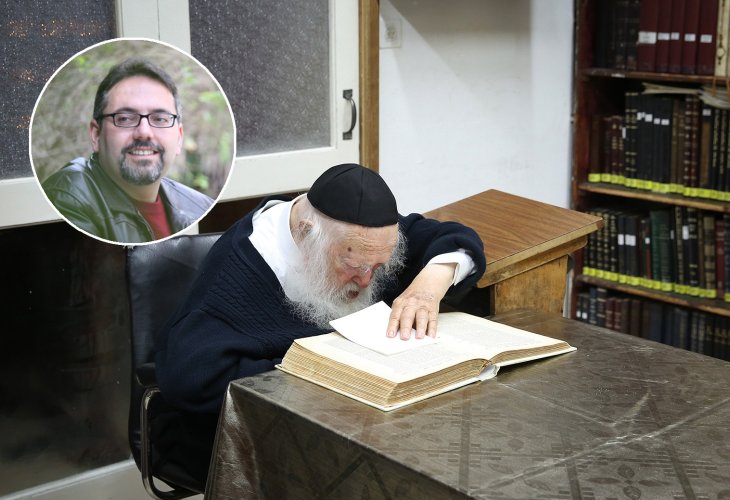 In the circle: Yuval Elbashan (Photo: Yossi Zamir / Flash 90)
Yuval Elbashan, a current affairs host on Israel’s Reshet Bet radio station, once shared his personal encounter with Maran, the Sar HaTorah, Rabbi Chaim Kanievsky, of blessed memory. Elbashan described the visit from the perspective of someone who grew up completely secular.
“I arrived at the home of Rabbi Chaim Kanievsky in Bnei Brak with many preconceived ideas,” Elbashan recalls. “As a fourth generation secular Jew, someone whose values center on human freedom and liberal ideals, a figure like him seemed to belong more to the world of cults than to the world of faith.”
He admits that he expected something very different from what he eventually saw.
“I assumed I was about to enter a luxurious home where a powerful rabbi and his relatives took advantage of devoted followers in order to gain influence and prestige.”
A Humble Home
The first surprise came even before he reached the door.
“When we arrived on the street, the yeshiva student who accompanied me pointed to the rabbi’s home,” Elbashan recalls. “It was the most modest building on the entire street.”
The building had only two floors and showed no signs of luxury or grandeur. Near the external staircase leading to the second floor apartment stood a long line of people waiting to enter.
“They were people whose faces carried the scars of life,” he says. “The kind of broken and struggling individuals you find on the margins of every society.”
The line stretched up the stairs to the door. Volunteers were organizing the line and helping people enter.
“They looked nothing like what I imagined when I thought about a ‘rabbi’s court,’” Elbashan writes. “They were simple people volunteering their time to keep things running smoothly.”
Still skeptical, he asked one of them how much it cost to meet the rabbi.
“Heaven forbid,” the volunteer replied. “The rabbi does not take money.”
Elbashan was not fully convinced. He pressed further and was directed to a small room nearby where a community charity fund operated to help people in need.
Later, he checked the matter more carefully and discovered that the donations collected there truly went to support the poor.
A Life of Simplicity
But the biggest surprise awaited him inside the apartment.
“When we entered the rabbi’s home, I was stunned,” Elbashan says. “He lived with a level of modesty I had never seen before, even among the poorest clients I had encountered during my years as a community lawyer.”
The apartment was extremely small and simply furnished. The furniture dated back decades, and the rooms were filled mainly with books.
At the center of the home was the rabbi’s study, located next to a simple bedroom containing two basic beds.
There, at a small table, Rabbi Kanievsky spent his days immersed in Torah study from morning until night.
Between learning sessions, even late at night, he would receive people who came seeking guidance or comfort.
“He welcomed anyone who came,” Elbashan recalls. “Broken people, people crushed by life, people searching for hope.”
And he did this without asking for any payment.
A Model of True Leadership
Two things in particular left a deep impression on Elbashan.
First was the fact that a person who devoted his entire life to Torah study and lived with so little could serve as a role model for hundreds of thousands of people.
“In a world where celebrity culture celebrates fame and power,” he reflects, “seeing someone whose influence comes from humility and dedication was extraordinary.”
The second thing that struck him was the compassion Rabbi Kanievsky showed toward every visitor.
“He used his enormous spiritual stature to lift people up,” Elbashan writes.
Each time Elbashan visited the rabbi’s home, he noticed the same thing. People would enter weighed down by pain and worry, but they would leave strengthened.
“They left his room with renewed faith,” he says. “The rabbi gave them hope that they could overcome their struggles.”
For Elbashan, the experience raised an important thought.
“If only we could build something similar in the secular world,” he says, “a place where broken people could find encouragement and strength without needing to pay large sums for professional treatment.”
A Legacy of Kindness
Elbashan concludes that many things will be remembered about Rabbi Chaim Kanievsky. His greatness in Torah learning, his humility, and the leadership role he played within the Haredi world will all be widely discussed.
But he wanted to emphasize something else.
“Every single day,” he writes, “the rabbi gave people a moment of kindness and a sense of hope.”
For the countless individuals who climbed those stairs in Bnei Brak searching for guidance, that kindness made all the difference.
May his memory be a blessing.

