

Wonders of Creation
Ancient Jewish Sources and the Idea of the Lightning Rod
An intriguing rabbinic text suggests knowledge of lightning protection long before Franklin’s famous discovery
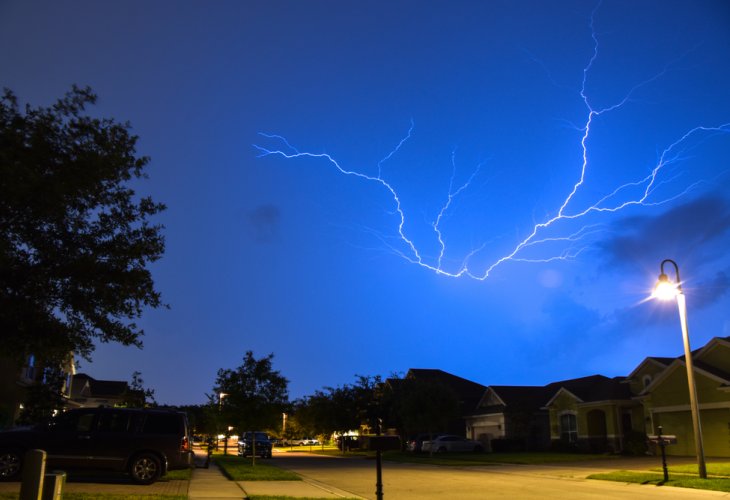 Image: shutterstock
Benjamin Franklin was a scientist, inventor, and one of the most prominent leaders in the American War of Independence. His signature appears on some of the most important documents in the history of the United States, including the Declaration of Independence and the U.S. Constitution. In recognition of his contributions, his portrait appears on one of the American dollar bills.
Among Franklin’s most important inventions is the lightning rod, which is a metal rod placed on a building to protect it from lightning strikes by directing the electrical discharge safely into the ground. Franklin developed this invention after discovering that lightning is essentially a form of electrical discharge. He famously demonstrated this insight through a daring and dangerous experiment in which he flew a kite into storm clouds during a thunderstorm.
Franklin lived a long and honored life and passed away in 1790. According to most encyclopedias and historical accounts, the lightning rod was first discovered or invented by Franklin roughly two centuries ago.
Was the Lightning Rod Truly Unknown Before Franklin?
Was the lightning rod truly unknown before Benjamin Franklin’s discovery, or might earlier scholars have been aware of the same principle?
In the Tosefta (Tractate Shabbat, chapter 7), written by the Sages of Israel nearly two thousand years ago, a discussion appears that distinguishes between superstitious practices and actions based on natural causes.
The Sages explain that certain practices were forbidden because they belonged to the magical customs of the ancient Amorite culture and had no natural explanation. For example, placing charms on the handles of cooking pots to prevent food from boiling over was prohibited because it relied on superstition rather than natural cause.
Natural Remedies Versus Superstitions
At the same time, the Tosefta clarifies that actions which have a natural explanation are permitted.
For example, it states that placing mulberry wood chips into a pot to accelerate cooking is allowed, because the action operates within the laws of nature and is not based on superstition.
Another example appears in the same passage: placing an iron rod among chicks in order to help them grow stronger is prohibited, because such a practice has no natural basis and therefore falls into the category of superstitious customs.
However, the text adds an important exception. If an iron rod is placed in order to protect the chicks from lightning, the action is permitted, because it has a natural explanation.
An Ancient Reference to Lightning Protection
This passage suggests that the Sages were aware that an iron rod can protect against lightning. Significantly, the Tosefta does not describe this as a mystical charm or supernatural protection, but rather as a phenomenon grounded in the natural order.
This raises a fascinating perspective. The real question may not be whether the Jewish people learned about lightning rods from Benjamin Franklin, or whether the Sages already referred to the concept nearly 1,800 years earlier.
Rather, the deeper question is how we would react to such a statement in the Tosefta if Franklin’s discovery had never become known in modern times.
How Would We React Today?
Suppose we encountered a Talmudic statement claiming that an iron rod can protect against lightning, not as a mystical remedy but as a natural phenomenon.
Would we accept it calmly? Or might we react with skepticism, perhaps even criticism, wondering how a halachic source could make a claim about nature that seems unsupported by modern science?
This question invites us to reflect on our broader attitude toward the teachings of the Sages. There are many statements in rabbinic literature whose reasoning may not be immediately clear to us — such as the example mentioned above regarding the cooking process, or other halachic instructions whose underlying logic is not always obvious.
The challenge, therefore, is not merely historical curiosity, but a deeper examination of how we approach traditional wisdom and whether we remain open to insights that may only later become fully understood.

