

Magazine
The Power of Words: A Whisper That Nearly Destroyed a Wedding
A jealous whisper nearly destroyed a young couple’s future until Rav Shach took extraordinary steps to restore the truth.
- Naama Green
- | Updated
It was Shabbat, and the brilliant Torah scholar Rabbi Ben Tzion Felman, then a young avreich, was staying at his parents’ home in Tel Aviv.
That Shabbat, one of the congregants of the Heichal Meir synagogue had just celebrated his daughter’s engagement to a yeshiva student. As was customary, the groom came to spend the Shabbat after the engagement with his future in laws and share the Shabbat meals with them.
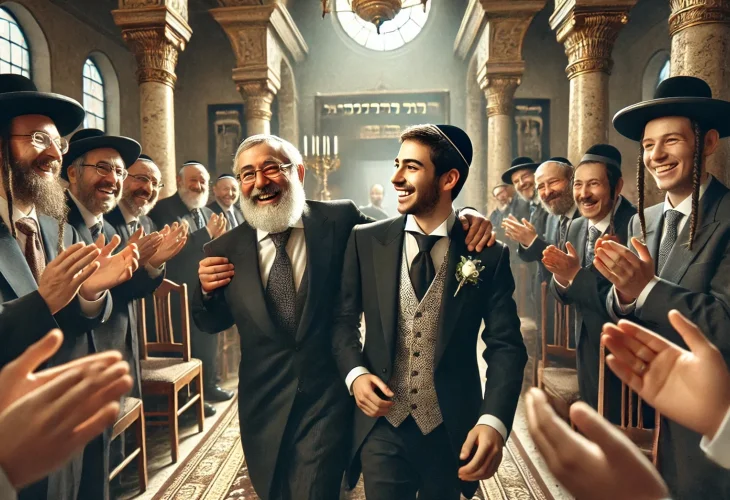
The bride’s father entered the synagogue together with his new son-in-law, glowing with happiness over the “diamond” that had come into his family. The congregation shared in his joy and gathered around to offer warm wishes of mazal tov.
A Poisonous Whisper
Among those congratulating him stood a man whose heart was filled with jealousy. In the middle of the celebration he leaned toward the bride’s father and whispered quietly:
“I think you made a mistake. This young man barely prays. I once checked into him and heard that he wastes most of his day doing nothing. It was foolish to take him as a son-in-law, but what’s done is done.”
The father-in-law was stunned. The words seeped into his heart like venom. By Shabbat afternoon he was already confiding to another congregant, “It seems I’ve fallen into a trap…”
The groom himself soon sensed that something had changed. The warmth he had felt from his future father-in-law had suddenly cooled. He could not understand what had happened, but a quiet fear began to grow inside him. The rest of the Shabbat passed under a cloud of tension and disappointment.
Witnessing a Terrible Moment
Rabbi Ben Tzion Felman had been standing nearby on Friday night when the slanderous whisper was spoken. The moment shook him deeply.
To him, it felt like witnessing someone stab another Jew in the heart with a few carefully chosen words. Several souls had been wounded in an instant.
He could barely bring himself to eat the Friday night meal. His stomach churned. He knew the groom personally and was certain the accusations were completely baseless.
Yet Rabbi Ben Tzion was known for his careful speech. He did not rush to intervene impulsively.
“Better a few words, sharp and precise like arrows, than many careless ones,” he would often say. “Sometimes words can cause more harm than help.”
Throughout the entire Shabbat he remained deeply troubled. Several times he felt tears welling in his eyes. It felt as though he had witnessed a terrible crime.
“What should I do?” he wondered again and again.
Who would believe the testimony of a young avreich over the confident claim of an older and respected man?
A Sleepless Night
After Shabbat, Rabbi Ben Tzion returned to his home in Bnei Brak, but he could not sleep. The incident kept replaying in his mind.
Early Sunday morning he set out as usual for the Ponevezh kollel. Along the way he met Rabbi David Frankel, a distinguished student of the Chazon Ish and the Brisker Rav.
Rabbi Frankel immediately noticed the distress on his friend’s face.
“What happened? Why do you look so troubled?” he asked.
Rabbi Ben Tzion told him the entire story.
Without hesitation, Rabbi Frankel advised him, “Go immediately to Rav Shach and ask what should be done.”
Rav Shach’s Immediate Decision
Instead of continuing to the kollel, Rabbi Ben Tzion turned toward Rav Shach’s home and recounted the painful episode in detail.
Rav Shach listened carefully and then asked, “And how do you think I can help in this matter?”
Rabbi Ben Tzion suggested, “If we could find their address in Tel Aviv, perhaps the rosh yeshiva could come with me to visit them and speak to them.”
Rav Shach considered the idea but raised a concern.
“I do not know this young man personally. He is not one of my students. How can I praise him if I cannot testify to what I know to be true?”
Rabbi Ben Tzion replied, “I know him very well. I can testify with certainty that the accusations are completely false. He is an outstanding young man, filled with Torah and yirat Shamayim.”
Rav Shach immediately stood up.
“If that is the case,” he said, “I will put on my hat and jacket, and we will go now to Tel Aviv.”
The Journey to Restore a Life
Rabbi Ben Tzion suggested ordering a taxi, but Rav Shach refused.
“We will take the bus,” he said.
They boarded the bus together. When Rabbi Ben Tzion tried to pay the fare, Rav Shach stopped him.
“I will pay for both of us,” he insisted.
During the journey Rav Shach continued asking questions about the young man’s character, listening carefully to every detail.
When they arrived in Tel Aviv, the two men walked toward the address of the bride’s parents. Rabbi Ben Tzion remained outside while Rav Shach went upstairs.
A Few Words That Changed Everything
Rav Shach knocked on the door. The parents opened it and were astonished to see the head of the Ponevezh yeshiva standing before them.
Without lengthy introductions he said warmly:
“I happened to be in the area and heard that your daughter became engaged to this young man. I told myself I could not pass by without wishing you mazal tov and telling you about the great fortune that has come to your family.
“This young man is like family to me. He is an exceptional individual, filled with Torah and fear of Heaven. He studies diligently and has a very promising future. Not everyone merits such a diamond.”
Rav Shach continued speaking until he saw the parents’ faces soften and their joy begin to return. Only then did he take his leave with blessings and warm wishes.
Later, when Rav Shach received the wedding invitation, he showed it to Rabbi Ben Tzion with quiet satisfaction.
Rabbi Ben Tzion would end the story with a humble reflection:
“Today that young man is already a grandfather. He has no idea what Rav Shach once did for him.”
In his modesty, Rabbi Ben Tzion never mentioned that he too had played a crucial role in that great act of kindness.
Rabbi Shalom Ben Tzion Felman (5694–5775) later became a renowned posek of halacha, the rabbi of the Nachalat Moshe community in Bnei Brak, and the author of the halachic series Shalmei Todah.
From the book Without a Name.

