

Magazine
A Knife in Her Back: A Mother’s Story of Faith and Survival
Stabbed by a terrorist in front of her children, Moria Cohen chose resilience and faith. She recounts the attack, the aftermath, and the fight that followed.
- Moriah Luz
- | Updated
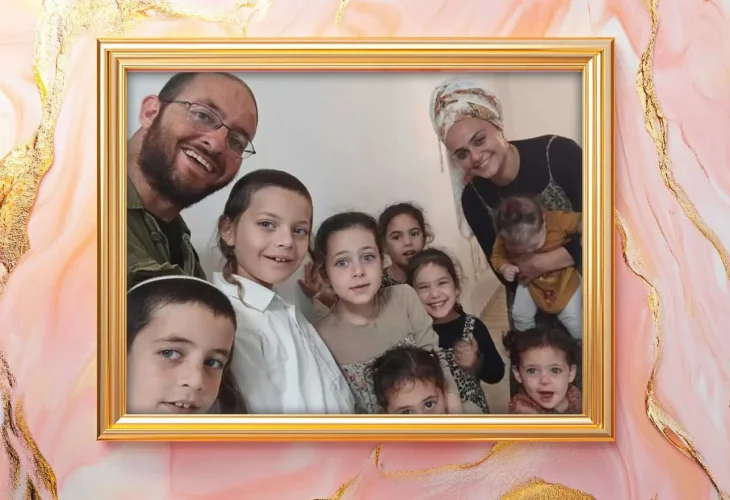 Moria Cohen and her family
On a cool Wednesday morning in the month of Tevet, four years ago, Moria Cohen was getting her five children ready for school, just as she did every day. By a few minutes past seven they were all dressed and prepared to leave.
Before stepping outside, she put on a sweater. Then, after a moment’s hesitation, she added a coat as well. The weather hardly required both layers, but that small decision would later prove crucial.
When they stepped out of the house, Moria noticed a teenage girl, about fourteen years old, walking nearby. She assumed the girl was a student heading to school and paid little attention.
A moment later, everything changed.
Suddenly she felt a powerful blow to her back. Before she could even understand what had happened, her five year old son looked at her and asked innocently:
“Mom, why is there a knife in your back?”
“Home Will Always Be Home”
Moria and her husband, Dvir, are parents of eight children and both work in education. Until recently they lived in the Shimon HaTzaddik neighborhood of Jerusalem, where they spent nearly a decade before moving this year to a community in the Jordan Valley.
“We both studied in the Old City, in yeshiva and midrasha,” Moria explains when describing how they first came to live there. “We were looking for somewhere quiet but still very close to the Old City.”
They discovered the Shimon HaTzaddik neighborhood and quickly felt connected to it.
“It’s a unique place,” she says. “It’s calmer and older than many parts of Jerusalem, with a mix of different communities and a strong sense of neighborhood life.”
For several years, life there felt peaceful.
But about five years ago, shortly before Operation Guardian of the Walls, the atmosphere began to change.
“During that Ramadan there were attempted break ins, stone throwing, and constant tension on the street,” Moria recalls. “For about a month and a half it was very challenging. Afterward things calmed somewhat, but relations between neighbors deteriorated.”
Even after the worst incidents subsided, provocations continued, including insults and spitting.
Despite the tension, the family believed the situation would pass.
“Home is home,” Moria says. “It’s the place where you feel safest. We had wonderful years there, and we believed this was just a difficult phase.”
She emphasizes that they tried to maintain a normal routine for their children.
“Our message at home was always: life continues.”
The Morning of the Attack
The stabbing attack occurred about eight months after that tense period.
Did she recognize the attacker?
“The face seemed familiar,” Moria says. “But I couldn’t say exactly who she was or where she lived.”
Recalling the moment itself, she says:
“We reached the intersection and passed by her. Suddenly I felt a strong blow in my back. My first thought was: ‘This can’t be happening to me.’”
She screamed, and the attacker ran away.
In those first moments, Moria’s mind was focused entirely on her children.
“I knew they needed immediate help,” she says. “My husband was serving in the reserves, so the fastest person I could call was my mother-in-law, who lives nearby.”
She called her and said calmly, “I’ve been stabbed in the back. Please come take the children.”
Later she laughed about the moment.
“Only afterward did I realize how shocking that must have sounded. But in those seconds I was very practical.”
She continued walking with the children toward a busier area where people quickly called for medical help.
During the ambulance ride she repeatedly asked about her children.
“Only after they told me the kids were with family did I allow myself to relax.”
A Miracle of Mercy
Because the knife appeared large and deeply embedded in her back, doctors initially feared severe internal damage.
“The possibilities they mentioned were terrifying,” she recalls. “They spoke about lung damage or even spinal injury that could lead to paralysis.”
During the ambulance ride, she prayed constantly.
“I kept saying to Hashem: I have children, and I want to raise them. Please give me another chance to live, without paralysis and without lasting injury.”
Despite the frightening appearance of the wound, doctors discovered something remarkable. The knife had missed all vital organs.
“It was an incredible miracle,” Moria says. “I was wearing several layers of clothing that morning. I rarely even wear a coat, but that day I did.”
The thick layers helped slow the blade and prevent catastrophic damage.
“It was tremendous kindness and mercy from Hashem,” she says.
Although the injury was painful and required deep stitching, the final medical evaluation classified it as relatively mild.
Moria insisted on being discharged the same day so she could return home to her children.
Walking the Same Path Again
Returning to normal life was not easy.
“My husband insisted that the next morning we walk the children to kindergarten along the same route,” she recalls.
She looked at him in disbelief.
“But he said: ‘We go together.’”
The walk was frightening. At one point she felt dizzy and had to sit down.
“My husband told me, ‘Take a breath, and we keep going.’”
Gradually she forced herself to walk that path again and again.
“It was a daily battle with fear,” she admits. “But the choice was clear. The desire to live is stronger.”
Her role as a mother gave her strength.
“I knew the way I looked at reality would influence my children. If I see the world as good, they will see it that way too.”
Changing Perspective
The attack also affected the children. Some needed therapy, and one of her sons began to stutter.
Psychologists advised her to explain to him that it might remain.
“I wondered how I could possibly say that to my child,” she says.
When she approached him gently and asked if he understood what stuttering meant, he answered with innocent confidence:
“Mom, Moses stuttered.”
That simple sentence changed her perspective.
“I realized he was telling me: I’m okay.”
From that moment, her prayers changed. Instead of asking that the stutter disappear, she prayed that he would live with strength and confidence.
“He taught me how to look at reality differently,” she says.
A Second Shock
Two years later the family faced another painful moment.
The attacker, originally sentenced to thirteen years in prison, was released early as part of a hostage deal with Gaza and returned to live near the Cohen family.
“It was surreal,” Moria says quietly.
For months she and her children lived near the person who had tried to kill her.
Eventually, after long legal struggles and emotional strain, the family decided to leave the neighborhood.
A New Mission
Leaving Jerusalem was not easy.
But the Cohens felt it was time to begin a new chapter. They moved to a community in the Jordan Valley and focused on rebuilding their lives.
“Our goal is to live healthy lives and raise our children with clarity,” Moria says.
She pauses before adding one final thought.
“Even though we live somewhere else now, our strength still comes from Jerusalem. Our soul remains connected to it.”

