

Magazine
Building Bridges: Torah Classes for Women of All Backgrounds
One grew up Chabad. The other calls herself secular in every way. Together they created a Torah class that’s bringing women together.
- Michal Arieli
- | Updated
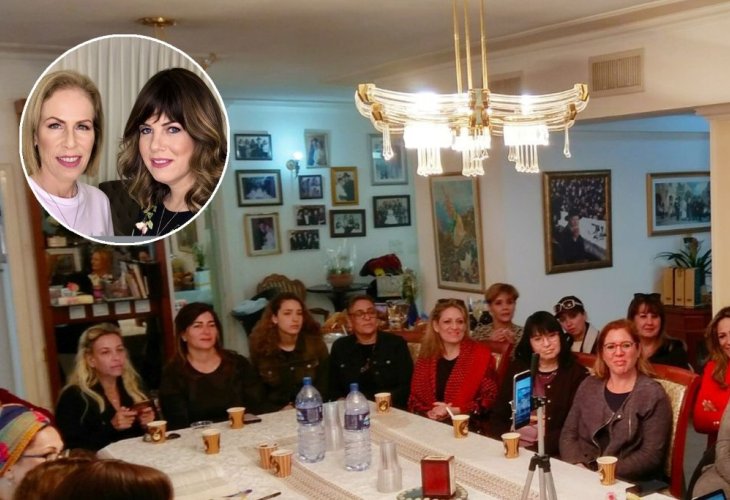
Entering Miri Shneurson’s home in Kfar Chabad on a Friday morning for the weekly Torah portion class is an experience that leaves many visitors amazed. The lesson is led jointly by Miri and her friend Shali Artman, and at first glance it is difficult to understand the connection between them.
Miri is a Chabad chassid, a member of the well-known Shneurson family, who grew up in chassidic educational institutions throughout her life. Shali, by contrast, is a retired military officer.
"As a child," Shali recalls, "I grew up in a home without faith. If anyone around me ever mentioned a higher power, I would immediately respond: ‘If there is a God, let Him appear before me, and then I will decide whether to accept Him.’ I essentially wanted to interview Him before letting Him into my life."
To this day, Shali describes herself as completely secular. That is what makes the sight of the two women teaching a Torah class together so striking. The women who attend the class also come from a wide range of backgrounds within Israeli society, making the gathering not only surprising but truly remarkable.
“I Was Afraid She Would Bring Me Back to Religion”
So how did this unusual class begin?
"It actually started twelve years ago, when I met Miri," Shali explains. "I work as a teacher of inner development, a breakthrough coach, and a social entrepreneur. We met during a professional training program. From the very first meeting we became close friends, and that friendship has remained strong ever since.
"Our souls connected very deeply. But from the beginning I had one major fear: that Miri would try to bring me back to religion."
Miri remembers that fear well.
"I recall once driving with Shali to Jerusalem for a meeting," she says. "During the drive I mentioned that I was struggling with an important project related to the laws of family purity. I asked her to help me think about how to present the topic to women who do not observe it."
Shali reacted immediately.
"She slammed on the brakes and began scolding me," Miri recalls with a smile. "She said, ‘Why don’t you just admit that what you really want is to bring all women back to observing family purity?’"
That moment, Miri says, changed something in their relationship.
"I suddenly understood more clearly what Shali was going through. From that point on our conversations became much more honest. Even when we disagreed, the dialogue between us felt more genuine."
Discovering the Jewish Bookshelf
Over time the two women began meeting regularly to study various topics connected to their professional interests.
"One day," Shali recalls, "Miri’s husband saw us studying professional materials in the living room. He looked at us and said, ‘You are sitting in a house with a Jewish bookshelf. Why not open one of those books?’"
Miri admits she felt embarrassed.
"I was worried about how Shali would react," she says.
But Shali surprised her.
"I told Miri that just because I am interested in Jewish texts does not mean I am becoming religious," Shali says. "I simply found the material fascinating."
From that moment on they began exploring Jewish texts together, including Pirkei Avot, Chassidic teachings, and the Tanya.
A Class for Women From Every Background
The weekly Torah portion class they now teach together was launched under the name Wonders, Women Act for Unity and Heartfelt Connection.
"In truth I have been teaching the weekly Torah portion for about seven years," Miri explains. "My first encounter with the parashah as a teaching subject came when I began broadcasting on Kol Chai radio and received a weekly slot on Tuesdays."
At first she wondered what she could possibly discuss on a Tuesday.
"It is not Sunday, when you talk about the start of the week, and it is not Thursday, when everyone is thinking about Shabbat preparations. But then I realized that Tuesday is actually the perfect day to explore the weekly Torah portion."
She began studying the parashah from a personal perspective, focusing on how its messages connect to everyday challenges faced by women such as relationships, parenting, and motherhood. Over time she also began writing columns about the weekly portion.
"I had always dreamed of creating a project that would encourage unity and heartfelt connection between women," she says. "When I started teaching the weekly portion, I realized that this could become the platform for that dream."
The Sukkah Gathering
"Miri invited many women to her sukkah for a gathering," Shali recalls. "Women from different backgrounds came together. Some were religious, some traditional, some secular. The atmosphere was so open and welcoming that we all felt uplifted."
At the end of the evening the women realized something.
"We all felt that something was missing," Shali says. "There was no Torah class where women from different worlds could sit together comfortably. Even women who do not define themselves as religious still wanted to explore Jewish ideas."
"So we decided simply to begin," Miri adds. "The following Friday morning, during the week of Parashat Bereshit, we held our first class."
Two Voices, One Conversation
The lessons are taught jointly by the two women.
"I enjoy focusing on the beauty of the Hebrew language found in the Torah portion," Shali explains. "After each class I send the participants summaries and what I call Shabbat word treats, special phrases and expressions from the text."
Miri approaches the portion from a different angle.
"I usually take an idea from Chassidic teachings and explore how it relates to our lives as women," she says. "Our two perspectives blend together, and the women who attend also contribute their thoughts. Each class becomes a living dialogue."
Differences That Build Connection
Do disagreements ever arise in such a diverse group?
"Of course," Miri admits. "When I see Shali arrive wearing pants or hear her pronounce God differently from how I am used to, it can feel uncomfortable for me. But I never say anything. The whole purpose of the class is to create a pleasant and joyful space."
Shali laughs as she describes her own moments of frustration.
"When I ask Miri something and she replies that she needs to consult a rabbi, it drives me crazy," she says. "And when I tell her how excited I am about a bicycle race that took place on Shabbat and she tells me she spent the entire day distressed about the desecration of Shabbat, I realize just how different we are."
Yet over time the two discovered that their shared values were stronger than their differences.
"We found that many of our disagreements are not really about religion," Shali says. "They are about personality and perspective. Those are things people can work through."
Women and Unity
Miri believes the project reflects a deeper message.
"It is written that because of the righteous women our ancestors were redeemed from Egypt, and because of women we will be redeemed again," she says.
"The Lubavitcher Rebbe taught that our generation is a continuation of the women of Egypt. Redemption will come through women who recognize their strength and their ability to unite."
According to Miri, this ability is especially characteristic of women.
"We have the capacity to bridge different worlds," she says. "We can find common ground and focus on connection rather than differences."
A Shabbat Atmosphere
The class takes place on Friday morning, a time that initially seemed impossible.
"At first all the women said there was no chance they would come," Shali says. "Even for me it was difficult. My husband and I made an agreement twenty two years ago that from Thursday night until Sunday morning our time would be reserved for family."
Eventually she decided to try it.
"Women now tell us that the class has transformed their Fridays," she says. "They cook most of their food on Thursday night, wake up calmly on Friday morning, attend the lesson, and return home spiritually refreshed."
Miri adds that the atmosphere of the home also contributes to the experience.
"I prepare for Shabbat on Thursday," she says. "By Friday morning everything is ready. At six in the morning I spread a white tablecloth on the table. When the women enter they immediately feel the scents of Shabbat and the warm atmosphere."
Learning From Each Other
When asked what she has learned from Miri, Shali answers without hesitation.
"I admire her ability to accept people who are different from her," she says. "She grew up in a very traditional chassidic environment, yet she welcomes women of every background with warmth."
Miri, in turn, praises her friend.
"From Shali I learn perseverance, intellectual curiosity, and determination," she says. "My life followed a very different path. I married at seventeen and by the age of twenty I was already the mother of three children."
She smiles as she continues.
"Shali brings wisdom and clarity. She knows what she wants to achieve and pursues it with strength. She is an extraordinary woman."
A Growing Vision
Looking ahead, both women share a common dream.
They are currently training additional women to establish similar learning circles across the country using the Jewish bookshelf as inspiration.
"There are many women who would like to teach but are afraid to begin," Miri explains. "Our hope is to encourage them and help them open more classes, so that women everywhere can benefit from the wisdom of our shared heritage."

