

Israel News
Netanyahu Calls for Iranian Uprising as U.S. Downplays Regime Change
“We are waging a historic war for liberty,” Netanyahu tells Iranians as the White House says overthrowing Tehran is not the goal of the war
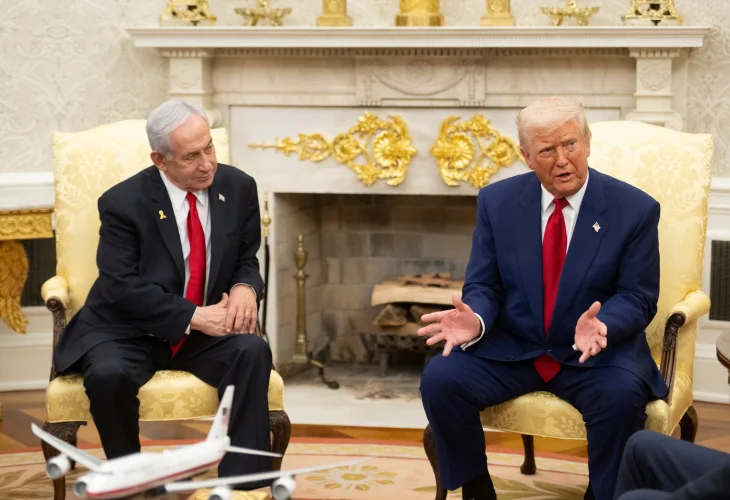 Donald Trump and Benjamin Netanyahu (Shutterstock)
Prime Minister Benjamin Netanyahu publicly called on the Iranian people to overthrow their rulers last night, even as the White House signaled that regime change is not an official goal of the ongoing U.S.–Israel war against Iran.
In a message addressed directly to Iranians, Netanyahu framed the military campaign as an opportunity for the public to remove the country’s clerical leadership after decades of repression. “We are waging a historic war for liberty. This is a once in a lifetime opportunity for you to remove the Ayatollah regime and gain your freedom,” Netanyahu wrote in a post on X.
The Israeli leader said the joint campaign with the United States was weakening Iran’s leadership and creating conditions for a potential uprising. “We will continue to hit with growing force the tyrants who terrorized you for decades,” he wrote. “When the time is right, and that time is fast approaching, we will pass the torch to you.”
The messaging comes as the U.S. administration outlines more limited war aims focused on Iran’s military capabilities rather than explicitly calling for the collapse of its government.
Speaking during a White House press briefing on Tuesday, Press Secretary Karoline Leavitt said the military campaign aims “to destroy their missiles and their ability to make them, destroy their navy, permanently deny them nuclear weapons forever, and weaken their evil terrorist proxies in the region… The operations will end when the commander-in-chief determines the military objectives have been met.”
She added that when President Donald Trump speaks of Iran reaching “unconditional surrender,” the administration means that Tehran will no longer possess the military capabilities needed to threaten the United States or its allies.
At the same time, Washington has reportedly begun placing limits on some Israeli targeting decisions as the war enters its second week.
According to Axios, the Trump administration asked Israel not to carry out further strikes on Iranian energy infrastructure, particularly oil facilities. U.S. officials warned such attacks could harm ordinary Iranians, provoke retaliatory strikes on Gulf energy facilities, and drive global oil prices sharply higher. Trump has reportedly described attacks on Iran’s oil sector as a “doomsday option” that should only be used if Tehran deliberately targets global energy supplies first.
Sen. Lindsey Graham, a Republican supporter of the war effort, also urged caution about fuel infrastructure targets. “Please be cautious about what targets you select,” Graham wrote on X, arguing that Iran’s oil economy could be critical if the country eventually attempts to rebuild after the conflict.
Behind the scenes, Israeli officials have also tempered expectations that the bombing campaign will immediately lead to the collapse of Iran’s clerical regime.
A senior Israeli official told Reuters today that there is no certainty the war will trigger the fall of Iran’s government, and that there has so far been no sign of a nationwide uprising despite the intense bombardment of Tehran and other cities.
Israeli ministers briefed on the conflict said the regime could potentially fall within a year, but acknowledged that the military campaign itself may end much sooner. “Our role is to continue striking the oppressors until the public rises up,” one Israeli official said following a security briefing.
The war has already reshaped Iran’s leadership structure. The joint U.S.–Israel campaign killed Supreme Leader Ayatollah Ali Khamenei and several senior military commanders, while also damaging military infrastructure and facilities across the country. Yet analysts and officials say Iran’s security forces continue to threaten severe punishment against anyone attempting to organize protests, making a large-scale uprising unlikely while the conflict continues.
Israeli and American leaders have not issued a unified public statement defining the war’s political end goals or specifying the conditions under which the campaign will end.
Netanyahu acknowledged that any eventual political transformation inside Iran ultimately depends on its own citizens. “Our joint action will create the conditions for the brave Iranian people to take their destiny into their own hands,” he said.

