

End of Days
Sirens, Shelters, and the Season of Redemption
From wartime Purim to Passover preparations, Israelis persist in the ancient rhythm of redemption
Purim of 1991 here in Israel was, according to my father, different than usual. He was a yeshiva student here at the time, and for about six weeks leading up to Purim, the country had been bombarded by Scud missiles coming in from Iraq. The nights were long and sleepless, the days were fraught and exhausted. Yet, with Purim came a ceasefire, and the country celebrated accordingly.
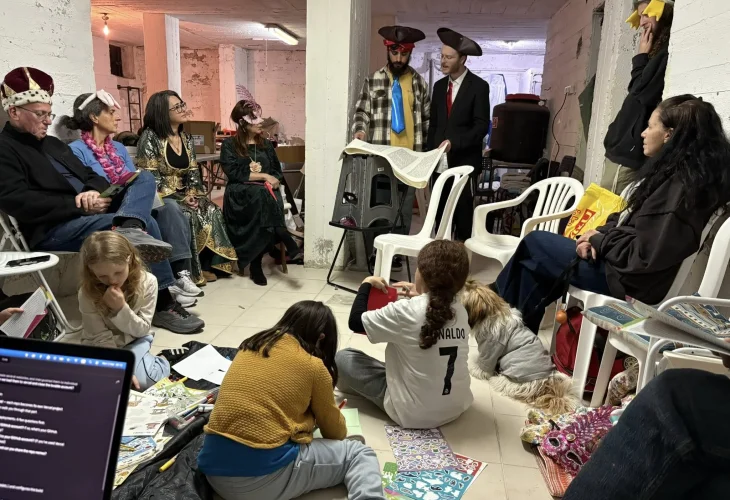
I had Purim 1991 on my mind a lot last week as we found ourselves, once again, bombarded by missiles, this time ballistic missiles from Iran threatening to turn Purim into a shell of itself. Typically, Purim is one of the most joyous days of the year as we celebrate the defeat of an ancient Persian enemy. Children (and adults) dress up in costumes, people are out and about all day delivering gifts of food to friends, and there is music and dancing just about everywhere you turn. Yet, this year, as we headed to our various shelters for the first time last Shabbat, many of us wondered: What would be this year? Would we be able to visit the people we wanted to? How would we hear the reading of the book of Esther? What would Purim look like if we had to stay near our bomb shelters?
In spite of all of our questions, my husband and I were determined to plan as though things would be normal. Our original plan was to go around visiting our families in and around Jerusalem, and we decided to continue to prepare as though it would happen. We figured that we will prepare our packages with the hopes that we will be able to visit everyone, and that if, for whatever reason, we could not make our rounds, we’d simply have to find where to donate a few dozen homemade blueberry muffins. (I was reasonably sure we wouldn’t have a problem with that.)
In the end, Purim went on. In many ways, it was not quite as robust as Purim normally is, but it was still Purim. The reading of the book of Esther happened in or near bomb shelters; we visited our friends and family, as did so many other people; and we joined together with other families for our festive Purim meal. Yes, we did have sirens a few times over the course of the day, but in spite of the sirens—or perhaps because of the sirens—Purim went on. And, if I’m being honest, it was a special day.
We find ourselves now in the time between Purim and Passover, where we bridge the gap from one celebration to the next. This Shabbat, as we begin in earnest the spiritual preparations for Passover, we’ll read from a portion of the Torah called Parshat Ha’hodesh (lit., the Portion of the Month), in which the Israelites were given their first commandments as a people: first, the commandment of sanctifying the new moon with which we begin each new month, and second, to set aside sheep in anticipation of the ritual Passover sacrifice.
These two commandments are crucial to the formation of the Israelites as a nation. Rabbi Abraham ibn Ezra, a prominent eleventh century Spanish commentator on the Bible, explains that the first of the two commandments was to set apart the Jewish calendar. The ancient nations of the world—as the modern nations—structured their calendars based on the sun. Jews, by contrast, have a hybrid lunar-solar calendar, with our months running according to the lunar cycle while maintaining our holidays at specific times of the solar year. With that foundation, the Israelites were then ready for the second of the two commandments, which, according to the Midrash, would give them the merit they needed to be redeemed from Egypt.
It was not enough that God had promised to Abraham that his descendants would be slaves in a foreign land and that He would redeem them. It was not enough that Moses had spent the better part of the previous year in the palace of the pharaoh pleading to let his people go. The people had a duty to themselves, to their past, and to their future, to be active participants in the story of their redemption. In taking that sheep, in preparing for Passover, and in ultimately partaking in the celebration of the redemption of which they stood on the cusp but that was yet to come, the Israelites earned the right the next day to walk out Egypt with their heads high, singing songs of praise and joy.
As of writing, we still have missiles coming into Israel multiple times a day, now from multiple fronts. We are still regularly making our way to bomb shelters and we are still very much at war. But we are also taking an active part in bringing about our redemption. Purim went on this year because we had a duty—to our past, present, and future—to play an active role in the upcoming redemption. And as we transition now to Passover, as we clean our homes and our souls of the leavened bread in our lives, as we move into the season of redemption, we will continue in our mission as a people, following in the footsteps of our ancestors, doing our part as we ready ourselves, please God, for the entirety of the Jewish people to join us for Passover this year in Jerusalem.

