

Magazine
Locusts in the Torah: The Science Behind the Swarm
From the plagues of Egypt to modern Israel, locust swarms have shaped history. Discover the science and Torah behind this remarkable phenomenon.
- Zoharat Cohen
- | Updated
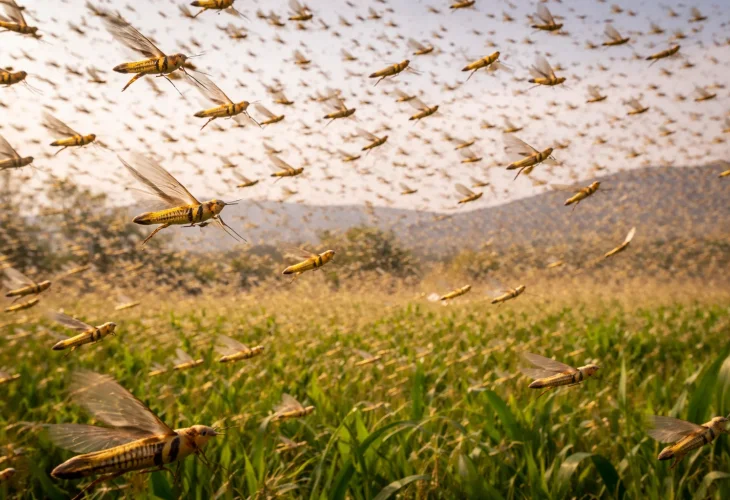
Throughout history, locust swarms have been among the most feared natural phenomena. In a matter of days, enormous clouds of insects can travel vast distances and devour nearly everything in their path.
Yet the story of locusts is not only about destruction. Their remarkable transformation from harmless grasshoppers into massive swarms is one of the most fascinating examples of how nature responds to environmental pressure. Locusts also appear in the Torah and Jewish history, where they carry spiritual meaning as well.
When Grasshoppers Become Locusts
There are about 8,000 species of grasshoppers in the world, but only around twelve species have the ability to transform into locusts. In this special state they band together and set out on a collective search for food.
These swarms can travel thousands of kilometers within just a few days. They leap over obstacles, cross rivers, and have even been reported to cross major waterways such as the Suez Canal.
A Dramatic Transformation
When solitary grasshoppers gather and turn into locusts, both their behavior and their appearance change dramatically. The opposite transformation can also occur.
Normally these insects live alone. They are nocturnal, green brown in color, and generally harmless. But when they transform into locusts, they become part of a massive yellow black swarm that travels and feeds during the day, leaving destruction wherever it goes.
The change is so dramatic that for many years zoologists believed they were two completely different species. Only in 1921 did scientists confirm that they are actually the same insect in two different states.
This remarkable shift shows the powerful influence of social conditions on behavior.
How a Swarm Forms
So how does a group of grasshoppers become a locust swarm?
The transformation begins when their hind legs are repeatedly stimulated while they are packed closely together. This often happens when food sources become scarce.
As solitary grasshoppers crowd into the few remaining patches of vegetation, they constantly brush against one another. This crowding triggers physical and behavioral changes that turn them into a coordinated swarm.
Against their will, the insects become part of a hungry community sharing a common fate.
What Do Locusts Eat
Locusts are not particularly selective about food and will consume almost any vegetation in their path.
However, there are two notable exceptions. Locusts generally avoid olive trees and date palms.
Locusts in the Torah
Locusts appear in the Torah as part of the Ten Plagues in Egypt. The plague of locusts was the eighth blow inflicted on Egypt after Pharaoh refused to release the people of Israel.
They are also mentioned later in the Torah in the book of Devarim, where locust invasions are described as one of the punishments that could come upon the land if the people turn away from Hashem.
Are Locusts Kosher
An interesting question is whether locusts are considered kosher.
In Vayikra chapter 11 the Torah states:
"Yet these you may eat from among all the winged swarming things that go on all fours, those that have jointed legs above their feet to leap with on the ground. Of these you may eat the locust according to its kind, the sol'am according to its kind, the chargol according to its kind, and the chagav according to its kind."
According to the Torah’s identifying signs, certain species of locusts are kosher.
However, most Jewish communities today do not eat them. The main reason is that the precise tradition identifying which species are permitted was not preserved in many communities, especially among Ashkenazi Jews.
Communities That Preserved the Tradition
Despite this, some communities continued to maintain the tradition of eating locusts.
In several North African communities and especially among Yemenite Jews, the identifying tradition remained intact. Locusts were common in those regions, and people often relied on them as a food source.
This practice continued until Rabbi Chaim ben Attar, born in Salé, Morocco in 1696, ruled that the residents of his city should refrain from eating grasshoppers. His ruling created a major debate between supporters and opponents.
In the end the ruling was adopted differently in different communities. The Tunisian community accepted it fully. Yemenite Jews continued their long standing tradition of eating locusts. In Morocco there was no complete consensus. Communities near the Sahara, where locusts were common, continued the practice, while northern urban communities gradually stopped due to the loss of tradition.
Different Names for Locusts in the Bible
The Bible mentions ten different types of locusts: arbeh, giv, gazam, chagav, chanamal, chasil, chargol, yelek, sol'am, and tzirtzal.
Some scholars believe that these names may refer to different stages or variations of the same insect.
Locust Plagues in the Land of Israel
Locust invasions are not just ancient history. They have struck the Land of Israel many times over the centuries.
In 1827 a severe locust plague caused famine in the region. Similar outbreaks were recorded in 1865 and again in 1866.
During World War I, in 1915, another devastating swarm struck the region. The authorities even required every resident over the age of fifteen to collect sixteen kilograms of locusts or pay a heavy fine.
Later swarms appeared as well. In 1945 locusts attacked fields in the Jordan Valley and reached Sha’ar HaGolan. In November 1955 a swarm struck the settlements of the western Negev. In 2004 a smaller group of grasshoppers was observed crossing the border near Eilat.
The Miracle of Komemiyut
One of the most remarkable stories connected to the 1955 locust plague comes from the Haredi moshav Komemiyut.
That year was a Shmita year. Despite the economic difficulty, the residents decided to fully observe the mitzvah of Shmita and did not plant crops during the seventh year.
They relied on grain that had been planted before the Shmita year, which was permitted to be eaten during the year with the sanctity of shevi’it.
That same year one of the largest locust swarms struck the western Negev, including the area around Komemiyut.
Yet something extraordinary happened.
The swarm skipped the fields of Komemiyut entirely.
Aryeh Moskowitz, today a resident of Nov, remembers the event clearly. At the time he was a child living in nearby Moshav Yad Natan, whose fields bordered those of Komemiyut.
He recalls:
The locusts attacked our moshav, and my father called me to help drive them away. There was no spraying then. The common method was to make loud noise by banging on tin cans and boards to scare them away.
We went out to the fields and began banging. While I was doing this, I looked toward the fields of the neighboring moshav, Komemiyut. There was not a single locust there.
I remember asking my father, Why do only we have locusts while their fields are empty?
He did not know how to answer.
Years later, when I was older, I came across the story in a book by the Chazon Ish. It included testimony from the residents of Komemiyut describing the Shmita year and the locust swarm that passed over their fields.
Then I realized that my own eyes had witnessed an open miracle.
Conclusion
Locusts are one of the most striking examples in nature of how small creatures can transform into a powerful force when circumstances change. Their sudden swarms have shaped agriculture, history, and even the biblical narrative.
From the plagues of Egypt to modern events in the Land of Israel, locusts remind us of both the power of nature and the deeper messages found in the Torah. At the same time, stories like the miracle of Komemiyut show how faith, mitzvot, and trust in Hashem continue to play a role in the life of the Jewish people.

