

Passover
Pesach Sheni Explained: The Jewish Holiday of Second Chances
Why the Torah created a second Passover and what it teaches about repentance, opportunity, and renewal
- Yehuda Lev
- | Updated
 (Photo: Shutterstock)
Rabbi Levi taught that during the summer months God wished to grant the Jewish people a festival in each month. In the month of Nisan He gave them Passover. In Iyar He gave them Pesach Sheni, the Second Passover. In Sivan He gave them Shavuot. In Tammuz He intended to grant them a great festival as well, but because of the sin of the Golden Calf the months of Tammuz, Av, and Elul lost this privilege. Later they were compensated with the festivals of Rosh Hashanah, Yom Kippur, and Sukkot (Yalkut Shimoni, Pinchas 29).
What Is Pesach Sheni?
Pesach Sheni applies to someone who was unable to bring the Passover offering at its proper time on the fourteenth of Nisan. This could happen if the person was ritually impure, traveling on a distant journey, or prevented by circumstances beyond their control.
Such a person was given another opportunity that same year. The offering could be brought one month later, on the fourteenth of Iyar, after midday (Pesachim, chapter 9).
Why Is It Called “Pesach Sheni” and “Pesach Katan”?
The day of the fourteenth of Iyar is called Pesach Sheni, meaning the Second Passover. It is also referred to as Pesach Katan, the “Small Passover.” In Aramaic it is called Pischa Zeira.
Several explanations are given for these names.
“Pesach Katan” (Small Passover)
One reason is that it lasts only one day, unlike the original Passover which continues for seven days.
Another explanation is that many of the strict rules of Passover are relaxed for Pesach Sheni.
“Pesach Sheni” (Second Passover)
The name refers to the Passover offering brought in the second month, Iyar.
The Biblical Source
The Torah describes this law in Parashat Behaalotecha.
In the second year after the Exodus from Egypt, the Jewish people were commanded to observe the Passover offering exactly as God had instructed Moshe.
However, several people were unable to participate because they had become ritually impure through contact with a dead body. They approached Moshe and Aaron and asked why they should lose the opportunity to bring the offering at its proper time.
God responded that anyone who was ritually impure or on a distant journey would be able to bring the Passover offering in the second month, on the fourteenth day in the afternoon (Bamidbar 9).
Differences Between the First Passover and Pesach Sheni
Although the two offerings are similar in many ways, several differences exist.
Restrictions on Chametz
During the original Passover, chametz may not be seen or found in a person’s possession. The offering also may not be slaughtered while chametz is present.
During Pesach Sheni, however, chametz may remain in the home together with matzah.
Additional Festival Offering
On the first Passover a festival offering is also brought. This is not required for Pesach Sheni.
Reciting Hallel
Hallel is recited while eating the first Passover offering but not during the eating of the Pesach Sheni offering.
Location of Eating
The first Passover offering must remain within the group that brought it and cannot be removed. The Pesach Sheni offering does not have this restriction.
Similar Laws
Despite these differences, both offerings share several laws. They override Shabbat, are eaten roasted in one house together with matzah and bitter herbs, no bones may be broken, and nothing may be left over.
The Deeper Meaning of the Commandment
The mitzvah of the Passover offering serves as a powerful sign of the creation of the world and God’s direct involvement in it.
Through the miracles of the Exodus, God changed the natural order of the world before the eyes of the nations. These events demonstrated His power and providence.
Because of the central importance of this belief, God desired that every Jew should have the merit of fulfilling this mitzvah. Therefore, even someone who was unable to participate at the proper time is given another opportunity one month later.
Why Is Pesach Sheni on the Fourteenth of Iyar?
One might ask why the Torah chose exactly one month later.
Rabbi Yaakov Emden explains that the Israelites continued eating the matzah they had taken out of Egypt until the night of the fifteenth of Iyar. This illustrates that the influence of the Exodus miracle continued until that time, making it the appropriate period for the second Passover.
Prayer Practices
Tachanun
On the fourteenth of Iyar, Tachanun is generally not recited because this day commemorates the offering of Pesach Sheni.
Customs differ regarding the day before. Ashkenazic communities usually recite Tachanun on the afternoon of the thirteenth of Iyar, while many Sephardic communities omit it.
On the fifteenth of Iyar Tachanun is again recited.
“Lamenatzeach”
Ashkenazic communities usually recite the psalm beginning with Lamenatzeach, since the day is not considered a full festival. Some Sephardic communities omit it.
Customs of Pesach Sheni
Although Pesach Sheni is not a full festival, several customs are observed.
Eating Matzah
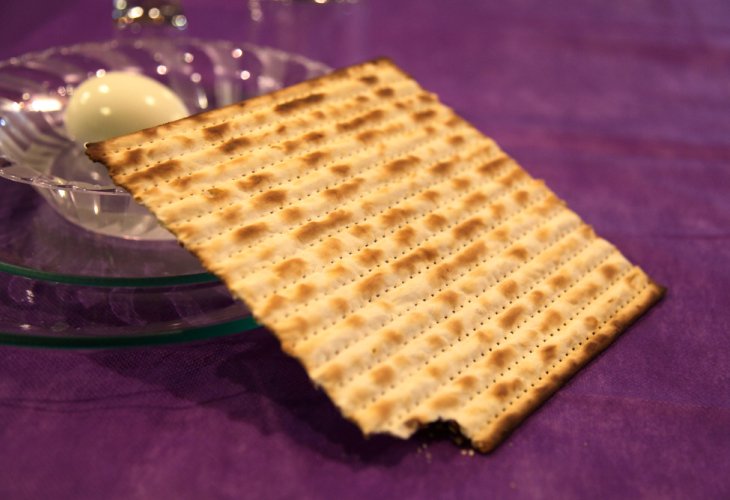
Many people have the custom to eat matzah on this day as a remembrance of the Passover offering that was eaten with matzah.
Some eat matzah on the fourteenth of Iyar, while others do so on the night of the fifteenth, corresponding to the time when the offering would have been eaten.
Others choose not to eat matzah at all, since the custom is not explicitly mentioned in the Torah.
Matzah and Bitter Herbs
Some communities eat both matzah and bitter herbs together, recalling the way the Pesach Sheni offering was originally eaten.
Eating an Egg
A number of communities have the custom to eat an egg. Just as on the Seder night, the egg symbolizes mourning for the destruction of the Temple. If the Temple still stood, the Pesach Sheni offering would have been brought there.
Studying the Portion of Pesach Sheni
Some authorities encourage studying the Torah portion describing Pesach Sheni on the fourteenth of Iyar. This follows the principle that learning about a mitzvah at its proper time brings blessing to the world.
Many therefore read the section in Bamidbar chapter 9 and review the related halachic laws.
A Day of Joy
Several sages wrote that it is appropriate to increase joy on Pesach Sheni, as the day possesses a measure of holiness. Even though it is not a full festival, it represents a powerful message in Jewish life, that there is always a second chance.

