

Relationships
The Rescuer Trap: When Couples Get Stuck in Roles Instead of Connection
When couples stop performing roles and start truly seeing each other, something powerful happens. The relationship shifts from pressure to real connection.
- Hannah Dayan
- | Updated
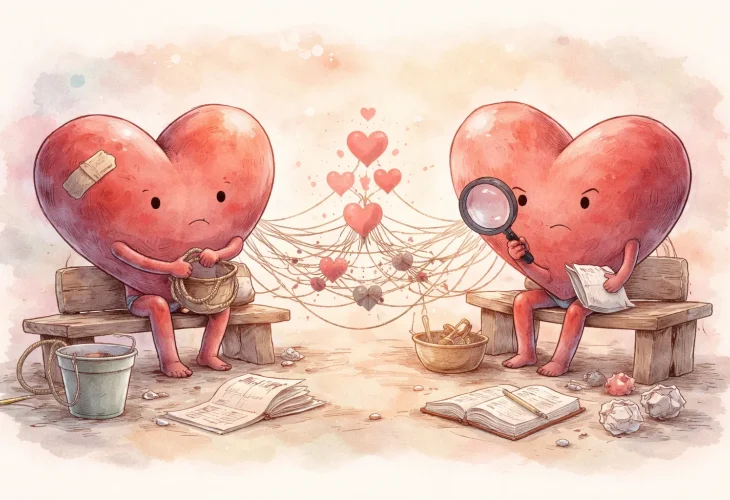
Many couples find themselves stuck in roles they never consciously chose. One becomes the fixer, the other the critic. Over time, these roles create tension, exhaustion, and distance. But when couples learn to recognize the patterns they are living inside, they can begin to step out of them and reconnect with each other in a deeper and more authentic way.
The Lifeguard and the Critic
"I don’t understand. I’m always doing things for Dana, for the kids, for everyone. But instead of feeling appreciated and relaxed, I just feel choked," Amichai said.
"Choked?" I asked.
"No matter what I do, it’s never enough," he replied.
Dana smiled wearily. "You really do a lot for me, but sometimes it feels like you're doing it to prove that you're okay, not really for me."
"Amichai, when you say that nothing you do is enough, how does that feel in your body right now?" I asked.
Amichai closed his eyes for a moment. "Heavy. Like pressure in my chest. As if I’m wearing a tight suit that I can’t take off."
"And what does this suit represent?" I asked.
He thought for a moment. "A role I took on. Like I’m the lifeguard."
"And what happens if you’re not in that role?"
He hesitated. "If I’m not the one holding everyone up… then who am I?"
When Identity Becomes a Burden
"Amichai, when your body tightens like that, it’s often a sign that you're holding onto an identity that no longer fits you. Beneath that role, there is something deeper — a natural current of life that wants to move through you."
"Through me?" he asked.
"Yes. Not through the lifeguard. Through Amichai."
"I’m not sure I understand," he admitted.
"We’re used to thinking in simple categories: right or wrong, good or bad. But the body works differently. It signals when we are trying to control everything and when we are open to connection. When we’re open, there is more flow, more calm, and more confidence."
Dana looked at him quietly. "I rarely see you in that state. Most of the time you’re stressed or defensive."
Three Simple Questions
"Let’s pause the explanations for a moment," I suggested. "Instead, ask yourselves three simple questions."
"What questions?" Dana asked.
"First: Who is the person sitting across from me?
Second: What is he or she feeling right now?
Third: What would benefit them the most in this moment?"
They both sat silently for a moment.
"I see that you’re tired," Amichai said softly, turning to Dana.
"And I see that you’re under a lot of pressure trying to hold everything together," Dana replied, her eyes filling with tears. "Maybe what you need most right now is simply to know that you don’t have to carry everything alone."
The silence that followed was no longer tense. It was a quiet filled with recognition.
Inherited Roles
"Dana," I asked gently, "what role do you think you tend to play?"
She sighed. "The critic. The one who always knows what’s wrong."
She paused and then added, "My mother was always like that — fixing, correcting, complaining. I guess I learned it from her."
"Pain rarely disappears on its own," I explained. "Often it simply passes from one generation to the next. But when we begin to look at it with compassion, something new becomes possible. Instead of continuing the pattern, we can begin to heal it."
Dana nodded slowly. "I always saw her as harsh. I never thought of her as someone who might have been hurting."
From Problems to Growth
"Life isn’t meant to be a series of problems we must constantly fix," I continued. "It’s a journey of growth. Sometimes our deepest wounds are not obstacles but gateways. They push us to grow beyond the roles we’ve been living inside."
"When couples meet the same conflict again and again, it may feel like they’re stuck in a loop. But often it’s more like a spiral. You return to the same place, but each time with the chance to understand something deeper."
Amichai looked thoughtful. "So I don’t actually have to be the lifeguard all the time?"
"You don’t need to perform a role," I said. "You simply need to be yourself. A person who allows life to move through him naturally, not someone constantly trying to prove his worth."
Dana smiled gently. "And maybe I can let go of being the judge and start seeing you for who you really are."
A Small Practice for Everyday Life
"That’s the beauty of those three questions," I concluded. "They help us step out of our roles and return to simple human connection."
The next time you feel tension rising, pause for a moment and ask yourself:
What role am I playing right now?
What am I actually feeling beneath it?
What would help me or my partner most in this moment?
When we move from control to compassion, something new becomes possible. Instead of repeating old patterns, we begin to build a relationship based on presence, understanding, and genuine connection.
Hannah Dayan, Relationship Counselor

