

Evolution
The Bombardier Beetle and the Puzzle of Biological Complexity
How a remarkable chemical defense system raises questions about complexity and the explanations behind evolutionary theory
- Yosef Yaavetz
- | Updated
Every institution has unwritten rules. There are things that are acceptable to say, and things that are better left unsaid. Some topics are welcomed, while others create discomfort, to say the least. Like any institution, the field of evolutionary research also has subjects that are often avoided. One of them is the “bombardier beetle.”
Meet the Bombardier Beetle
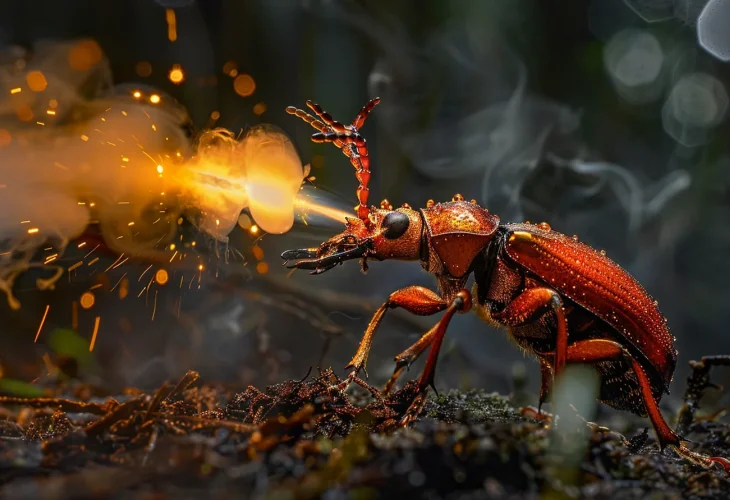
The bombardier beetle is a small insect equipped with a remarkably precise and powerful defense system. It has a tiny, adjustable “cannon” that can spray its enemies with a boiling chemical blast. This defense mechanism has often been described as a challenge to common explanations of how life develops.
A Unique Chemical Defense System
The bombardier beetle is far from an ordinary insect. It possesses an impressive chemical system that allows it to defend itself in a unique way.
When the beetle senses danger, it activates an internal mechanism. Inside its body, it combines hydroquinone and hydrogen peroxide. These two chemicals are not harmful when stored separately. At the critical moment, enzymes that act as chemical catalysts trigger a reaction between them.
The result is a hot spray that can reach temperatures of around 100°C. The beetle fires this spray in short, controlled bursts and can aim it in almost any direction. Whether the attacker is an ant, spider, or frog, the blast causes the predator to retreat quickly.
Why the System Raises Questions
What makes this system fascinating is its complexity. For the mechanism to function, multiple parts must work together perfectly. The beetle must have glands that produce the chemicals, cells that store them separately, enzymes that trigger the reaction in the correct proportions, and a nozzle that directs the spray.
If the chemical mixture is even slightly off balance, the reaction could fail or even harm the beetle itself.
The Question of Gradual Development
How could such a system develop over time?
Supporters of evolutionary theory argue that the process took millions of years. According to this view, tiny changes that offered survival advantages accumulated gradually, step by step.
However, critics point out a potential problem. If the beetle began with an imprecise chemical mixture, the reaction might not have worked effectively. Too much hydroquinone could cause a destructive internal reaction, while too little hydrogen peroxide might produce only weak bubbles that could not defend the insect. Such ineffective stages would provide little survival benefit.
This raises the question of whether intermediate stages of the mechanism could have been useful enough to persist.
The Possibility of Sudden Appearance
Another possibility sometimes considered is that the system appeared suddenly through a large mutation. Yet this also seems unlikely to many critics.
For a single mutation to simultaneously produce glands, storage cells, enzymes, and a directional nozzle would require an extremely unlikely series of events. Evolutionary researchers may suggest that ancestral beetles produced simpler defensive chemicals, but the exact pathway from a basic system to the highly specialized bombardier mechanism is still debated.
Interdependence of the Components
The precise chemical mixture is not the only challenge. The beetle’s reaction chamber must be strong enough to withstand repeated chemical reactions. The nozzle must also be positioned so that the spray does not damage the beetle itself.
Each component depends on the others. This makes the system resemble a machine in which every part is essential from the beginning, leaving little room for partial or ineffective versions.
A Continuing Debate
Because of these features, the bombardier beetle is sometimes presented as a challenge to evolutionary explanations. Critics argue that it is difficult to show how a system requiring such precise coordination could emerge through gradual steps, while the idea of a sudden change appears statistically improbable.
A Point Often Raised in Discussions
When someone speaks with great confidence about evolution and the mechanisms behind the development of species, critics of the theory sometimes point to complex biological systems like the bombardier beetle. They argue that when such systems are presented, the explanation often returns to the idea of many small changes accumulating over millions of years, even when the exact sequence of those changes is not clearly described.
For them, the bombardier beetle remains an example frequently used in debates about the limits and explanations of evolutionary theory.

