

Wonders of Creation
Trees That Produce Gold: Myth or Scientific Reality?
The science behind gold-absorbing plants and the ancient sources that seem to describe this phenomenon
- Yosef Yaavetz
- | Updated
 (Photo: shutterstock)
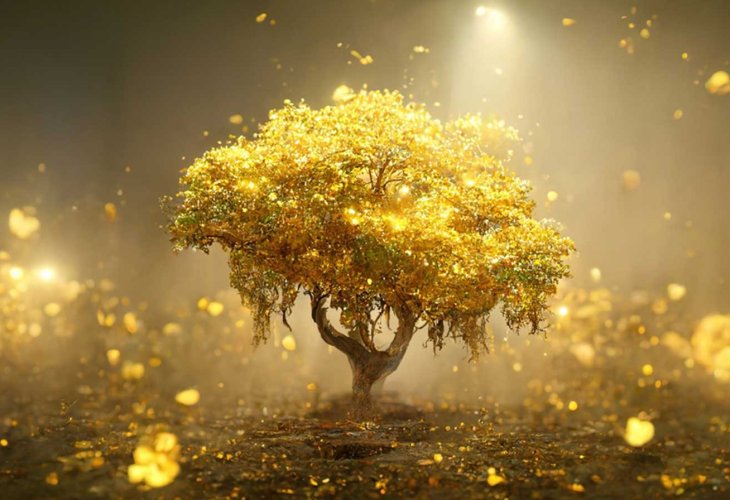
The Sages taught: “Rabbi Hoshaya said: When Shlomo HaMelech built the Temple, he planted within it all kinds of precious golden plants. They would produce fruit in their proper seasons, and when the wind blew, their fruits would fall.” (Yoma 39b)
Have you ever heard of trees that grow gold?
A Remarkable Tradition
This fascinating teaching describes a miraculous reality in the time of Shlomo HaMelech of trees that produced golden “fruit.” While this may sound purely symbolic or supernatural, later sources suggest that something similar may actually exist in nature.
The Yaavetz (Rabbi Yaakov Emden), in his glosses on Tractate Yoma, writes: “A phenomenon like this can still be found today in the region of Takai. Sometimes, grains of gold are found inside grapes that grow there, and even threads of gold grow on their outer surface. This was reported to me by reliable and distinguished individuals who saw it with their own eyes.”
Can Plants Really Absorb Gold?
Modern observations suggest that this idea may not be as far-fetched as it sounds.
Certain plants and trees have the ability to absorb minerals from the soil in which they grow. When these plants grow above gold deposits, they can absorb tiny amounts of gold into their structure.
For example, a plant known as horsetail can contain measurable quantities of gold within its stems. In fact, from one ton of this plant, it is possible to extract approximately 600 grams of gold.
This may help explain the Midrashic phrase “gold that produces fruit” — suggesting that God created a miracle in which trees absorbed large amounts of gold, as if gold mines lay beneath them.
Scientific Discoveries: Plants and Metals
Modern research supports the idea that plants can absorb and concentrate metals.
A team of Israeli researchers from the Faculty of Agriculture at the Hebrew University discovered that the aquatic plant Azolla, a type of fern, is highly resistant to metals such as copper, cadmium, zinc, chromium, and nickel. It can absorb these metals at concentrations up to 500 times higher than their levels in wastewater.
Remarkably, Azolla is also capable of absorbing gold. Because of this, it can be used in processes that recycle gold from industrial waste, such as the byproducts of jewelry manufacturing.
The Role of Bacteria in Gold Formation
Certain types of bacteria can accumulate and concentrate minerals in the soil, including gold.
Scientists have discovered that in the Amazon rainforest in Brazil — particularly in areas known as “gold fields”, large quantities of precious metals exist beneath the surface due to the activity of bacteria. These microorganisms gather and concentrate minerals underground over time.
It is possible that, through the action of such bacteria, large amounts of gold became available in the soil, allowing the trees in Solomon’s Temple to absorb it.
The Many Types of Gold in the Temple
Beyond the idea of trees producing gold, the Temple itself contained many different types of gold.
The Sages taught: “There were seven types of gold in the Temple: good gold, pure gold, beaten gold, closed gold, refined gold, Parvaim gold, and Ophir gold…”
They further explained:
Pure gold – when placed in a furnace, loses nothing.
Ophir gold – according to one opinion, it resembled glowing sulfur refined in fire.
Another opinion describes it as having a deep red hue, similar to the blood of bulls.
Where Wonder Meets Reality
What begins as a seemingly mystical description of trees producing gold, finds intriguing parallels in the natural world. From plants that absorb metals to bacteria that concentrate minerals, science reveals mechanisms that echo ancient teachings in unexpected ways.
Perhaps the description of “gold-bearing trees” was not only a miracle, but also a reflection of hidden processes within creation — where the boundaries between the natural and the wondrous are closer than we might think.

