

Sukkot
The Arba Minim: The Four Species of Sukkot
Learn what each of the four species represents and why they are central to the Sukkot holiday
- Debbie Reichman
- | Updated
 (Photo: shutterstock)
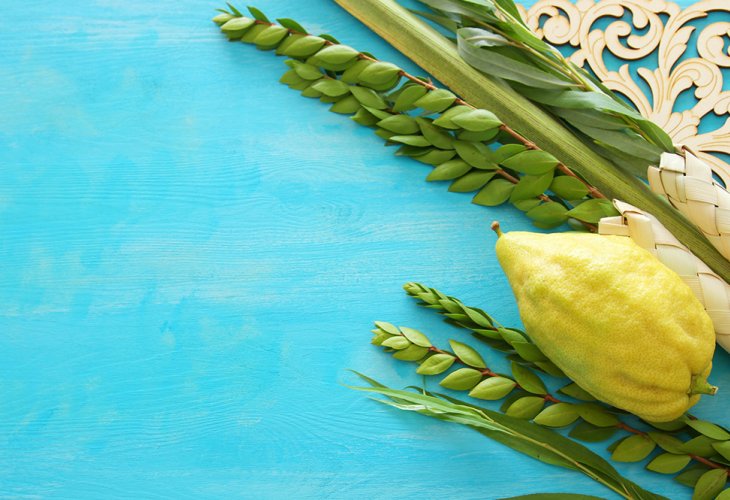
The Torah commands us to take four specific species during the festival of Sukkot: “The fruit of a beautiful tree, branches of date palms, boughs of thick-leaved trees, and willows of the brook” (Vayikra 23:40).
What exactly are these four species?
The Fruit of a Beautiful Tree – Etrog
The “fruit of a beautiful tree” mentioned in the Torah is understood in the Talmud to refer to the etrog (citron), and various explanations are given as to why this particular fruit fits the description.
The etrog comes from an evergreen tree in the citrus family. Its fruit is elongated, with size varying depending on the specific variety. The peel is thick, textured, and highly fragrant, while the inside is divided into small segments.
Unlike other citrus fruits, the flesh of the etrog is relatively dry and not commonly eaten as is. However, it is often used to make etrog jam or candied peel.
Branches of Date Palms – Lulav
The lulav is the young, unopened frond of a date palm, whose leaves have not yet separated from one another.
It is the most prominent of the four species, and for this reason, the Sages sometimes refer to all four species collectively as “lulav,” and the mitzvah itself is often called “taking the lulav.”
For a lulav to be valid for the mitzvah, most of its leaves must remain closed and attached. Additionally, it must retain some green color, as a completely dried lulav is not suitable.
Boughs of Thick-Leaved Trees – Hadas
The hadas (myrtle) is a type of evergreen shrub. There are several known varieties, with the common myrtle being the most widespread.
Beyond its use during Sukkot, myrtle is valued for its pleasant fragrance and is often used as a spice. Its leaves are also used in various medicinal and cosmetic products, particularly for supporting the respiratory system and promoting skin health.
Willows of the Brook – Aravah
The term aravah (willow) refers to a group of deciduous trees and shrubs. There are approximately 350 different species of willow.
The variety used for the four species is typically the white willow, which is also known for its medicinal properties.
Each of these four species carries its own unique characteristics, and together they form one of the most well-known and meaningful mitzvot of the Sukkot holiday.

