

Wonders of Creation
Saturn’s Rings: Nature’s Most Stunning Space Phenomenon
Saturn’s rings are one of the most breathtaking sights in space. Discover what they are made of, how they formed, and why they continue to amaze scientists.
- Hidabroot
- | Updated
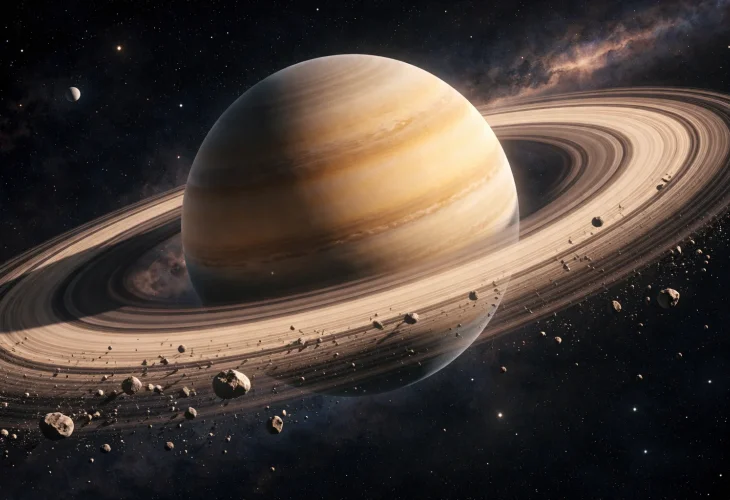
Have you ever wondered which planet has the most impressive ring system? The answer is Saturn.
Among all the planets in our solar system, Saturn stands out with its breathtaking rings. While other planets like Jupiter, Uranus, and Neptune also have rings, Saturn’s are by far the largest, brightest, and most visible.
From a distance, they look like smooth, solid bands. But up close, they reveal something far more fascinating.
What Are Saturn’s Rings Made Of?
Saturn’s rings are not solid at all. They are made up of countless pieces of ice and rock, each orbiting the planet on its own path.
These particles range in size from tiny grains, like dust or pebbles, to massive chunks as large as mountains. Most of them are composed of water ice, which reflects sunlight and gives the rings their bright, shimmering appearance.
Even though the rings stretch across hundreds of thousands of kilometers, they are surprisingly thin. In many places, they are only about 10 to 30 meters thick.
The Famous Cassini Division
One of the most striking features of Saturn’s rings is a large gap known as the Cassini Division.
This gap lies between two of the main rings, called Ring A and Ring B. It is about 3,000 miles wide and was first observed in 1675 by the Italian astronomer Giovanni Cassini.
Although it appears empty from afar, the Cassini Division actually contains many smaller ring particles. The gap exists because of the gravitational influence of Saturn’s moons, which shape and organize the material in the rings.
A System of Many Rings
Saturn’s ring system is more complex than it first appears.
There are eight main rings, labeled with letters such as A, B, and C, along with thousands of smaller ringlets within them. Each ring has its own structure, density, and pattern.
Some rings are bright and dense, while others are faint and nearly invisible. Together, they form one of the most intricate and beautiful structures in our solar system.
Always in Motion
Saturn’s rings are not static. Every particle within them is constantly moving, orbiting the planet at incredible speeds.
Some pieces complete an orbit in just a few hours. Collisions between particles happen regularly, breaking them into smaller pieces or causing them to clump together.
Over time, these movements create waves, gaps, and patterns across the rings, almost like ripples in water.
A Temporary Wonder
As magnificent as Saturn’s rings are, they may not last forever.
Scientists believe the rings are relatively young in cosmic terms, possibly only a few hundred million years old. Over time, some of the material is gradually pulled into Saturn or lost into space.
This means that one day, far in the future, Saturn may lose its iconic rings entirely.
A Glimpse of Cosmic Beauty
Saturn’s rings remind us that even in the vastness of space, there is beauty, structure, and precision.
What looks like a simple band from afar turns out to be a dynamic, complex system made of countless pieces working together in harmony.
Just like many things in the universe, the closer we look, the more wonder we discover.

