

Magazine
“You Can’t See My Injury”: Living with the Invisible Wounds of War
One man’s honest journey through depression, trauma, and finding the strength to keep going
- Moriah Luz
- | Updated
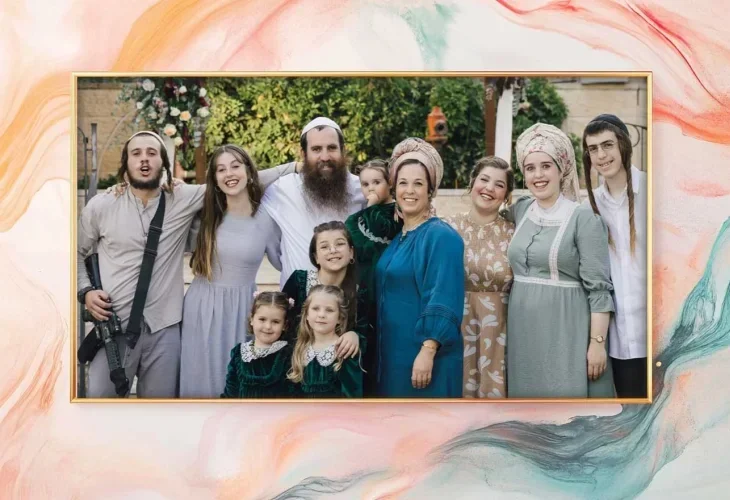 Avraham Shapira and his family (Credit: Emmanuel Maimon)
After a year of intense reserve duty as an assistant to the Chief of Staff of the Military Rabbinate, Avraham Shapira arrived at his nephew’s circumcision ceremony. From the moment he entered the hall, he sensed that something within him was not the same.
By nature, Shapira is warm, social, and deeply family oriented. He is usually at the center of things. Yet at this event, he felt distant and indifferent to those around him.
During the ceremony, he was honored with placing the baby on the Chair of Eliyahu.
“I placed the baby on the chair and simply turned around and walked away,” he recalls. “The baby started to roll, and the mohel caught him at the last second. I am a responsible, attentive person. This was completely unlike me. It just was not me.”
As the event continued, all he wanted was to go home and lie down.
Two days later, after a heavy Shabbat and a troubling feeling that would not pass, he called a close friend on his way to reserve duty.
“I told him something simply was not working. He looked at me and said, ‘Avraham, you need treatment today.’”
A Life of Strength and Responsibility
Shapira, 43, lives in Beit She’an. He is married, a father of eight, and a grandfather of two. In recent years, he worked in real estate project management. Courage and openness have always defined him. Years earlier, he donated a kidney, becoming one of the early donors in Israel.
These same qualities led him not to hide his current struggle.
When the war broke out, he was called to serve within the Military Rabbinate under Central Command. His role focused on logistics, supporting large military units operating across the country.
Within days, he found himself at the Shura base, where fallen soldiers were brought for identification.
Seeing Everything and Unable to Help
“This was the first time I saw the handling of the deceased,” he says quietly. “Trucks filled with bags, the process, the overwhelming scale.”
As a Kohen, Jewish law limited how close he could come. He stood at a distance, doing what he could, but unable to fully participate.
“I saw everything, but I could not be part of the team handling them. There is one image that keeps returning to me. I am sitting outside a truck, and it feels as if the souls are waiting to be cared for, but I cannot approach.”
For weeks, he continued to work under these conditions, assisting with logistics, preparing equipment, and supporting the ongoing operations.
Living in a World of Death
As his responsibilities grew, so did his exposure.
He became involved in planning and preparing for worst case scenarios, calculating how many bodies could be transported or stored, and managing the logistics of loss on a massive scale.
“Yes,” he says simply when asked, “I was dealing with death almost every day.”
Gradually, subtle changes began to appear. He stopped eating meat because of the persistent smells at the base. Later, even ordinary environments began to trigger disturbing thoughts.
“Every time I saw large shelves, I would automatically calculate how many bodies could fit there. I started avoiding places like that.”
At the time, he believed these reactions were normal.
The Collapse
A year after the war began, everything surfaced at once.
Following the circumcision ceremony, his condition deteriorated rapidly. Within days, he began therapy. “When I got home, I could not even climb the stairs to my bedroom. I had no strength at all.”
He was soon diagnosed with severe depression.
Simple daily tasks became overwhelming. He was instructed to shower once a day and to sit at the table for a few minutes. Eating no longer interested him, and he sometimes went days without food.
“In one day, I became like a person who was no longer alive,” he says.
Held Together by Family
Throughout this time, his family became his anchor.
“Thanks to my wife, I am alive. She is incredible.”
She took immediate steps to protect him. His firearm was removed, and medications were carefully managed. His wife and daughter stayed close, supporting him through each moment.
On one particularly difficult day, he left the house with no intention of returning. At the last moment, something within him shifted. He turned on his phone and reached out for help.
Police were already searching for him. When they arrived, they acted with sensitivity and care.
“They told me, ‘You are a soldier who has given so much. We are here to help you.’”
An Invisible Injury
Shapira later described his condition in a public post:
“I am also a wounded soldier. You cannot see my injury. I am not bleeding. I have not lost a limb. Something inside my heart has snapped.”
The challenge, he explains, is that nothing about his struggle is visible.
“On the outside, I look normal. People do not see what is happening inside. They do not understand why I cannot function. When the inner life force is not there, you simply cannot move. It has nothing to do with what you want.”
Even activities that once defined him, like teaching Torah or attending prayer, became nearly impossible.
The Long Path Back
Despite everything, Shapira holds on to a deep belief that healing will come.
“I know this will pass. I will return to full functioning. It is not a question of if, only when.”
He describes his experience as a deep fracture within the heart, one that must be repaired slowly and carefully with professional help.
“There is progress,” he says. “It is slow, and there are difficult waves, but the direction is forward.”
In some ways, he feels that the struggle has made him more sensitive and present as a father.
A Message of Understanding and Compassion
Shapira’s message is clear and powerful.
“There is no shame in a broken soul. Just as we would not be ashamed of a physical injury, we should not be ashamed of emotional pain.”
To those who are struggling, he says: “You are not to blame. Recognize what you are going through and allow yourself to be supported.”
To society at large: “You do not need to understand someone’s pain in order to help. Just ask what they need.”
And to those close to someone who is struggling: “Do not wait for perfect answers. If you think they need something, offer it. Give support, and give space.”
He also emphasizes the importance of persistence in friendship: “Even if someone pushes you away, do not give up on them. A small visit, a simple presence, at the right moment, can save a life.”
At his core, Shapira says, there is still a strong desire to live. “There is a part of me that knows things will be good again.”
That belief, quiet but steady, continues to guide him forward, step by step, on the long road back to himself.

