

World News
New Report Says Harvard Jewish Enrollment Has Fallen to 7%
HJAA study says Jewish representation at Harvard has dropped sharply over two decades and calls for an audit of admissions practices
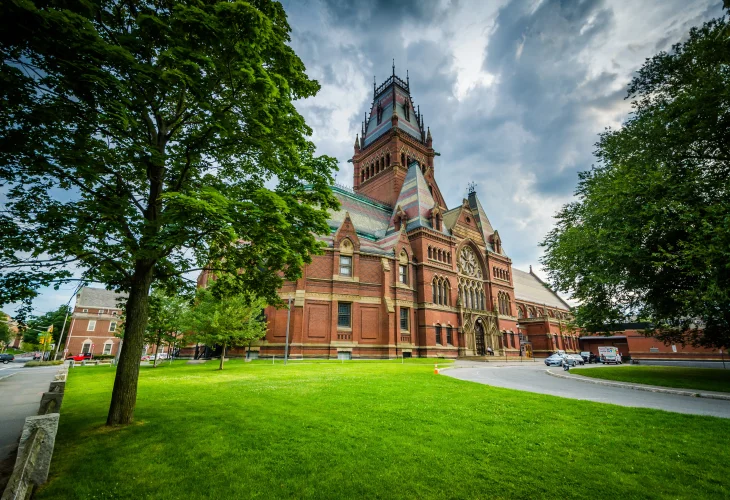 Harvard (Shutterstock)
A new report released this week says Jewish undergraduate enrollment at Harvard has fallen to about 7 percent, roughly half the level of a decade ago and the lowest recorded at the university since before World War II.
The findings were published by the Harvard Jewish Alumni Alliance, which says the data reveal an unusual pattern in Harvard admissions that cannot be explained by broader demographic trends affecting other groups or institutions.
The report emphasizes that it does not conclude that Harvard intentionally discriminates against Jewish applicants. Instead, it describes what the authors call a statistical anomaly and urges the university to examine its admissions practices more closely. “Prior reporting identified a pattern. This report identifies an anomaly,” the report states.
According to the data analyzed by the group, Jewish students once made up roughly 20–25 percent of Harvard undergraduates for much of the late twentieth century. The current share is now less than a third of that level.
The report also notes that the decline cannot be attributed to the surge in antisemitism on campuses following the Hamas attacks of October 7. Notably, the steepest single drop occurred with the Class of 2020, students who entered Harvard in fall 2016, several years before those events.
Researchers compared Harvard’s trend with other Ivy League universities and found the pattern was not uniform across the system. Jewish enrollment declined significantly at Harvard, Penn, and Yale, but remained stable or grew at Brown and Cornell. At Princeton, the decline was minimal.
The report also analyzed whether structural changes in admissions could explain the shift. It examined factors including geographic diversification, expanded international enrollment, increased recruitment of student-athletes, and growth in Asian American enrollment. According to the analysis, none of those explanations accounted for the disparity.
The authors argue that the core problem is a lack of institutional monitoring. Harvard tracks enrollment data by race, gender, geography, income, and first-generation status, but Jewish students fall outside those categories. Harvard previously collected religious preference data but stopped doing so in the early 1990s.
“What we are asking of Harvard is straightforward: count, audit, and report,” the group said. The report calls on the university to begin tracking Jewish enrollment and to conduct an independent review of its admissions process, similar to the analysis Harvard previously carried out for Asian American applicants during litigation over admissions policies.
Adrian Ashkenazy, president of the Harvard Jewish Alumni Alliance, said the goal of the report is transparency rather than accusation. “This report is not an accusation. It is an invitation to build the infrastructure that makes accountability possible,” Ashkenazy said.
The findings have also drawn political attention in Washington. Rep. Elise Stefanik (R-N.Y.), who previously questioned Harvard’s leadership about antisemitism during a widely watched congressional hearing in 2023, cited the report as evidence that the issue may extend beyond campus climate. “I strongly believe the antisemitism does not just impact students on campus at Harvard; it shapes admissions,” Stefanik wrote in a statement responding to the report.
The alumni group says it has published the full data, methodology, and source materials used in the analysis so that independent researchers and the university itself can review the findings.

