

Wonders of Creation
Locust Swarms: From Biblical Plague to Modern Threat
From the plague in Egypt to modern outbreaks, locust swarms remain one of nature’s most destructive forces.
- Debbie Reichman
- | Updated
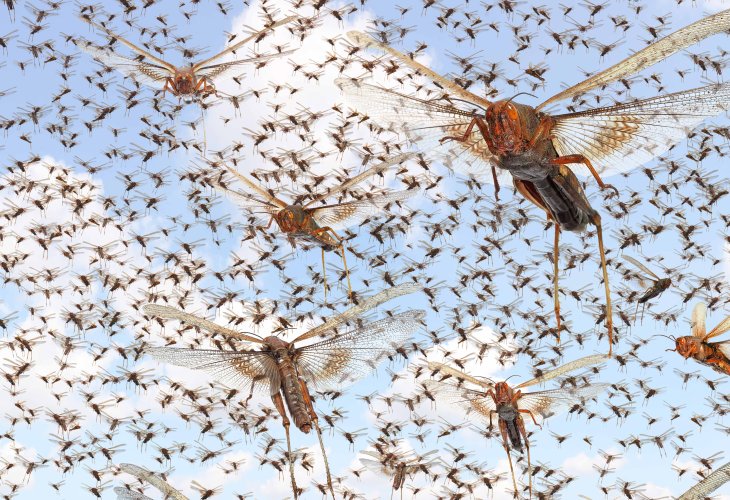 (Photo: shutterstock)
The plague of locusts that Hashem brought upon Egypt was one of the most devastating events described in the Torah. Massive swarms covered the land, devouring every remaining crop and leaving Egypt stripped of its food supply.
While such a total calamity has not been repeated on that scale, locust swarms still exist today and continue to pose a serious threat in many parts of the world.
A Small Creature with Enormous Impact
At first glance, a locust seems harmless. But when they gather in swarms, the destruction is extraordinary.
A single swarm can consume enough food in one day to feed about 35,000 people. When locusts descend on a fertile field, they can strip it bare within minutes, leaving nothing behind.
The desert locust, in particular, forms massive swarms that can reach up to 250 billion insects. These swarms move as one living cloud, darkening the sky and overwhelming everything in their path.
How Locust Swarms Form and Spread
Most large swarms begin in East Africa, especially after periods of heavy rainfall. The moisture creates ideal breeding conditions, allowing locust populations to grow rapidly.
From there, carried by strong winds, the swarms can travel across entire regions. They often spread throughout Africa and can even reach the Middle East, especially when rainfall creates temporary fertile conditions in otherwise dry desert areas.
As they move, they travel at remarkable speed, covering great distances while consuming nearly all vegetation they encounter.
Speed and Scale of Destruction
Locust swarms are not only massive, they are fast.
For example, a swarm recorded in 2020 covered an area of nearly one square kilometer and traveled approximately 144 kilometers in a single day. Wherever it moved, it left widespread agricultural damage behind.
In recent years, swarms have been growing in size. In 2019, one of the largest swarms since 1950 developed in Africa, raising serious concerns about food security.
Locust Swarms Today: A Continuing Threat
Even after the widely reported outbreaks of 2019 and 2020, locust activity has not disappeared.
In 2025, significant outbreaks were still being reported in parts of North and West Africa, with new swarms forming and spreading across regions such as Mauritania, Morocco, and surrounding areas. Weather conditions, especially rainfall in desert regions, continue to create ideal environments for breeding.
In early 2026, large swarms were even observed in parts of the Sahara and reached areas as far as the Canary Islands. Reports described skies darkened by insects and roads covered with locusts, scenes that many compared to biblical times.
These outbreaks may not always reach the global scale of the 2020 crisis, but they remain recurring, powerful, and capable of causing serious damage to crops and food supplies.
A Modern Threat to Food Supply
Today, locust swarms remain a major threat, particularly in African countries where agriculture is a primary source of food and income.
When swarms strike, they can wipe out entire harvests, leading to shortages and economic hardship.
To combat this, one of the main strategies used is aerial spraying of pesticides over affected areas. While this can help reduce the damage, controlling such vast and fast-moving swarms remains a significant challenge.
A Powerful Reminder
The phenomenon of locust swarms serves as a powerful reminder of how even the smallest creatures, when multiplied, can have an overwhelming impact.
What once struck Egypt in biblical times continues, in a different form, to challenge humanity even today.

