

Passover
Giving Birth on Seder Night: The Story I Never Expected
She didn’t want to give birth on Seder night. But what happened in that hospital room became a story of connection, tears, and unexpected light.
- A. Friedman
- | Updated
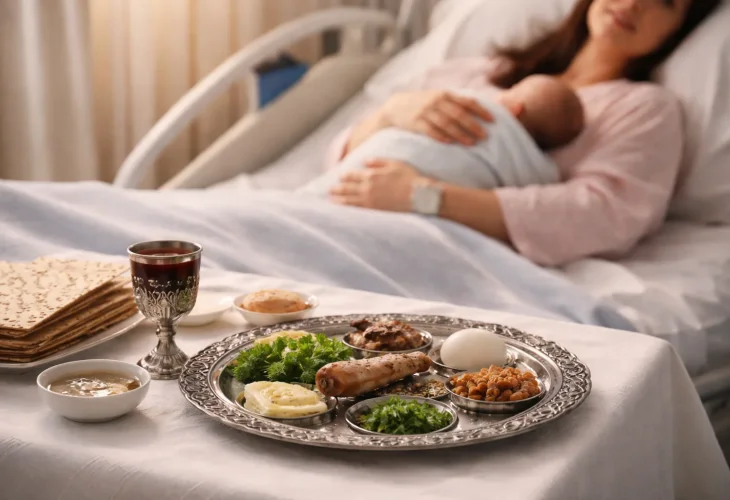
On Seder night, every detail feels meaningful. The preparation, the anticipation, the family gathered together. But sometimes, what we plan and what actually happens are very different. And in those moments, we discover a deeper kind of meaning we could never have planned ourselves.
When Everything Doesn’t Go According to Plan
By the eve of the Seder, I was completely exhausted.
The 14th of Nisan was my due date, and I had done everything I could to avoid giving birth on that day. I prayed, gave charity, cleaned for Pesach with all my strength, hoping somehow it would help move things along earlier.
One request stayed with me the entire time.
“Master of the world, please, not on this night. I want to sit at the Seder with my family.”
But as the house filled with the final preparations and everything was ready, something shifted.
The pain began.
At first, I tried to ignore it. Maybe it was just from all the work. But then it came again. And again.
I understood.
This was happening.
Letting Go of Expectations
With a heavy heart, I turned to my husband.
“We need to go to the hospital.”
Tears filled my eyes. Not because I wasn’t grateful, but because I felt like something I had hoped for so deeply was slipping away.
As I packed, my children tried to comfort me. I reassured them as best as I could, insisting that my husband return home after the birth so they would still have a proper Seder.
Inside, though, I felt something much deeper.
Like I had been pushed away from the moment I so desperately wanted to be part of.
A Private Seder, Alone
A few hours later, I held my newborn son in my arms.
In that moment, everything felt worth it.
But soon after, I found myself alone in a hospital room on Seder night.
My husband had set up everything for me before leaving. The matzah, the wine, the Haggadah. I lit the candles, completely drained, and fell asleep.
When I woke up, it was already late.
I had just enough time to make my own Seder.
Around me, the room was filled with the glow of television screens. I turned away and began quietly:
“Ha lachma anya…”
Each word brought my family to life in my mind. I could hear my children, picture their faces, imagine every moment happening at home without me.
Tears fell as I continued.
An Unexpected Turn
At some point, I noticed two women standing by my bed.
“Can we join?” one of them asked.
I was surprised. These were women who, just hours earlier, had been watching television on Seder night.
But something in them had shifted.
I welcomed them.
Slowly, the room changed.
I began reading aloud, explaining as we went. They asked questions, listened, and joined in. When we reached the matzah, I showed them what to do. We created a Seder together, right there in that hospital room.
What had started in loneliness turned into warmth, connection, and even joy.
Seeing the Bigger Picture
That night, I did not sleep.
I felt I needed to ask forgiveness.
I had prayed so hard not to be there. I had felt rejected when things didn’t go my way.
But now I saw something else entirely.
This night had been planned. Not by me, but from Above.
I had been placed exactly where I needed to be.
A Connection That Continued
The connection did not end there.
The next day, they continued asking questions. Over time, we stayed in touch. Slowly, step by step, they grew closer.
A year later, we met again.
This time, not in a hospital, but at my Seder table at home. Together with our families, we celebrated again.
It was a completely different Seder, but just as powerful.
Maybe even more.
From Mitzrayim to Geulah
Looking back, I understood something I hadn’t been able to see before.
What felt like disappointment, was actually the beginning of something much greater.
What I thought was distance, was actually connection.
What I experienced as Mitzrayim, a place of limitation and pain, revealed itself as Geulah, redemption.
Because sometimes, the moments we try hardest to avoid are the very ones that bring the greatest light.

