

Behind the News
Kharg Island: The Island That Could Decide the Iran War
As Trump pauses strikes and claims progress in talks, Kharg Island is emerging as the key battleground that could shape how the war ends
- Brian Racer
- | Updated
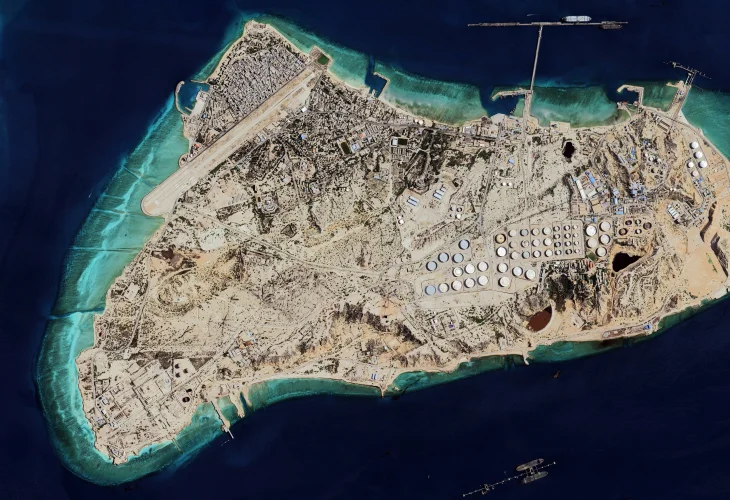 Kharg Island (Shutterstock)
The Pentagon is weighing new plans to send airborne troops and Marines for a possible operation targeting Iran’s Kharg Island, The New York Times reported Monday, in a potential expansion of the U.S. role in the war. The plan could include a rapid-response brigade from the 82nd Airborne Division, along with thousands of Marines already moving toward the Middle East.
Kharg Island is Iran’s main oil export terminal, where roughly 90% of the country’s crude is loaded onto tankers before passing through the Strait of Hormuz. Because nearly all of Iran’s oil exports begin at Kharg and must move through that corridor, the island is directly tied to Tehran’s ability to threaten tanker traffic at the Strait.
The island has already been drawn into the conflict. Last week, U.S. forces struck more than 90 military targets on Kharg, including missile storage and naval infrastructure, while deliberately avoiding oil facilities. Trump said at the time that the United States had chosen not to “wipe out the Oil Infrastructure,” signaling a limited approach that left room for further escalation.
Since then, the pressure has continued to build. Washington has warned Iran over interference with shipping in the Strait of Hormuz and escalated threats against Iranian energy targets, while also preparing additional military options.
Now, that escalation appears to be entering a new phase. The Pentagon is considering whether to move beyond limited strikes toward seizing or holding the island, a shift that would mark a significant expansion of U.S. involvement.
The military planning comes even as President Trump said Monday that Washington has held “very good and productive” talks with Iran and ordered a five-day pause on planned strikes, creating a contrast between diplomatic messaging and continued operational preparation.
The plan would likely begin with Marines securing the island and repairing its airfields, followed by airborne troops arriving as reinforcements, a sequence that would allow the United States not just to strike Kharg, but to take control of it. That approach reflects a key strategic calculation: destroying the island’s oil infrastructure would deal a severe blow to Iran’s economy but risk a spike in global oil prices and wider escalation, while seizing or controlling Kharg could deny Iran revenue while preserving the infrastructure and creating leverage over Tehran’s actions in the Strait of Hormuz.
Iran has drawn clear red lines around that scenario. Military sources have warned that any attack on Kharg would trigger an “unprecedented” response, including threats to “burn all facilities in the region” and expand the conflict into additional maritime corridors such as the Bab al-Mandeb. Officials have also signaled the possibility of targeting energy infrastructure across the Gulf and disrupting shipping routes beyond Hormuz.
In Israel, officials increasingly assess that control of Kharg is tied directly to the war’s outcome. According to reporting from recent closed discussions, airstrikes alone are unlikely to remove Iran’s ability to threaten shipping, while physical control of the island could simultaneously cut off oil revenue and limit Tehran’s leverage in the Gulf. One Israeli assessment described reopening Hormuz as a necessary condition for concluding the conflict.
Trump’s comments on Monday add another layer to that dynamic. “Based on the tenor and tone” of the discussions, which he described as “very intense” and “constructive,” he said the U.S. would delay strikes to allow talks to continue. Iran, however, publicly denied that any negotiations are taking place.
For Washington, the hesitation goes beyond military planning. A ground operation inside Iran would risk U.S. casualties, a longer and more complicated conflict, and wider escalation across the region. It would also face significant domestic opposition, with most Americans opposed to sending troops into Iran, and raise questions about how long the U.S. would be willing to stay. At the same time, the global stakes are rising. Much of the oil exported through Kharg flows to China, and disruption to the island’s operations has already begun affecting supply expectations and energy markets.
The next phase of the war may hinge on how Kharg is used. A U.S. seizure of the island could sharply reduce Iran’s revenue and weaken its position, but risks triggering a broader regional conflict. Avoiding such a move could leave Iran’s leverage over Hormuz intact. A third possibility is that the threat itself becomes the basis for an agreement, allowing shipping to resume while both sides claim success.
Kharg is no longer just a target. It has become the point at which military pressure, economic leverage, and political decision-making converge, and where the direction of the war may ultimately be decided.

