

World News
Brooklyn School Used Mamdani Wife’s Artwork While Blocking Holocaust Survivor
MS 447 cited “political” concerns to deny Sami Steigmann in November, then reversed course after backlash
- Brian Racer
- | Updated
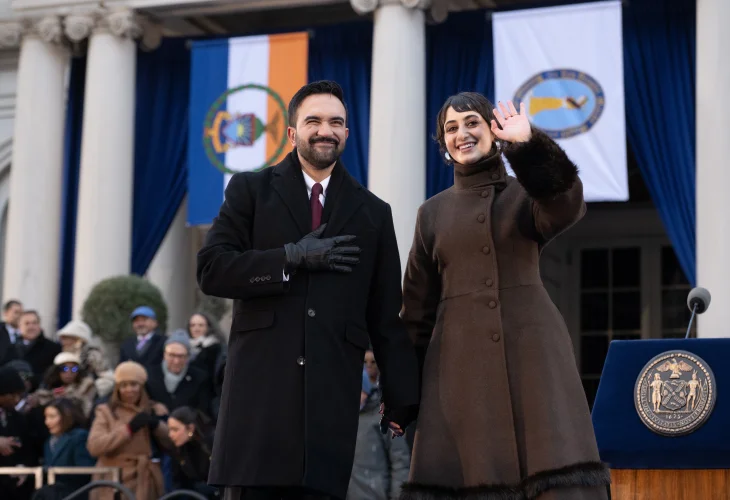 Rama Duwaji and Zohran Mamdani (Shutterstock)
A Brooklyn middle school used artwork by Rama Duwaji, the wife of New York City Mayor Zohran Mamdani, in a seventh-grade activist-themed lesson at the same time it blocked a Holocaust survivor from speaking to students, before reversing the decision months later, according to a report yesterday by the New York Post.
The episode, centered at MS 447 in Boerum Hill between November 2025 and February 2026, has drawn renewed scrutiny over how New York City public schools define “political” content, after administrators excluded a survivor over Israel-related concerns while presenting activist artwork in class.
As part of a unit titled “Art for Social Change,” students were introduced to Duwaji’s illustrations alongside figures such as Kendrick Lamar and Misty Copeland. In a notice to parents, teacher Joy Cannon said students were exploring “their own deep culture, their identities, their interests and activities, and social justice issues.” Students were asked, “What is the message in Syrian-American Rama Duwaji’s art?” and “How do you think her deep culture shapes what she cares about and what she creates?”
Duwaji, an illustrator and political activist, is married to Mamdani and has previously created artwork for the Democratic Socialists of America-linked campaign “PalestineOnTheBallot.com,” which promoted candidates critical of Israel. Her work featured themes such as protest, displacement, and resistance.
At the same time, the school rejected a request for Holocaust survivor Sami Steigmann to speak to students. In a November 18, 2025 email, the school’s principal wrote that Steigmann’s presentation was not appropriate due to his “messages around Israel and Palestine,” citing concerns about political neutrality. The New York City Department of Education initially backed that position, saying outside speakers are reviewed to ensure neutrality on current events.
Steigmann, 86, who survived a Nazi labor camp and was subjected to medical experimentation as a child, said he was not given a clear explanation. “I wasn’t given any reason why I was not wanted,” he said at the time, adding that the situation reflected broader bias.
The decision sparked backlash from parents, educators, and elected officials, who questioned why a Holocaust survivor was excluded while activist material remained in the curriculum. “I was concerned about a double standard and not teaching in a critical manner, and just forcing a political ideology on students,” one parent told The New York Post. Moshe Spern, a public school teacher and head of Jewish United Teachers, wrote on X that the school “had no issue teaching” Duwaji’s work while rejecting a survivor.
Councilwoman Inna Vernikov also criticized the decision, writing on X: “A HOLOCAUST SURVIVOR was not good enough for this public school, but cheering for Hamas, spouting racist slurs, exhibiting homophobia, that’s just ART made by an artist so talented that the school can’t resist including her CREATIVITY and EXPRESSION in their lesson plans for students to explore!”
New York City Mayor Eric Adams initially supported the school’s decision at the time, but later reversed course, saying Steigmann “is ABSOLUTELY the right person to speak with kids about the atrocities of the Holocaust.” The Department of Education subsequently intervened and extended an invitation.
Steigmann ultimately spoke at MS 447 on February 5, 2026. “This is a groundbreaking decision, and the Holocaust survivors will not be denied,” he said after the visit, noting that students engaged with his testimony. Reports indicated that no apology was issued by the school.
Duwaji has also drawn criticism over past social media activity and her involvement in political campaigns, with some activists accusing her of promoting anti-Israel messaging. Those claims have been disputed in public debate, while her work continues to be used in educational and activist contexts. Mamdani has described his wife as “the love of my life” and “a private person who has held no formal position” in his political work.

