

World News
Toronto Police Restrict Protests in Jewish Neighborhood After Antisemitic Incident
Directive follows Nazi-style imagery at rallies and community pressure, as critics warn of free speech limits and delayed enforcement
- Brian Racer
- | Updated
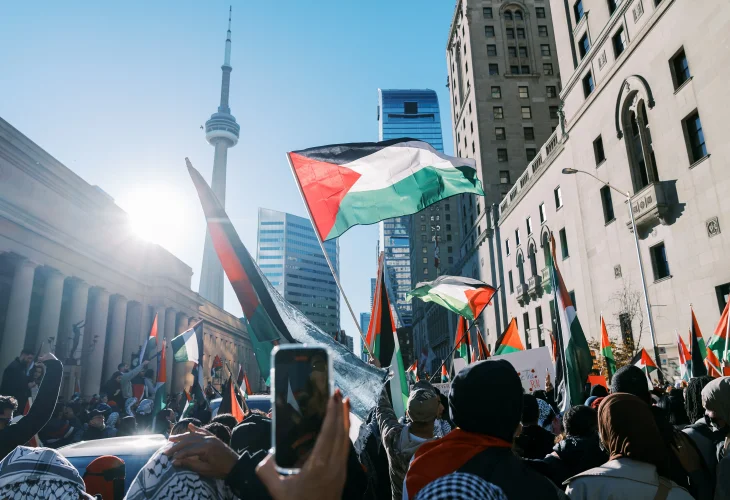 Pro-Palestine protest Toronto (Shutterstock)
Toronto police have prohibited protests on residential streets in a predominantly Jewish area of North York, in a move confirmed Monday, following months of recurring demonstrations in the neighborhood.
The directive marks a shift from largely hands-off policing to targeted restrictions, coming after a surge in pressure from Jewish organizations and residents who cited rising antisemitism and safety concerns in the wake of recent protests.
Police said the measure is not a full ban but applies specifically to residential streets, while demonstrations may continue on major roads. The decision is a “targeted response to specific concerns” aimed at reducing the risk of escalation and maintaining public safety, spokesperson Stephanie Sayer said. Authorities added that individuals who refuse police direction could face arrest for obstruction.
The move follows a March 15 protest in the area where demonstrators displayed imagery that Jewish organizations said was reminiscent of Nazi incitement and dehumanized Jews. Toronto police said they are investigating whether the images constitute hate propaganda under the Criminal Code.
The incident triggered a coordinated advocacy campaign. On March 16, the Centre for Israel and Jewish Affairs, B’nai Brith Canada, and UJA Federation of Greater Toronto sent a joint letter calling for immediate enforcement. “The imagery and threats displayed this weekend are not protest—they are hate,” the groups said. A day later, CIJA launched a public campaign urging action.
Jewish organizations welcomed the police directive while stressing the need for continued enforcement. “This is a meaningful step—but it must be matched with consistent enforcement and protection for our community,” CIJA said. B’nai Brith Canada described the decision as the result of “sustained, serious action” by residents, calling it a reminder of “what is possible when people act together with purpose.”
At the same time, critics said the move came too late. HonestReporting Canada accused authorities of inaction, writing: “You could have done this a long time ago, but made a choice not to.”
Others warned the policy risks limiting protest rights. Activist Omar Abdullah called the directive “unsettling” and a “slippery slope,” arguing it could lead to broader restrictions on pro-Palestinian demonstrations and disputing any connection between the protests and recent synagogue shootings.
Jewish groups have pointed to a wider climate of fear, noting that three synagogues were shot at within a single week, and arguing that rhetoric seen at protests contributes to a broader pattern of antisemitic incidents.
The directive also comes amid ongoing legal tension over protest rights in Toronto. On March 14, a court rejected an effort by Ontario authorities to block an Al-Quds Day rally, ruling that the threshold for restricting freedom of expression had not been met.
Protests linked to the war have continued across the city since Oct. 7. At a December 26 rally at the Eaton Centre, demonstrators chanted “We demand an intifada,” with no arrests made. During the March 14 Al-Quds Day rally, police arrested two counter-protesters.
Toronto city councillor James Pasternak defended the restriction, saying: “There’s absolutely no reason to protest at Bathurst and Sheppard other than to harass the Jewish community.”
The new policy may reduce direct friction in residential areas, but it leaves unresolved questions about how authorities will balance public safety concerns with the right to protest as tensions in the city continue.

