

Raising Children
When Your Married Children Fight: How to Respond Wisely
A practical guide for grandparents on handling conflicts between married children while maintaining peace and boundaries.
- Sarah Langzam
- | Updated
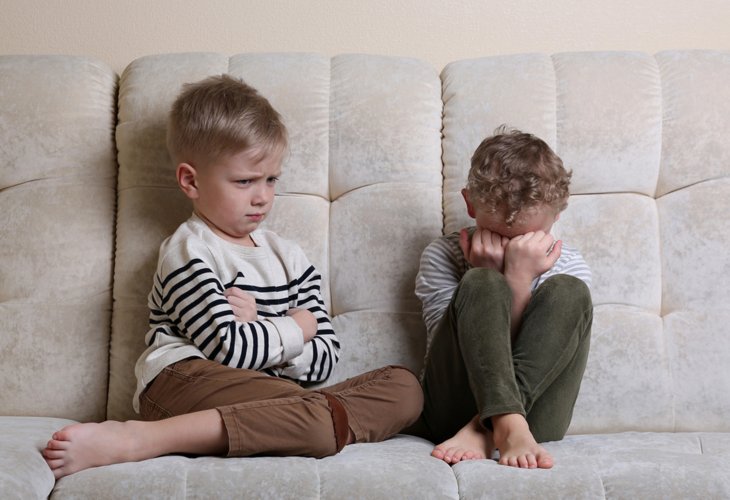 (Photo: Shutterstock)
Fights.
They are not pleasant, but they happen even in the best families.
So what is our role, as grandmothers, when our married children are in conflict?
As we have said before, we do not step in. We do not take sides, and we do not try to convince one to give in to the other.
To Invite or Not to Invite
A common question comes up: when two couples are not getting along, should we invite them together, or separate them and host them on different days?
But let’s pause for a moment.
Are we supposed to start managing our Shabbat table like an event planner? Should we sit down before every Shabbat and calculate who can be invited together and who cannot?
Because once we begin planning around the conflict, something subtle happens. The disagreement becomes fixed. It turns into a reality we are organizing our lives around.
Imagine this situation. One couple has already confirmed they are coming. Then the other couple calls and asks, “Can we come for Shabbat?”
There is space. There is food. But suddenly there is tension.
And in that moment, the conflict takes center stage.
Staying Out of It
So we take a step back.
We do not get involved in the disagreement. We invite as we normally would, and we are happy with whoever chooses to come.
But what happens when one of the children says, “If they are coming, I would rather stay home”?
It hurts. Of course it hurts.
Every conflict between our children affects us. But even in that moment, we stay neutral.
We trust that they will find their way back to each other. We make it clear that our home is open, and that every child is welcome.
Who comes is their choice.
When There Is an Exception
There is, however, one important exception.
When the situation involves young children.
Let’s say two grandchildren are not getting along, and one is consistently provoking the other. The second child may not yet have the tools to handle the situation on their own.
In these cases, we cannot expect children to manage everything themselves.
They need support.
Protecting Without Blaming
When a young child needs protection, we step in carefully.
We work together with the parents to create a solution that keeps the child safe and supported. Sometimes, that may mean hosting the families separately for a period of time.
But we do this with sensitivity.
We do not blame the parents. We understand that some children take longer to learn how to interact in a healthy way.
We recognize this as part of normal development.
And once the situation improves, we can return to hosting everyone together.
Conclusion
Family life is not always smooth. There are disagreements, tensions, and moments that test us.
But our role is not to fix everything.
Our role is to create a home that remains steady, open, and loving.
A place where everyone is welcome.
And a place where, with time and patience, relationships can heal on their own.

