

Faith (Emunah)
Did the Israelites Leave a Trail? A New Look at Sinai’s Ruins
Do Sinai’s ancient ruins hold clues to the Israelites’ journey? Discover a compelling perspective that brings archaeology and Torah together.
- Rabbi Tzuriel Cohen
- | Updated
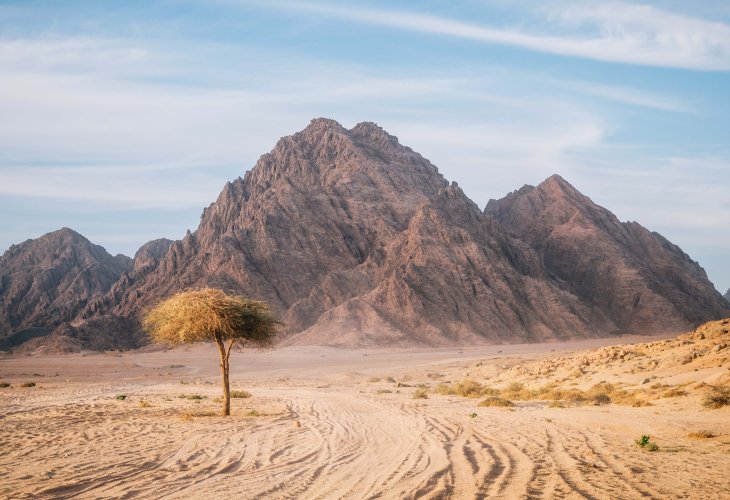 (Photo: Shutterstock)
Early one morning at Rachel’s Tomb, about thirty years ago, worshippers gathered for a sunrise minyan. As the Torah reading from Parashat Pekudei was chanted, Rabbi Daniel, one of the yeshiva rabbis, followed along in his Chumash.
He reached the closing verses of the Book of Exodus: the description of the cloud of Hashem guiding the Israelites through the desert. By day, a cloud rested over the Mishkan (the Tabernacle). By night, it appeared as fire. When the cloud lifted, the people traveled. When it remained, they stayed.
Rabbi Daniel sighed.
These verses describe open miracles. For forty years, the Jewish people journeyed through a vast and dangerous desert under clear divine guidance. Yet just the night before, Rabbi Daniel had been reading an archaeology book that left him unsettled. The author reviewed findings from the Sinai Desert and concluded that if the Israelites truly wandered there for forty years, they left behind no trace at all.
Not a single artifact.
The Archaeological Puzzle
Rabbi Daniel was familiar with the standard explanations. Nomadic groups do not always leave significant remains. In the case of the Israelites, their situation was even more unique. Their clothing did not wear out. Their food came from manna. They did not need to farm, trade, or build permanent settlements. Their lives revolved around spiritual growth and Torah study.
Still, the question lingered. Could there really be no trace?
Then something clicked.
He recalled a fascinating detail from the same book. Archaeologists had identified a mysterious culture known as the Nawamis. This group left behind numerous remains in two primary regions: southern Sinai near St. Catherine and the area of Kadesh Barnea, close to Israel’s southern border.
These findings raised serious questions.
There were clear signs of long term habitation in areas with no water source. Millstones were discovered, suggesting food preparation, yet there was no evidence of agriculture. No plows. No sickles. Not even traces of grain.
In southern Sinai, researchers found animal bones and seashells brought from the Red Sea. The sites appeared to have been abandoned in an orderly fashion, not suddenly or violently. There were no permanent buildings, only temporary encampments.
The archaeologist who documented these findings openly admitted the mystery. How did these people survive in such harsh conditions? Why settle in places with no natural resources when better locations were nearby? What explains this intense and prolonged settlement pattern?
There was no clear answer.
A Surprising Connection
To Rabbi Daniel, the answer seemed simple.
These remains could belong to the Israelites.
The locations match the Torah’s description of where the Jewish people traveled. Their unusual lifestyle explains the lack of typical tools and agricultural evidence. They did not need to grow food because they ate manna. Yet the Torah does mention that they ground the manna using millstones, exactly the kind of tools found at these sites.
So why has this connection not been widely accepted?
The main issue is how archaeologists date ancient sites. They rely heavily on the types of tools found in a location. Since the tools typical of the Exodus period are missing, the sites are not dated to that time.
But this method assumes a standard pattern of human life. It assumes people relied on agriculture, trade, and tools. The Israelites in the desert did not follow that pattern. Their needs were met in a completely different way.
Encampments That Match the Torah
Rabbi Daniel revisited the book and examined the details more closely.
One particularly puzzling observation stood out. Many sites appeared to have been prepared for habitation but were never actually used. This pattern repeated itself again and again.
To archaeologists, this made no sense.
But to someone familiar with the Torah, it fit perfectly.
The Israelites traveled according to the movement of the cloud. Sometimes they camped for days. Other times, they moved quickly, even overnight. It is entirely possible that camps were prepared but abandoned when the cloud signaled them to continue their journey.
A Structured and Organized People
The Nawamis structures themselves are also intriguing. Archaeologists describe them as well built and uniform, suggesting a shared cultural tradition. The entrances often face west, indicating a possible origin in Egypt.
There are also slight variations between different clusters of structures, leading researchers to conclude that each area served a distinct social group, similar to tribes.
This description closely aligns with the Jewish people in the desert. They were organized by tribes and had experience with complex construction from their time in Egypt.
The Mystery of the Empty Graves
Perhaps the most astonishing discovery was the burial sites.
Thousands of graves were found.
All of them were empty.
Where were the remains?
Rabbi Daniel found the answer in Jewish tradition. The Gemara teaches that it was customary to gather the bones of the deceased and bring them to a family burial place. It is entirely possible that the Israelites later returned to collect the remains of those who died in the wilderness and reburied them in the Land of Israel.
What appeared to be a mystery to archaeologists may actually reflect a known Jewish practice.
Looking at the Desert with New Eyes
This perspective does not claim to prove anything definitively. But it offers a compelling way to look at the evidence.
Instead of assuming the Israelites left no trace, perhaps we simply have not been interpreting the findings correctly.
When viewed through the lens of the Torah, the pieces begin to fit together in a remarkable way.

