

World News
Trump May Be Willing to End Iran War Without Reopening Hormuz
U.S. officials increasingly say reopening the Strait can wait, as war goals only focus on Iran’s missiles, navy, and nuclear program
- Brian Racer
- | Updated
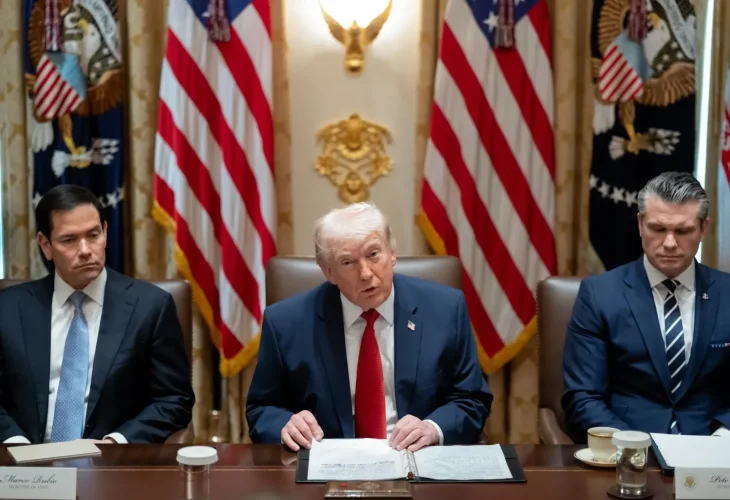 Donald Trump, Marco Rubio, Pete Hegseth (White House)
U.S. President Donald Trump has told aides he is willing to end the war with Iran even if the Strait of Hormuz is not fully reopened, according to a report published Monday by the Wall Street Journal, signaling a potential shift in how Washington may define victory in the conflict..
The position reflects a broader pattern in recent days, as senior U.S. officials increasingly describe reopening Hormuz as a longer-term challenge rather than a core condition for ending the war.
According to WSJ, Trump and his advisers concluded that a military operation to fully reopen the strait could take four to six weeks, extending beyond the administration’s preferred timeline for the campaign. Instead, the report said, the U.S. is focusing on degrading Iran’s missile capabilities and naval forces while seeking to pressure Tehran diplomatically to restore shipping through the passage.
That approach has been echoed in recent public statements. White House Press Secretary Karoline Leavitt said Monday that “the full reopening of the Strait is something the Administration is working towards, but the core objectives of the operation have been clearly defined,” indicating that restoring traffic through Hormuz is not among the primary benchmarks for ending the war. Just days earlier, Leavitt had said the military remained “laser-focused” on threats to the free flow of energy through the strait, underscoring a shift in emphasis.
Secretary of State Marco Rubio similarly suggested that reopening the waterway may be handled after the military phase concludes. “It will be open because Iran agrees to abide by international law… or a coalition of nations… will make sure that it’s open,” Rubio said in an interview with Al Jazeera on Monday. He also said the U.S. objectives remain focused on destroying Iran’s military capabilities and preventing it from obtaining a nuclear weapon.
Defense Secretary Pete Hegseth has also outlined U.S. objectives in terms that do not explicitly include reopening the strait. In briefings earlier this month, he said the campaign aims to destroy Iran’s navy, dismantle its missile and drone infrastructure, and prevent Tehran from obtaining a nuclear weapon. “Our objectives… remain to destroy Iran’s missile launchers, its defense industrial base and navy, and to never allow Iran to get a nuclear weapon,” he said.
Trump’s internal position contrasts with his public rhetoric. In a post on Monday, he warned that if a deal is not reached and the strait is not “immediately ‘Open for Business,’” the United States would move to destroy Iran’s energy infrastructure, including power plants, oil facilities, and Kharg Island. The difference highlights a gap between the administration’s coercive messaging and its apparent willingness to end the war without first resolving the maritime chokepoint.
The evolving U.S. stance comes as the broader strategic picture remains fluid. The New York Times reported that the killing of senior Iranian leaders has complicated Tehran’s decision-making, making negotiations more difficult even as it disrupts Iran’s ability to coordinate large-scale retaliation. Prime Minister Benjamin Netanyahu said Monday that the campaign is “beyond the halfway point” in terms of its objectives and suggested that long-term solutions could include rerouting Gulf energy pipelines to bypass the strait entirely. At the same time, officials from Gulf states have urged Washington to continue the war until Iran is more decisively weakened.
Defense Secretary Pete Hegseth and Gen. Dan Caine are expected to hold a press conference Tuesday, which may provide further clarity on how the administration defines its end goals as the war enters its next phase.

