

Wonders of Creation
The Golden Ratio: The Math Behind Beauty in Nature
Why do we find nature so beautiful? Discover how the Golden Ratio shapes flowers, shells, and even crystals with surprising precision.
- Yosef Yabece
- | Updated
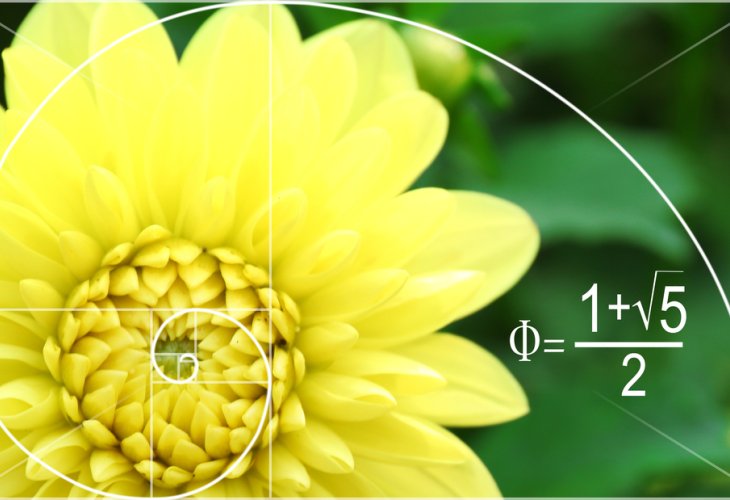 (Photo: Shutterstock)
Have you ever wondered why certain things look naturally beautiful to us?
Most people do not think in terms of mathematical formulas when they admire a flower, an animal, or a work of art. Yet behind that sense of beauty lies a surprising principle: a mathematical pattern known as the Golden Ratio.
What Is the Golden Ratio
The Golden Ratio is a specific proportion that has long been considered especially pleasing to the human eye. It reflects a balance and harmony that feels natural, even if we cannot explain why.
This idea dates back to ancient Greece, where it was used in architecture and design. Famous structures such as the Parthenon, the Great Pyramid of Giza, and even the Dome of the Rock reflect proportions connected to this ratio.
During the Renaissance, artists studied and applied the Golden Ratio to create works that would feel balanced and visually appealing.
A Pattern Found Throughout Nature
What is most remarkable is that this same mathematical pattern appears throughout the natural world.
The Golden Ratio is not only about beauty. It is also about efficiency. It allows living organisms to grow in a way that preserves structure while minimizing wasted energy.
For example, the spiral of a snail’s shell follows this pattern, enabling it to expand while maintaining its shape. Many flowers also display this proportion, creating the symmetry that naturally draws our attention.
Even when we cannot identify the pattern, we are responding to it.
A Discovery That Changed Science
In 1982, scientist Dan Shechtman made a surprising discovery. He identified crystals with a structure that seemed impossible according to accepted scientific understanding.
At first, his findings were dismissed. Many scientists believed such shapes could not exist. For years, his work was questioned and debated.
But Shechtman persisted, and his discovery was eventually confirmed. In 2011, he was awarded the Nobel Prize for his groundbreaking research.
The Hidden Order Within Complexity
Later, Professor Mario Livio pointed out that even these unusual crystal structures follow patterns related to the Golden Ratio.
In other words, even formations that initially appeared chaotic or impossible were organized according to a deeper mathematical order.
Professor Livio has written extensively about how mathematics reveals the underlying structure of the natural world. What may appear simple or random often reflects an intricate and carefully balanced design.
A World of Hidden Harmony
The more we explore the natural world, the more we uncover patterns of order, balance, and precision.
The Golden Ratio is just one example of how beauty and structure are woven together. It reminds us that what we perceive as beautiful is often rooted in deeper principles that guide both nature and human creativity.
Sometimes, what seems simple on the surface holds layers of complexity beneath it, waiting to be discovered.

