

Trump Announces Two-Week Cease-Fire Between U.S. and Iran; Israel Backs Move With Conditions
VP J.D. Vance is headed to Pakistan to meet an Iranian delegation as Tehran reopens the Strait of Hormuz; Trump touts no uranium enrichment and threatens 50% tariffs on arms suppliers. Later, Iran alleges violations.
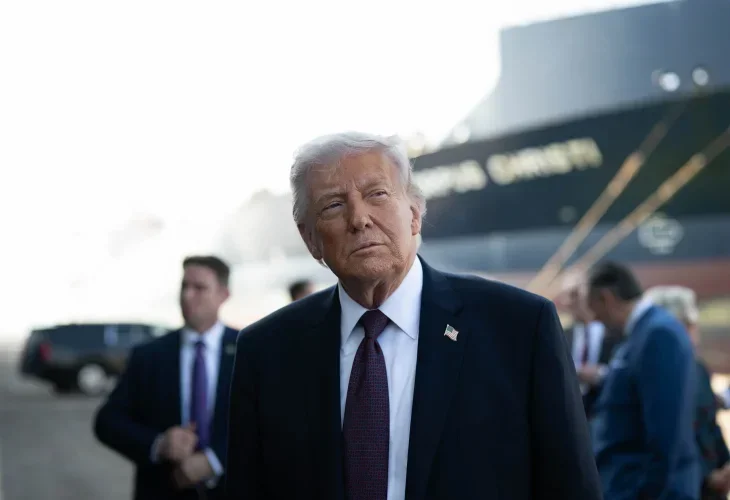 Trump (Credit: Shutterstock)
U.S. President Donald Trump announced overnight (Tuesday into Wednesday) a two-week cease-fire in the war between the United States and Iran. His declaration is binding on Israel, and he informed Prime Minister Benjamin Netanyahu shortly before he released the decision at the White House.
Trump confirmed that his vice president, J.D. Vance, will arrive this Friday in Pakistan's capital, where he will meet with an Iranian delegation and begin negotiations between the countries. The first condition for starting the cease-fire is that the Iranians open the Strait of Hormuz to traffic. The Iranians did so today, and the first ships passed through the strait. Trump said that most of the conditions presented by the Iranians are acceptable to him, but he did not specify what they are.
The American president posted this evening on his Truth account: "The United States will work in close cooperation with Iran, which we have determined has undergone what will be a most 'productive regime change'! There will be no enrichment of uranium, and the United States, in cooperation with Iran, will dig up and remove all the nuclear 'dust' buried deep in the ground (from the B-2 bombs). The site is now, and has been, under the most precise satellite monitoring. Nothing has been moved since the date of the strike. We are discussing and will discuss with Iran tariffs and relief from sanctions. Many of the 15 points have already been agreed."
Minutes later he posted another message threatening to impose "immediately" tariffs of 50% on any country that sends "military weapons" to Iran. "There will be no exceptions!", he wrote.
White House press secretary Karoline Leavitt addressed the contacts between Iran and the United States this evening, emphasizing that the Islamic Republic "will not be able to obtain a nuclear weapon". According to her, "their murderous and wicked plans have literally blown up. The world witnessed a historic military victory; the president's maximum pressure led to Iran's request for a cease-fire". She referred to Iran's 10-point plan and claimed that the first version sent "was thrown in the trash".
According to her, "as the deadline approached the Iranians sent a new plan that the president decided we can work with. His red line - that Iran will not have a nuclear capability - will never change. What the Iranians tell you in the media is completely different from what they tell the president. We are seeing increased traffic in Hormuz and the reports that it has closed again are not true. The uranium issue is a red line at the very top of the president's agenda. The Iranians have indicated they are prepared to compromise on that".
Meanwhile, Iran announced this evening that the agreement was violated. In a statement from Iran's Foreign Ministry it was written: "There is a failure to comply with the first clause of the 10-point proposal, concerning the cease-fire in Lebanon - a commitment that Pakistan's Prime Minister, Shehbaz Sharif, referred to explicitly and defined as 'an immediate cease-fire everywhere, including in Lebanon and additional areas, to take effect immediately'."
Also, according to the Iranians, a penetration of an unmanned aerial vehicle into Iran's airspace was detected, which was shot down over the city of Lar in Fars Province - a clear violation of the clause forbidding any further infringement of Iran's airspace. In addition, they say, American officials denied in statements to the media the right of Iran to enrich uranium, a right included in the sixth clause of the framework. "Now" the Iranians said "a workable basis for negotiations has been openly and clearly violated, even before the talks began. In such a situation, a bilateral cease-fire or holding negotiations is unlikely".
Earlier, the U.S. vice president, J.D. Vance, who according to a CBS report will lead the American negotiating delegation in the talks with Iran, said that President Trump is "impatient" when it comes to his desire to reach an agreement to end the war".
According to Vance, "The president of the United States told me, and told the entire negotiating team, the secretary of state, and the special envoy Steve Witkoff - he said: 'Go and act in good faith to reach an agreement.' That is what he instructed us to do. If the Iranians are willing to work with us in good faith, I think we can reach an agreement".
"But if they are going to lie, if they are going to cheat, if they are going to try to prevent this fragile cease-fire we have initiated from taking effect - then they are not going to be happy. Because what the president has also shown is that we still have clear military and diplomatic leverage, and perhaps most importantly - we have extraordinary economic leverage. The president has instructed us right now not to use those tools; he has instructed us to come to the negotiating table. But if the Iranians do not do exactly the same, they will find that the president of the United States is not someone to play with".
Also the U.S. war minister, Pete Hegseth, referred to the cease-fire: "If Iran refuses our terms - the next targets are power stations and bridges. The cease-fire is a big day for the free world. The Iranians wanted the agreement. Because they said 'enough.' This is a big day of victory for our forces. Operation 'Mighty Rage' destroyed Iran's ability to arm itself for years to come. The number one spreader of terror in the world can no longer threaten us and its citizens. Together with our Israeli partners, the U.S. military achieved every goal as planned from day one".
According to Hegseth, "We have finished completely destroying their defense industries. What they have in the bunkers is their only armament. It would not be wise of them to fire what remains. Their industry has been wiped out underground. If Iran had refused to negotiate, we would have struck their energy and oil infrastructure. We were armed and loaded".
Hegseth added: "All nuclear material will be handed over to us. At the moment it is being monitored 24/7. The president has made it clear that they will not have a nuclear weapon. The Iranians are humiliated. We control their fate".
The office of Prime Minister Benjamin Netanyahu referred today to Trump's decision: "Israel supports President Trump's decision to suspend strikes against Iran for two weeks, subject to Iran immediately opening the straits and ceasing all attacks on the U.S., Israel, and countries in the region. Israel also supports the American effort to ensure that Iran will no longer pose a nuclear, missile, or terrorist threat to the U.S., Israel, Iran's Arab neighbors, and the world".

