

End of Days
Isaac Newton’s 2060 Prophecy: The Hidden End-of-the-World Prediction Revealed
Hidden for centuries, Isaac Newton’s personal theological notes reveal a startling prophecy about the year 2060 and the future of the world
- Hidabroot
- | Updated
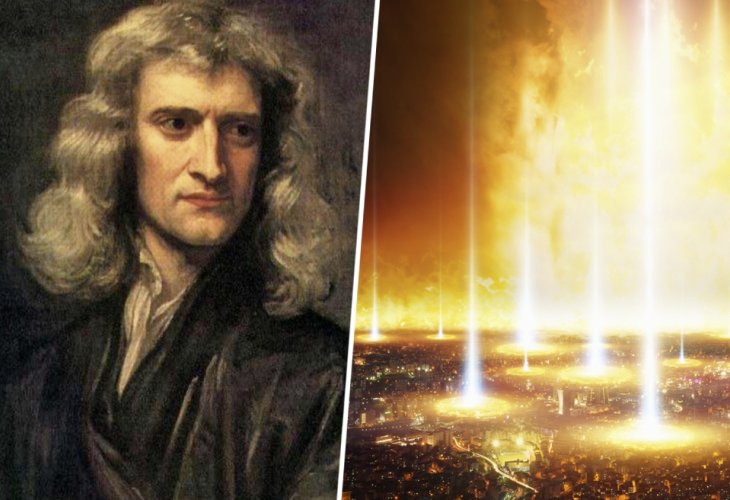 On the left, physicist Isaac Newton (Photo: shutterstock)
Isaac Newton was not only known as one of history’s greatest scientists, but also as a deeply religious thinker who devoted much of his life to biblical study.
Newton privately calculated that the world as we know it would reach its end in the year 2060. This revelation is striking not only because of the date itself, but because Newton was known to strongly criticize those who publicly issued predictions about the end of the world.
More Than a Scientist
Newton is widely remembered for his groundbreaking work in physics, mathematics, and astronomy. His laws of motion and theory of gravity transformed science and permanently changed humanity’s understanding of the universe.
Yet there was another side to him that remained hidden for centuries.
Newton was also a deeply religious man who spent much of his life studying Scripture, particularly biblical prophecy. He devoted considerable time to the interpretation of the Book of Daniel and other prophetic texts.
From these studies, he arrived at a personal conclusion, that the culmination of history would occur in 2060.
Newton did not publish this prediction, but instead wrote it on a small private note that he kept among his personal papers.
Why Newton Kept It Secret
The irony is striking.
Newton himself was sharply critical of people who publicly announced dates for the end of days, and he believed that failed predictions damaged the credibility of the Bible and undermined faith. Whenever such forecasts proved wrong, people were inclined to dismiss Scripture itself.
For this reason, even though he appears to have been confident in his own calculations, he chose not to make them public. He preferred to keep his conclusions private rather than risk contributing to speculation and eventual disillusionment.
The Manuscripts That Stayed Hidden for Centuries
For many years, the world knew almost nothing about Newton’s extensive theological writings.
His manuscripts were preserved by the family of the Earl of Portsmouth and remained out of public view for centuries.
Only in 1936 were these writings offered for auction by Sotheby's.
They were purchased by a Jewish collector, Abraham Shalom Yehuda, whose interest in historical manuscripts preserved these remarkable documents.
After Yehuda’s death in 1961, he bequeathed his collection to the State of Israel.
The papers themselves arrived in Israel in 1969, but even then they remained largely inaccessible to scholars. It was only in 1991, when the documents were published on microfilm, that researchers began to carefully examine Newton’s theological notes.
Among these papers, scholars eventually discovered the small note referring to 2060.
Newton’s Vision of the Future
Newton did not view biblical prophecy as symbolic alone.
He saw it as what he called a “history of the future” — a framework through which events yet to come could be understood.
Among his interpretations was the belief that the Jewish people would return to their ancient homeland before the end of days, following attempts by hostile nations to destroy them.
After that final period of upheaval, Newton believed history would move into an era of restoration and peace.
He described it as: “the end of all crying and troubles, and the establishment of a flourishing and eternal kingdom.”
This vision reflects not only an ending, but a transformation from suffering to redemption.
A Different Side of Newton
This story reveals a more complex image of Newton than the one most people know.
He was not only a scientific genius but also a man deeply engaged with questions of destiny, faith, and the meaning of history.
Whether one views his prediction as theological speculation, historical curiosity, or a reflection of his religious convictions, it offers a fascinating glimpse into the mind of one of the most influential figures in human history.
Far from being merely a scientist, Newton was also a thinker profoundly concerned with the future of humanity and the unfolding of sacred history.

