

Israel News
Unexpected Ally: Ugandan Army Chief Offers 100,000 Troops to Israel
Uganda’s military chief warns any attempt to destroy Israel would trigger intervention, announces troop offer and signals visit to Tel Aviv Uganda’s army chief, General Muhoozi Kainerugaba, issued a series of unusually forceful pro-Israel statements over the past day, declaring that his country would join a war on Israel’s side if it faces destruction and offering to deploy tens of thousands of troops. In one post, he also said he was on his way to Tel Aviv to meet “our Israeli brothers.” The remarks, made on Kainerugaba’s personal social media accounts stand out as a rare and direct show of support from a senior African military figure. No official Ugandan government deployment or visit has been formally confirmed. “We want the war in the Middle East to end now, the world is tired of it. But let it be clear to everyone: any talk of destroying Israel or defeating it militarily will bring us into the war on Israel’s side,” Kainerugaba wrote. In another post, he added: “No one will touch Israel. Africa will defend it. The Jews are Africa’s first children.” Kainerugaba framed his position in both religious and historical terms. “We stand with Israel because we are Christians,” he wrote, adding in a separate message that Israel “stood with us when we were nobodys in the 1980s and 1990s.” He went further, offering direct military support. The general said he was prepared to deploy 100,000 Ugandan soldiers in Israel “under my command, to defend the Holy Land.” In a separate statement reflecting his broader rhetoric during the same period, he claimed that “a single Ugandan brigade can capture Tehran within two weeks,” urging observers not to underestimate his country’s forces. One of the most widely circulated statements came when Kainerugaba announced a planned visit to Israel. “I am on my way to Tel Aviv to meet our Israeli brothers,” he wrote. As of now, there has been no independent confirmation that the trip has taken place or that an official visit has been scheduled by either Jerusalem or Kampala. Kainerugaba also pointed to the historic ties between the two countries, referencing the 1976 Entebbe rescue operation. He reaffirmed Uganda’s plan to build a monument at Entebbe International Airport in honor of Yoni Netanyahu, the Israeli officer killed during the mission. “We will build a statue at Entebbe International Airport in honor of Yoni Netanyahu,” he wrote, adding: “The blood spilled at Entebbe bound our fate forever.” The latest statements were part of a broader series of posts in which the general also issued threats toward regional actors and commented on global conflicts, reflecting a pattern of highly provocative messaging. Kainerugaba has previously drawn international attention for controversial remarks on social media, including statements that sparked diplomatic tensions. As of now, Israeli officials have not publicly responded to the remarks, and no formal military coordination between the countries has been announced. The statements nonetheless highlight an unusual and vocal alignment with Israel from a senior African military leader, even as it remains unclear whether they signal any concrete policy shift or operational cooperation.
- Brian Racer
- | Updated
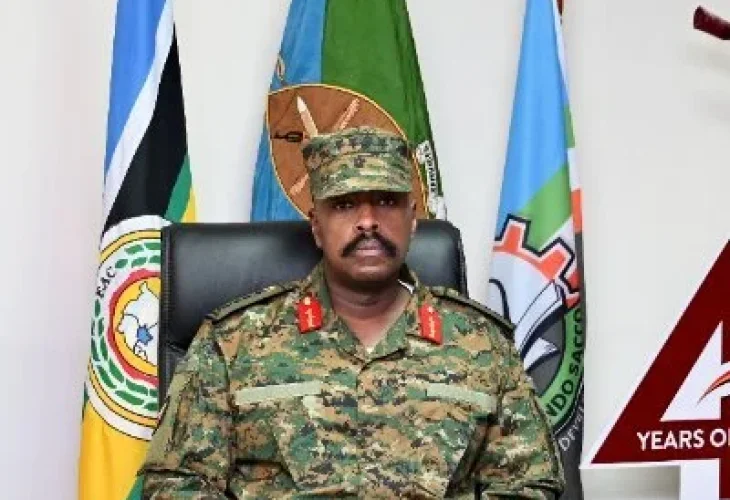 General Muhoozi Kainerugaba (Screenshot/X)
Uganda’s military chief warns any attempt to destroy Israel would trigger intervention, announces troop offer and signals visit to Tel Aviv
Uganda’s army chief, General Muhoozi Kainerugaba, issued a series of unusually forceful pro-Israel statements over the past day, declaring that his country would join a war on Israel’s side if it faces destruction and offering to deploy tens of thousands of troops. In one post, he also said he was on his way to Tel Aviv to meet “our Israeli brothers.”
The remarks, made on Kainerugaba’s personal social media accounts stand out as a rare and direct show of support from a senior African military figure. No official Ugandan government deployment or visit has been formally confirmed.
“We want the war in the Middle East to end now, the world is tired of it. But let it be clear to everyone: any talk of destroying Israel or defeating it militarily will bring us into the war on Israel’s side,” Kainerugaba wrote. In another post, he added: “No one will touch Israel. Africa will defend it. The Jews are Africa’s first children.”
Kainerugaba framed his position in both religious and historical terms. “We stand with Israel because we are Christians,” he wrote, adding in a separate message that Israel “stood with us when we were nobodys in the 1980s and 1990s.”
He went further, offering direct military support. The general said he was prepared to deploy 100,000 Ugandan soldiers in Israel “under my command, to defend the Holy Land.” In a separate statement reflecting his broader rhetoric during the same period, he claimed that “a single Ugandan brigade can capture Tehran within two weeks,” urging observers not to underestimate his country’s forces.
One of the most widely circulated statements came when Kainerugaba announced a planned visit to Israel. “I am on my way to Tel Aviv to meet our Israeli brothers,” he wrote. As of now, there has been no independent confirmation that the trip has taken place or that an official visit has been scheduled by either Jerusalem or Kampala.
Kainerugaba also pointed to the historic ties between the two countries, referencing the 1976 Entebbe rescue operation. He reaffirmed Uganda’s plan to build a monument at Entebbe International Airport in honor of Yoni Netanyahu, the Israeli officer killed during the mission. “We will build a statue at Entebbe International Airport in honor of Yoni Netanyahu,” he wrote, adding: “The blood spilled at Entebbe bound our fate forever.”
The latest statements were part of a broader series of posts in which the general also issued threats toward regional actors and commented on global conflicts, reflecting a pattern of highly provocative messaging. Kainerugaba has previously drawn international attention for controversial remarks on social media, including statements that sparked diplomatic tensions.
As of now, Israeli officials have not publicly responded to the remarks, and no formal military coordination between the countries has been announced. The statements nonetheless highlight an unusual and vocal alignment with Israel from a senior African military leader, even as it remains unclear whether they signal any concrete policy shift or operational cooperation.

